

The Simple Ancient Gardening Technique You'll Wish You Tried Sooner

In the Middle Ages, German farmers began using a technique called hügelkultur ("hill culture"), which involves building raised garden beds in the form of large mounds with logs and other organic material inside the base of the mound. Hügelkultur started as a way to improve soil quality and water retention, and it accomplished this mission and more. It works by creating tiered levels of organic material, gradually decreasing in size from logs to twigs, which are then covered by a layer of topsoil. Essentially you're building a nutrient-rich compost bed right into your raised garden. These hügelbeds have excellent water retention, and, as such, require very little maintenance. The best are nearly self-watering. Additionally, the organic material will decompose over time, creating healthy, nutrient-filled soil.
Traditionally, hügelkultur was done with just logs, sticks, and dirt; farmers would create tall, long mounds out of these materials, which would stretch and wind around a field. And the practice is still done in some places today. It's highly affordable depending on where you live, especially if you have easy access to fallen trees for your hügelbeds, and, since the bed is filled with mostly wood, you spend less on soil. For another form of hügelkultur, you can repurpose an old tree stump to create nutrient-rich soil in your raised bed.
How to create a modern hügelbed
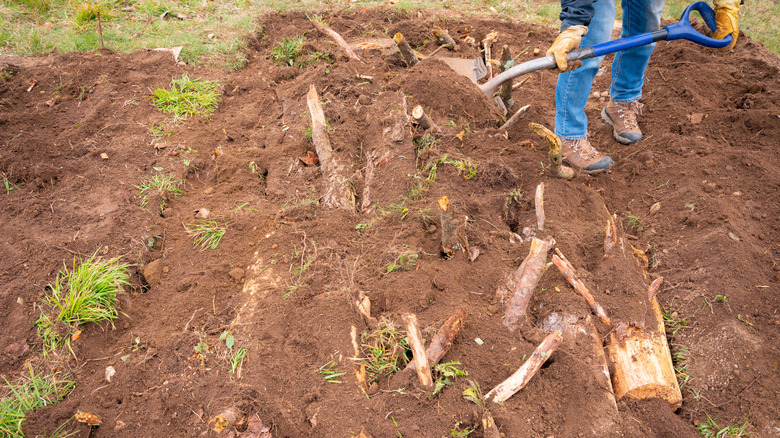
To create your own hügelkultur bed, begin as if you were creating a normal raised garden bed: Figure out the dimensions and either purchase or build the frame. For this, you should know how to choose between a wood and metal raised garden bed. You can also repurpose an old headboard to create a unique raised garden bed. If you want your mound to have a lower profile, dig down to create room for the logs. Otherwise, once you remove and save the topsoil, you can just lay logs down on the exposed ground. Before laying down any logs, clear the designated ground of all grass, weeds, and other organic material using a layer of weed-suppressing mulch over everything for several weeks.
The first layer in your garden's hügelkultur bed will be the logs. A variety of sizes allows you to fill in gaps like a puzzle, creating a more compact layer. It's perfectly fine if they're already in a state of decay. Next, place a layer of medium-to-smaller size sticks followed by another layer of small twigs to fill in all the spaces. You can then add a covering of leaf mulch on top. Once all the organic material has been placed, the only thing left is to fill the rest of the bed with soil and start planting.
There are some drawbacks: It's fairly labor intensive and requires access to the necessary materials. There's a risk that all that wood creates a carbon-to-nitrogen imbalance that impacts soil bacteria. In addition you may want to avoid certain woods, like black walnut, containing toxic juglone which can kill other plants (although most of that is contained in the shells, not the wood or bark).