

What To Consider Before Growing A Hop Vine Fence In Your Yard
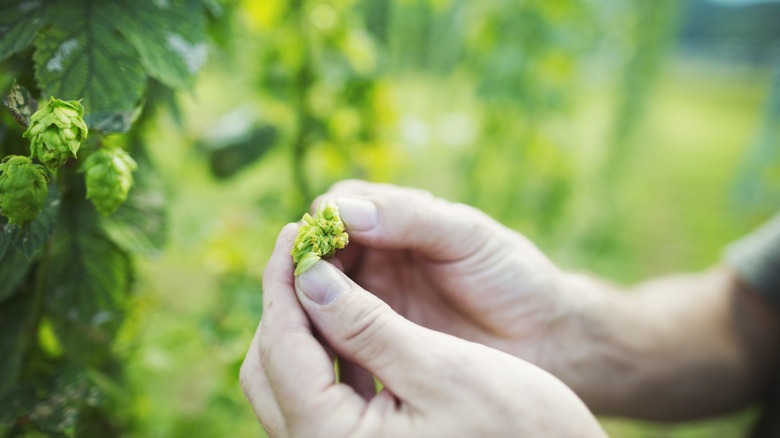
Even if you never plan on using them to make homemade beer, hops (Humulus lupulus) create beautiful living fences. For thousands of years, hops have been cultivated across the Northern Hemisphere and have become naturalized in the U.S. Growing a perennial hop vine on a fence, trellis, or pergola adds long-lasting, dense coverage to your yard. However, hops require specific conditions for optimal growth, including at least 12 full hours of sunlight, great air circulation, and not too much wind.
Additionally, hop vines grow very tall. Plan for a height between 10 to 20 feet, and do not grow a hop vine fence if you are not looking for a tall, vigorous type of climbing plant. At the beginning, hop rhizomes or seedlings need to establish their roots in rich soil. A proper hop vine fence will take several years to reach a lush, mature height and fullness. At maturity, a hop vine may reach 10 feet both vertically and horizontally. It's a fence alternative that'll have birds flocking to your yard for its dense cover.
If not carefully maintained, hop vines — technically bines, since their stems wrap around supports with sticky hairs – can become too vigorous and sprawl out from the designated spot in your yard. Attention to details like regular pruning and maintenance ensures your vine continues to climb and thrive on your trellis system. It is also wise to only grow the American hop (Humulus lupulus) that is native to the area, not the Japanese hop (Humulus japonicus) that tends towards invasiveness.
Training and maintaining a hop vine fence for success
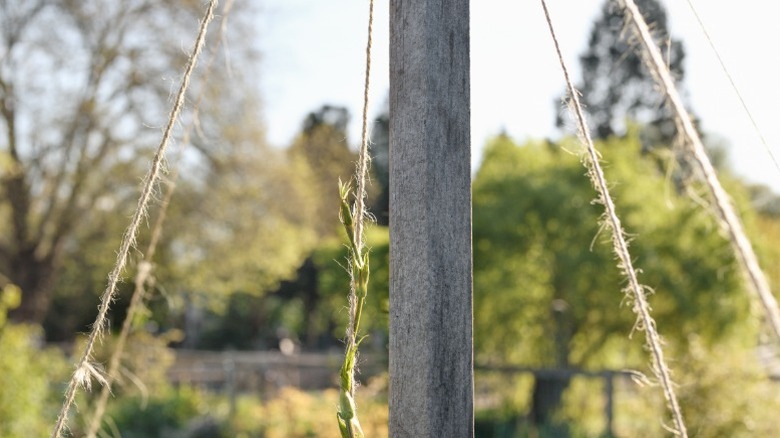
Growing hops requires special attention, and you should be willing to learn how to properly train the plant. Consider where you will grow it, as in a special trellis, fence, or netting. The first years of growth are important to establish a tall, robust plant. Out of the first shoots in its second year, choose a few of the individual bines and cut back the rest. Then, start training the bines to climb a string or support. Training involves winding the shoots clockwise around your support system. As shoots continue to grow, prune regularly and be conscious of overcrowding.
How you grow your plant and how tall it gets are important factors to consider before you start planting hops. If your sole interest in a hop vine fence is its ornamental value, height does not matter too much as long as you train the bines. Consider DIYing a cute garden trellis with the help of leftover fence materials to support your hop vine. A gardener growing hops for use in a home beer brewing project will need to ensure a practical way to harvest the hop cones. If the plant grows too high, you may not be able to reach the cones without cutting down the entire plant.
Ultimately, hops can make a beautiful ornamental addition when grown along a fence or trellis, even if you don't take advantage of the harvest. American hops are a native plant well-suited to many states in the U.S. It's a plant you'll want in your garden to attract colorful butterflies, including the eastern comma and question mark species.