

What To Know If You Spot A Fairy Ring In Your Yard
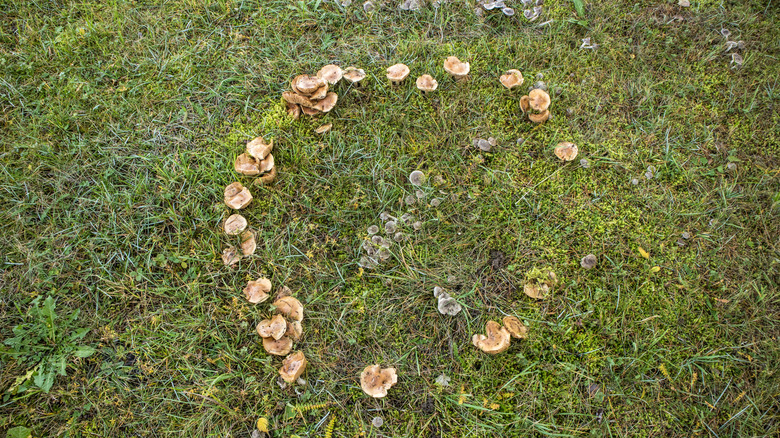
A fairy ring seems to suggest a fantasy get-together of benevolent, otherworldly beings, all celebrating the joys of the forest and various other realms. Back in medieval times, folklore attributed these unusual ground markings to places where groups of fairies had danced. And in that light, who wouldn't want to see a fairy ring in their yard? Today, though, the term has nothing to do with fairies, elves, gnomes, or any other mystical and mythical creatures.
Fairy rings are ring-shaped spots on the lawn with thicker and darker growth than the surrounding area; sometimes, they're similar in shape but browner and drier than the rest of the grass. They may show up as semi-circles or arcs, and, during a period of wet weather, some types may develop mushrooms around their perimeter. It's also worth knowing that any kind of fairy ring is really a sign of what's happening beneath the surface of the soil.
What fairy rings mean in your yard
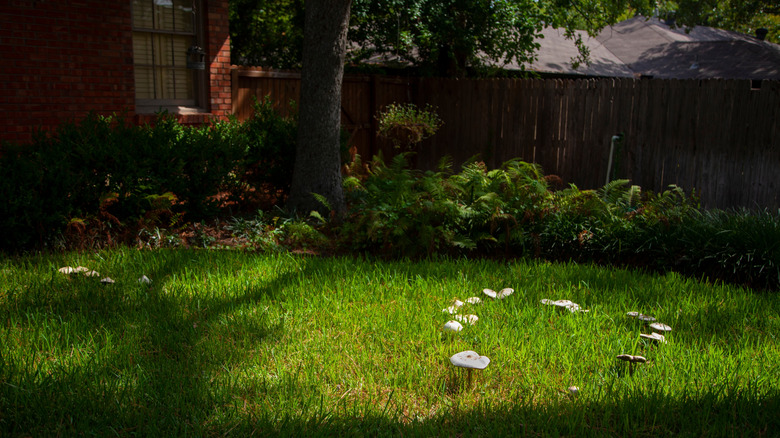
Fairy rings, sometimes called fungal fairy rings or fairy circles, are caused by fungi that feed on organic matter underground. One interesting fact about them is that they start in a central area and move outwards, eventually resulting in those telltale circles. As tree stumps, leaves, or roots decay, different fungi feed on them, affecting the surrounding soil.
A Type 1 fairy ring makes it harder for soil to absorb water, so the grass dries out and dies. Ironically, this type of ring is more frequently found on heavily-groomed golf courses than on residential lawns. Type 2 fairy rings are caused by fungi that are great at breaking down old matter, releasing nitrogen that boosts the growth of the grass. Type 3 fairy rings are most common in fall, when the soil stays wetter than normal, causing mushrooms to grow from decaying matter underground. These also happen in areas with poor drainage.
What to do about fairy rings in your yard
How to manage fairy rings depends upon the type, but ultimately, the absolute best method is prevention. Take out old tree roots and stumps before planting new grass. For any new construction in your yard, old and woody material should be removed before topsoil is added to the area. The good news about fairy rings is that most of them aren't harmful to the soil or plants. Type 1 rings, which result in dead or overly dry turf, are potentially the most aggravating; they negatively affect grass growth by making the thatch and soil repel water to some degree. Aerating the lawn and watering the soil in the newly created holes could help remedy the situation, especially if you choose the right type of a spike aerator for your lawn.
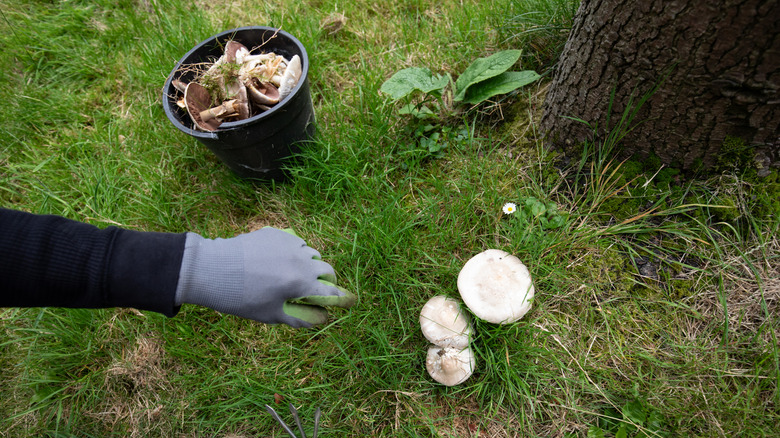
If you don't like the look of Type 2 fairy rings, applying a nitrogen-rich fertilizer over the lighter areas will boost the rest of the grass to match the dark spots. Wait until fall to do it, however, to prevent lawn burn during summer months. As for that ring of mushrooms: You can remove them by raking them out before composting or putting them in a lawn bag. Grabbing them with gloved hands also works if the rake isn't effective. Mushrooms may grow back, though — especially if the affected area has drainage issues. The simplest way to remove standing water from your yard is to dethatch and aerate it.