

The Small But Terrifying Shark That Lives In The Deep Ocean

When people think of dangers at the beaches and oceans around the world, dangerous types of sharks are typically what comes to mind. They may know to beware of great whites or to watch out for bull sharks when they enter the water. However, it is unlikely that many people feel much trepidation regarding the cookiecutter shark, if they even know it exists. Despite being roughly the same size as a great white's fin, this small shark has a terrifying set of dentures that it isn't afraid to use.
The cookiecutter shark has disproportionately large teeth for its tiny body. Despite its menacing chompers and the fact that it is found in tropical and subtropical ocean waters around the world, the cookiecutter is not listed among the ocean's deadliest creatures. That's because it has relatively little interaction with humans, as cookiecutter sharks live at extreme depth. They are right at home in water as deep as 3,500 meters, but they do move closer to the surface at night, and have actually been involved in a handful of attacks on humans.
Small in size, big in teeth
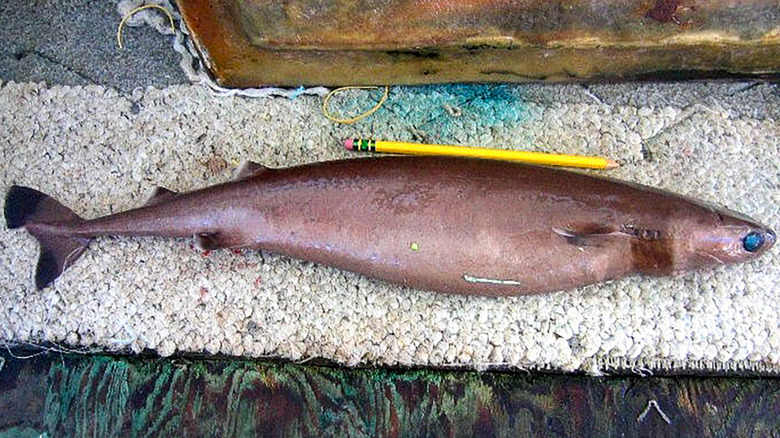
Cookiecutter sharks are less than two feet long, with males reaching a maximum size of 16 inches and females growing up to 22 inches. They have an impressive array of teeth — their top jaw is covered with about three dozen small, razor-sharp teeth, while the bottom jaw holds just over two dozen teeth, which are much larger but equally sharp. The teeth are all connected to each other, and the entire row moves as a single unit. Likewise, when the teeth are lost, the entire unit is discarded at once. Still, you are unlikely to find cookiecutter shark teeth while beachcombing. That's because cookiecutters swallow the lost teeth in order to recycle the calcium necessary to produce replacements.
As far as physical appearance, cookiecutters don't really resemble a great white or other well-known shark species. For starters, they lack the prominent dorsal fin that is so often depicted slicing through the surface of the water. Instead, both of the small dorsal fins are far back on the body, near the tail fin. They do, however, have a pair of prominent lips, which are designed to help them with their unique biting style. Their small bodies are somewhat torpedo-shaped, resulting in their other name — the cigar shark. They are dark brown in color with a light-colored, bioluminescent belly.
Since cookiecutters spend the majority of their lives in such deep water, they are rarely seen by humans. But they do occasionally wash up on beaches that are near deep-water habitats. They are usually easy to identify due to their distinctive traits.
How cookiecutter sharks attack
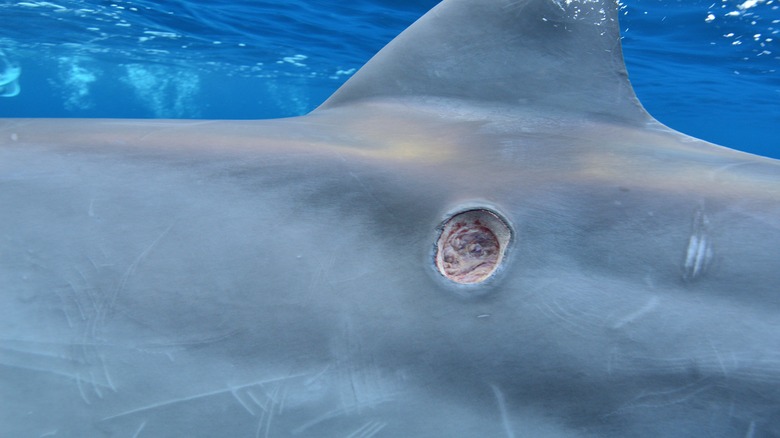
Cookiecutter sharks are indiscriminate eaters and will attack almost anything they can sink their teeth into, regardless of size. It is very common to see larger sea creatures, such as dolphins, with the unique, circular scar caused by a cookiecutter shark bite. These voracious fish have even been known to attack inanimate objects, such as research subs and wire cables. To date, there have only been four documented attacks on humans. Each of those biting incidents took place in the Hawaiian Islands, where shallow water drops steeply into depths of up to 15,000 feet.
When it is time to feed, cookiecutter sharks utilize their entire bodies in the process. To attract prey up close, these small sharks rely on the green glow of their bioluminescent belly. Unlike many species that prey on smaller life forms, cookiecutter sharks routinely target species much larger than themselves, such as marlin, tuna, stingrays, other sharks, whales, seals, and dolphins. Once they lure their oversized prey in close, cookiecutter sharks attack by attaching themselves to their prey's body with their large lips functioning as suction cups.
Unlike other sharks that use super strong jaws to bite, cookiecutter sharks insert their small upper teeth into their victim's body. This helps them leverage their larger bottom teeth into the flesh. The combination functions somewhat like a melon scoop. To finalize the circular cut, the small sharks spin their bodies. While this isn't pleasant for the victim, it is not designed to be lethal. Instead, the cookiecutter shark takes one clean, cookie-cutter-shaped bite and then moves on. The still-alive prey animal may then be attacked again later in life by a different shark.