

Are Your Hydrangea Leaves Turning Brown? Here's How To Easily Fix It
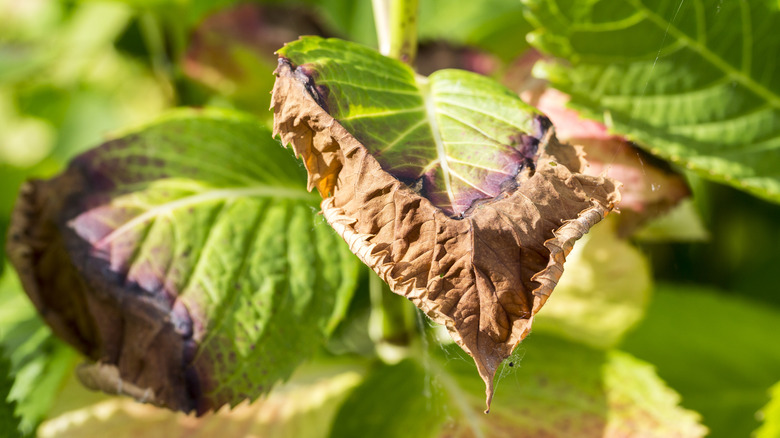
Hydrangeas, when properly taken care of, can be the prettiest plants in your garden, but like any other flower, they can show signs of stress and a lack of proper tending. Luckily, when their leaves start to turn brown and yellow, you can easily restore them to their former glory. But before you can solve the problem, you'll need to first identity what's wrong with your hydrangea, and among several possibilities, the easiest and most common issue to deal with is inadequate watering.
If the leaves are turning yellow, brown, and crunchy, then you're probably underwatering your hydrangeas. The biggest mistake in attempting to repair an underwatered hydrangea is to overwater it. Instead, make sure to only resume a normal and healthy watering schedule. If your hydrangea leaves are starting to droop before they turn yellow, brown, and mushy, you're probably giving your plants too much liquid. The easiest fix for this particular problem is to sustain from watering the plant until the soil is dried out. To water your hydrangeas for optimal growth, water your hydrangeas three times a week.
Other issues and fixes for your hydrangea
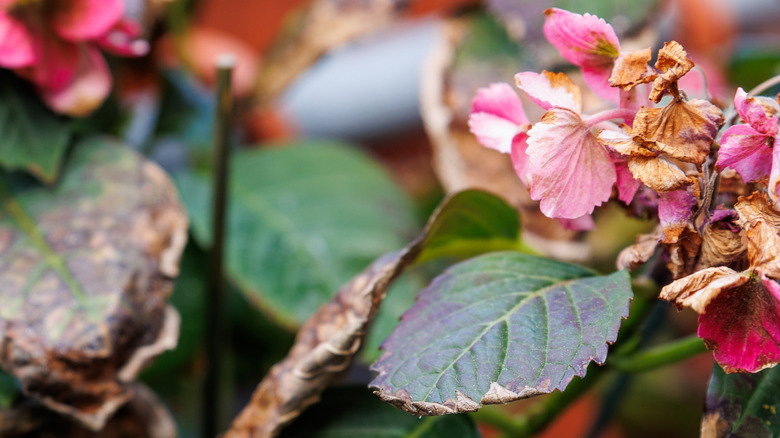
Another common issue that can cause your hydrangea leaves to brown is improper lighting. Hydrangeas grow best with partial shade, and if their leaves are turning yellow, brown, and crispy, they may be receiving too much light. The simplest fix, albeit maybe the most inconvenient, is to move your hydrangea to the optimal spot in your garden that receives sun in the morning and shade in the afternoon. This way, your hydrangea receives a good balance of light and gets a reprieve when the sun is at its hottest. If you can't move your hydrangea or there isn't a place in your garden or yard that fulfills the optimal lighting, you can also try to compensate for the extra sun by slightly increasing your watering so it can better retain moisture in its leaves. If you have to choose this route, be careful not to overwater your hydrangea. You can also create a structure to combat the heat of the sun, using something like a shade cloth or a bed sheet.
You can also over fertilize your hydrangea, and if that happens, the leaves may start to turn brown and suffer fertilizer burn. There may already be enough nutrients in your soil for your hydrangea, so be careful not to potentially harm the plant. If the hydrangea does begin to get fertilizer burn, the first thing you should do is try cleaning out the excess fertilizer by watering the plant slightly more than normal. If the fertilizer is granular, you can try raking it away from your plants. Afterwards, you should limit how often you fertilize your hydrangea. If you're still experiencing fertilizer burn, you should stop fertilizing the hydrangea. You can also ensure your hydrangeas impress all season long with these spring fertilizing tips.