

The Small Rare Bird To Look Out For When Exploring Indiana's Forests

Discovering a colorful, new-to-you bird in your own yard or while hiking can be a rewarding experience. And while there are simple ways to attract more songbirds to your yard, many people may not even realize that brightly plumaged birds (beyond blue jays and cardinals) can be found in just about any locale if you know exactly where to look. The cerulean warbler is the perfect example, with many of its feathers a deep, azure blue. These sky-blue beauties are quite small, measuring less than five inches from the tip of the beak to the tip of the tail, and they're much more likely to be sighted high up in a tree canopy in Indiana rather than at your backyard bird feeders.
Like many other types of warblers, the cerulean warbler only hangs around Indiana and other areas from Wisconsin to New York during its breeding season (late spring to early summer) before heading south. Sadly, their numbers have declined significantly over the past 50 years, largely due to habitat loss in the U.S., as well as in their winter home in the Andes Mountains of South America. In fact, they're considered endangered in Indiana. This songbird is also on the U.S. Fish & Wildlife Services' Birds of Conservation list, which means the organization has prioritized improving the habitat for it and other forest-dwelling songbirds in response to population decline.
How to spot a cerulean warbler in Indiana
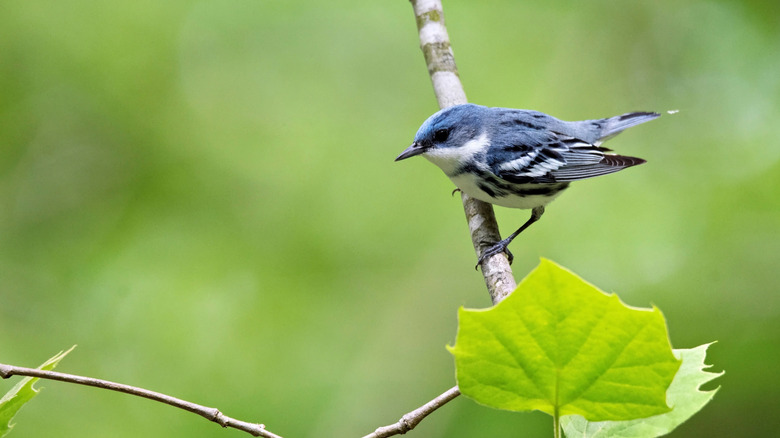
Locating a cerulean warbler in Indiana and surrounding states — and even parts of Canada — means being on the lookout at the right time. They typically arrive in Indiana in late April and start heading south as early as late July, offering a two-month window to find them. Since they prefer tree canopies, it's often easier to hear them before you see them. Listen for three or four quick buzzy chirps, followed immediately by a warbly trill. Cornell University's All About Birds site has examples of the songs and calls. Cerulean warblers also make a "chip" sound as a warning call, not all that different from a chipmunk's call.
The elusive birds are sometimes seen at Indiana's Dunes State Park, which has its own birding festival each May. Though it's a state park, it's a good one to put on your list alongside the best national parks for birding. At the Dunes — considered one of the most breathtaking places to camp in the U.S. — or anywhere else within the Midwestern breeding zone in late spring, look up; cerulean warblers build their nests higher than other warblers. Male cerulean warblers have denim to sky blue coloring on their head, back, and wings, and a band around the neck. Wings have black details and two white bars on them. Female ceruleans have beautiful coloration as well, in subdued turquoise, green, and yellow shades.
These warblers are often found flitting around, foraging up high for insects in some of their favorite trees such as sugar maple, cucumber magnolia, and bitternut hickory. Look for movement in gaps in the tree canopy, then pull out the binoculars for a better view. Cerulean warblers often forage near twigs around those gaps in the forest canopy.