

A DIY Bird Feeder That'll Add A Tropical Feel To Your Backyard
We may receive a commission on purchases made from links.
There's something instantly relaxing about a backyard or outdoor living space with a tropical vibe, whether it comes from the colorful prints on patio furniture cushions or a homemade tiki bar ready for summer soirees. Flowers such as bird-of-paradise add even more tropical interest to your garden and attract hummingbirds, but there's one backyard accessory that's often overlooked when coordinating a theme: The bird feeder. Keep the island vibes going by adding a tropical-themed bird feeder made from a coconut. It's a unique, all-natural DIY adornment that keeps the birdseed out of the elements, if you leave the spherical shape of the coconut shell intact.
The beauty in this project is that there's no need for exact measurements, or even any one way of doing things. The end result is open to interpretation, too. Some coconut bird feeders have just one large entry hole for the birds, similar to a bird house, while others have several. You can decorate them or paint them, or don't. And if any coconuts break as you're cutting the holes, transform them into bowl-shaped feeders to place in miniature macrame plant hangers in different areas around the yard.
To get started, any fresh coconut from the grocery store will do. Look for a round, brown coconut shell with lots of fibers on the outside rather than a young or "green" coconut that's white on the outside and is used primarily as a source of coconut water to drink.
How to transform a coconut into a bird feeder
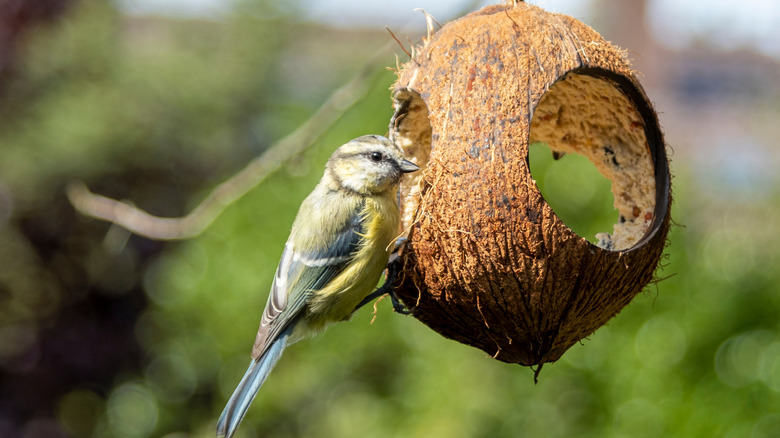
Making a coconut shell bird feeder requires emptying the coconut. Use a corkscrew to tap through one of the dark "eyes" of the coconut; sometimes one is softer than the others. Twist the corkscrew until you feel it get through to the hollow center of the coconut. Repeat the process on another eye, then drain the coconut water into a glass and drink it, if you like. Coconut water is helpful in preventing the things that happen to your body when you're severely dehydrated, since it contains electrolytes.
Draw a fairly large circle or oval on one side of the coconut as a guideline for where to cut the opening. If the hole is too small, it'll be difficult to remove the coconut meat inside. For two openings, make a similar circle opposite the first one. Set the coconut in a vice and cut along each drawn circle using a rotary tool, such as the Dremel 4300 5/40 rotary tool kit, outfitted with a cutoff wheel. Wrapping a folded towel around part of the coconut gives the vice a better grip.
Once you've cut the access holes, pry out all of the coconut meat using a knife or a flat-head screwdriver. Decide whether the end with the coconut eyes will be the top or bottom of the feeder, then drill holes opposite them either for drainage, or to thread jute through. Loop some jute twine through the top hole or holes, then knot it to create the hanger for the feeder. Hang the coconut from a shepherd's hook and put your new bird feeder in a location that'll keep birds safe. Finally, fill it with black oil sunflower seed, or a mix of suet and seeds.