

Creative Ways To Cook And Heat Up Meals Without A Campfire
We may receive a commission on purchases made from links.
Campfire cooking has been around for millennia, long before what we know as recreational camping even existed. While many campers still cling to their favorite campfire cooking methods, there is an ever-growing reason to come up with creative ways to cook and heat up meals without a campfire. Luckily, modern-day campers have plenty of options beyond the campfire, including an array of portable stoves, grills, and even self-heating meals.
Although campfire cooking is the traditional way to prepare meals when spending nights afield, there are actually a myriad of reasons why campers are seeking alternative methods. For one, limiting or eliminating campfires is a cornerstone of sustainable camping practices. Campfires are also one of the primary causes of wildfires. This has resulted in campfires being banned in a number of parks and campgrounds. Additional temporary bans are also often issued when various areas are in a drought and under a burn ban. Beyond that, issues such shortage of available firewoods, a camper's time constraints, and rainy or wet conditions can make campfire cooking impractical.
In some areas where campfires are banned, grills and barbecue pits are allowed, although you may still be restricted to using the grills provided by the campground. Even in areas where no burn ban or campfire restrictions exist, portable grills are still often a convenient option to cooking over a live campfire. The wire grate on grills are easy for placing food and pots and pans, while confining the fire at the same time. Following the leave no trace principles, be sure to completely extinguish your grill and don't dump any residual coals and food on the ground.
Camp stoves and self-heating meals are tasty options
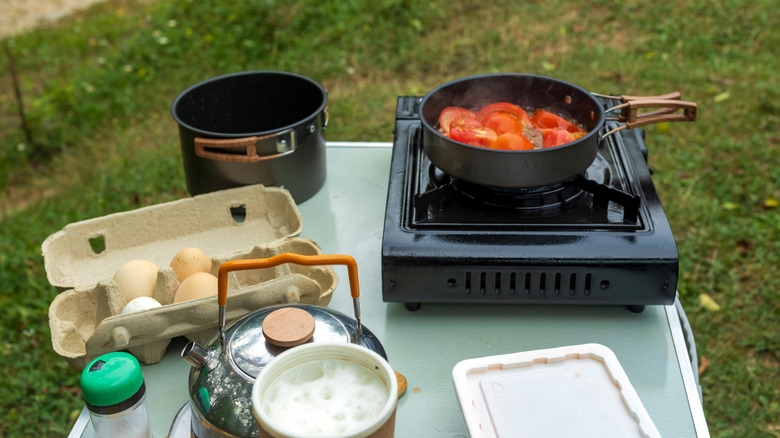
Another method for cooking with a flame that doesn't involve a campfire is a portable camp stove. Camp stoves are available in a dizzying array of configurations. These include tiny burners fueled by cans of alcohol gel, single burners with propane canisters, and multiple-burner stove tops using larger propane tanks. Each has their advantages and disadvantages in regards to portability, cook time, functionality, stability, and wind protection.
When it comes to choosing a portable stove, consider how many people you will be cooking for, how far you have to haul it, and how many days you will be camping out. For avid campers, it makes sense to have multiple types of camp stoves. Then, it is a matter of packing the proper one for each trip. Regardless of the style or styles you choose, camp stoves generally have the advantage over campfires in that they are convenient, easy to light, and waterproof. They also tend to have a more even heat and the heat level is easier to control.
When it is not possible to utilize any sort of flame — or you just want to spend as little time as possible cooking while camping — consider self-heating meals. These individually packaged meals come with a variety of menu items like turkey chile or maple oatmeal. Most self-heating meals require only that you open the packet, add water, and wait a few minutes for your meal to heat. Yet another option is the Lava Gel Flameless Portable Oven. This setup allows you to heat a variety of different meals inside the container, warmed by reusable heat charges. Campers can also meal-prep their own meals ahead of time to heat in the Lava Gel Oven.