

A Common Mistake To Avoid When Sharpening Your Lawn Mower Blades
We may receive a commission on purchases made from links.
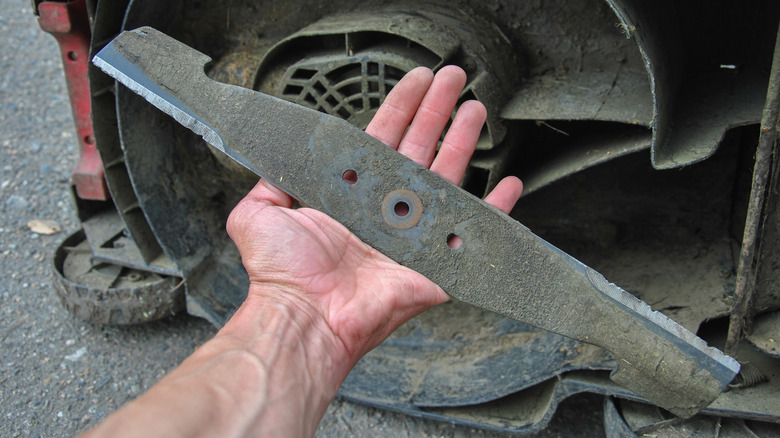
Even if you have the perfect lawn mower for your type of grass, in order to maintain a manicured lawn, your mower will require some routine maintenance. If your grass begins to look ripped, ragged, or uneven after mowing, that's a sign it's time to sharpen your mower blades. While there are several ways to sharpen lawn mower blades, a key component for each of them is knowing when to stop. Oversharpening is a common mistake to avoid. Although it may seem as if the sharper the blades are the better they'll cut, you can actually cause harm to both your blades and thus your grass by honing them razor sharp.
The biggest issue with over-sharpened blades is they will actually become dull faster and are more apt to become nicked, dented, or otherwise damaged. This means you will actually have to sharpen them more often. Given that every time you sharpen the blades you actually remove some of the metal, you will end up needing to replace blades more frequently as well. So, in the end, sharpening your blades too much is actually less efficient and more expensive.
How to prevent over-sharpening
The first thing to know is that you shouldn't expect a mower blade to be as sharp as a knife or razor, which can easily cut through paper or shave hair without applied pressure. Instead, even when sharpened, mower blades should be more of a blunt sharp edge, like a butter knife. This has everything to do with the angle at which it's sharpened. Depending on their uses, knives may be sharpened at angles varying between 10 and 30 degrees, with the sharpest — and most delicate — blades being on the low end of that range. By contrast, the lowest angle you should ever use for a mower blade is 30 degrees — and that is only for well-groomed turf lawns. Typically, you will want to use a 35 degree angle and may need to go as steep as 40 or 45 for rougher mowing duties.
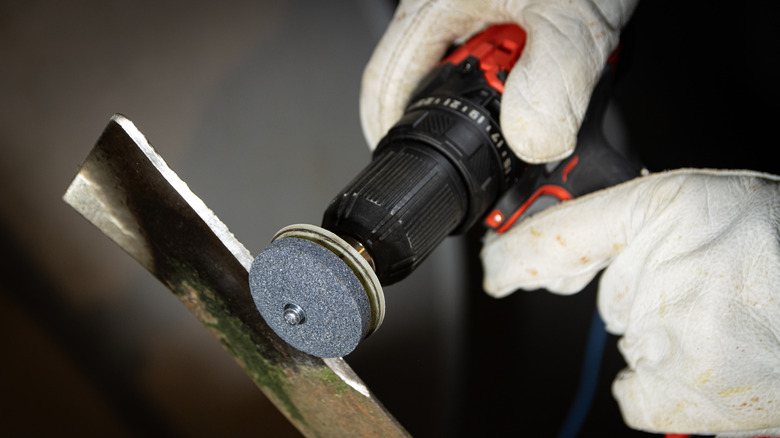
Once you've determined the angle that's right for your mower use, be sure to use right tools and check your progress often. When sharpening by hand with a file such as the WorkPro flat file, you will likely be able to achieve proper sharpness in less than 4 dozen strokes. It is important to only file in one direction, and to stop every few strokes to check your progress. When using a motorized grinder, whether it be a handheld rotary or bench grinder, you should check for sharpness as soon as you have worked the blade enough to remove any nicks, burrs, and dents. If it is still not quite sharp enough, continue to check after every few seconds of grinding. If you want to check the sharpness by more than just touching the blade, pull a piece of grass across it. If it cuts the grass blade cleanly with just minimal pressure, it is ready for use.