

Hawaii Is Seeing A Rapid Rise In Sea Urchins And The Consequences Could Be Devastating

We may receive a commission on purchases made from links.
Hōnaunau Bay, a popular snorkeling and diving spot on the Big Island of Hawaii, has seen a rapid rise in sea urchin population in recent years. The increase in sea urchins is a result of several factors. However, most researchers believe the most significant factor is the decline in fish species that prey on these spiny sea creatures. Regardless of the reason, the fact remains there is a rapid proliferation of these spiny shellfish, which are among dangerous creatures to beware of when swimming in Hawaii waters. Beyond just becoming an increased hazard for those spending time in the water in Hōnaunau Bay, the vast volume of sea urchins could have a devastating effect on Hawaii's coral reefs.
Like reefs throughout the world's oceans, Hawaii's coral reefs are in a perilous position due to a multitude of threats. Climate change has resulted in warmer sea water temperatures, increased freshwater runoff, changes in ocean currents, and lowered pH levels. All of these factors, along with increased pollution, already had the reefs in Hōnaunau Bay struggling to survive. The popularity of the area has also contributed to the decline of the reef system, leading Hawaii to become the first state to require reef safe sunscreen to protect coral reefs from harmful chemicals found in many sunscreen products. Now, with sea urchins quickly taking over much of the area, experts are worried the reefs in this popular bay may not be able to recover.
The spread of sea urchins threatens coral reefs
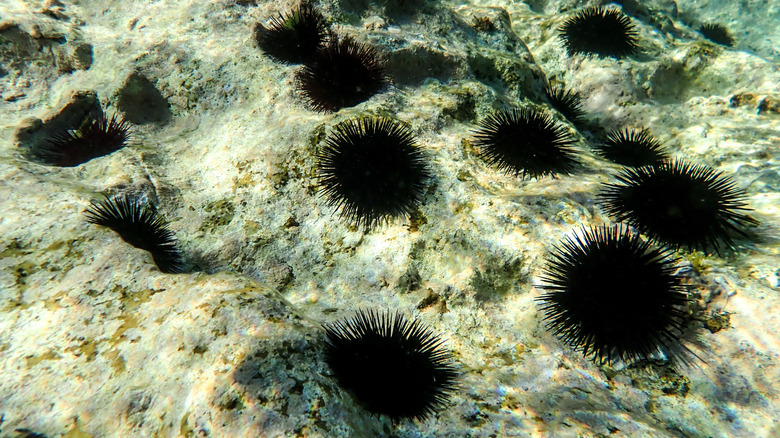
At first glance, it may be difficult to imagine how a rise in sea urchins could spell demise for coral reefs. After all, sea urchins are commonly found around reefs. In fact, they feed on coral reefs. However, therein lies the problem. In a healthy, balanced marine ecosystem, coral reefs are able to grow at a pace that equals or exceeds the amount of predation by the sea urchins. However, there is a tipping point when the sheer volume of sea urchins will begin stripping away the coral reefs outer layer of limestone faster than it can be regenerated. With sea urchins in Hōnaunau Bay now at a density exceeding 50 per square meter, scientists are fearful that point may be near.
Complicating the situation is the fact the reefs in Hōnaunau Bay are already in a weakened state due to the factors mentioned above. As a result, scientists are seeing the coral in the bay barely able to maintain a positive growth rate. To prevent this once thriving reef system from becoming a last chance natural tourism destination, a number of conservation measures have been put in place, including efforts to restore fish populations to help control sea urchins and improve the water quality in the bay. In the meantime, it is critically important — and required by law — that visitors to Hawaii wear reef safe sunscreen, such as Coral Safe Reef Safe Sunscreen.