

Popular Fertilizers To Avoid When Planting Carrots In Your Garden
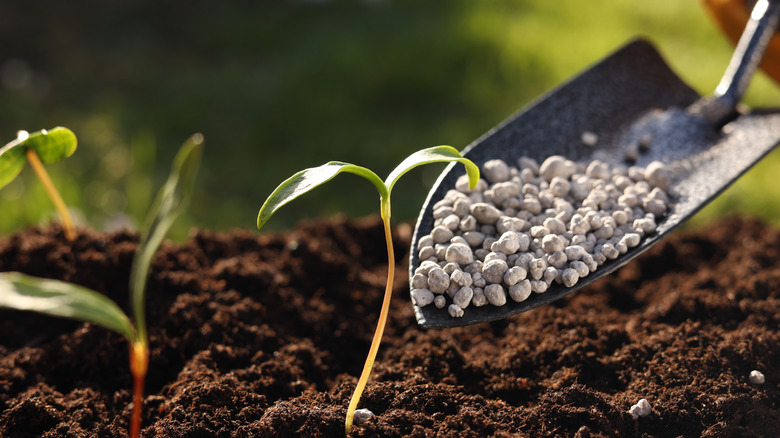
If you have ever pulled a carrot from your garden that looks like a twisted, orange Dr. Seuss character instead of a perfect cone-shaped specimen, then you know there's something wrong with your soil. Carrots (Daucus carota subsp. sativus) are sensitive to too much nitrogen, the consequences of which are misshapen, stunted roots, hiding under lush green tops. Nitrogen is important for the growth of many garden vegetables, but a lot of the popular veggie fertilizers simply have too much of this nutrient to be good for your carrots.
Carrots prefer a sandy soil with room to move. If you have this soil type, your carrots should be an easy-to-grow vegetable without the need for much fertilizer. But if your soil is full of clay, you'll need to amend it to give those orange roots the space and nutrients they need to develop properly. A well-rotted, organic compost from your own properly filled compost bin or from the garden store is perfect for carrots. But be careful when adding other garden fertilizers to these sensitive roots. Fresh manure, including from your backyard chickens, will add way too much nitrogen, resulting in an ugly and inedible harvest. Similarly, blood meal and kelp meal fertilizers may be great for your lettuce and peppers, but adding them to your carrot bed will amp up nitrogen levels too high and you'll be disappointed with the harvest.
Avoid misshapen roots with better fertilizers
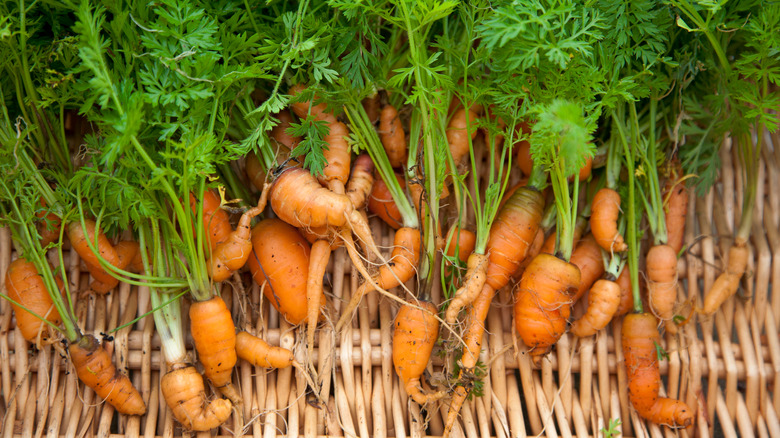
You can still fertilize your carrots to promote robust roots. Synthetic NPK fertilizers for revitalizing your garden are labeled with their nitrogen-phosphorus-potassium ratio giving you the information you need to choose the right formulation. Carrots need an NPK ratio of 1-2-2 or 0-10-10, where phosphorus and potassium — which promote root growth — are at a much higher ratio than nitrogen.
Natural fertilizer sources higher in phosphorus and potassium can also be added to your carrot bed. A natural source of phosphorus is bone meal, and you can boost potassium by using the wood ash from your fireplace to help your garden thrive. Fish emulsion can also work because its nitrogen content is balanced out by higher phosphorus and potassium and slowly releases nutrients to the plants. Well-composted manure is also a good choice to encourage healthy roots.
If you are unsure about your soil, it's easy to tell if your garden soil is lacking nitrogen, and it's just as easy to tell if it has too much. A simple soil test kit available online or at your local garden center will be helpful to gauge nitrogen levels, ensuring you are starting your carrots in soil right for root growth.