

Avoid Annoying Fellow Campers With An Unspoken Etiquette Rule
We may receive a commission on purchases made from links.
The immersive outdoor experience that camping provides is why many people head out to sleep under the stars. And what brilliant stars they are, once you are miles away from city lights. There are even certified dark sky parks like Arches National Park in Utah and Big Cypress National Preserve in Florida, where people go specifically to experience a view of the cosmos unaffected by light pollution. The deep darkness you find at a campsite also makes your other senses perk up, bringing you into a closer relationship with the natural world. To some, this darkness may be a bit intimidating — which is why people bring lanterns, headlamps, and even string lights along with their other camping essentials. But whether it is your first time camping alone or you are a seasoned camper on a group trip with friends or family, you don't want to spoil your own or other's peace by lighting up your campsite like a stage show.
Most campsites aren't remote. You are bound to have neighbors nearby, even in dispersed camping areas. And those neighbors don't want to see your blinding or blinking LEDs as they try to connect with nature. Being mindful of how and when you are lighting your campsite is key to being a polite camping neighbor. A good rule of thumb for camping lights is to use the least brightness you can, and turn them off at a reasonable hour.
The right (and wrong) lights for camping
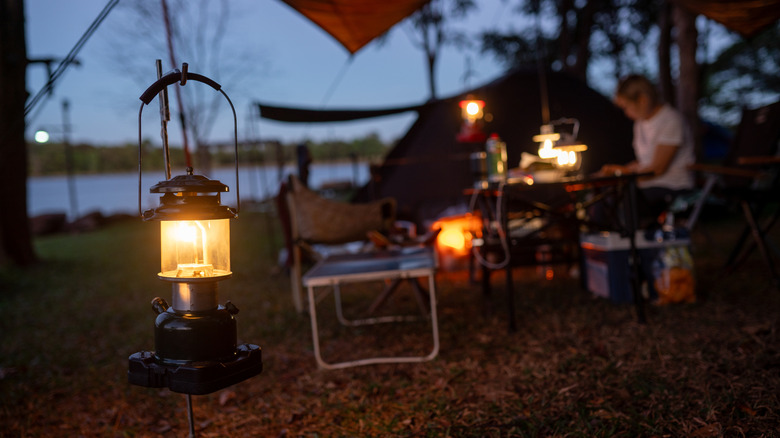
Lumens are a measure of brightness, and are something to look for when thinking about your camping lights. That 60 watt bulb in your bedside lamp puts out about 800 lumens. Most LED camping lanterns on the market have at least 1000 lumens, and many are much brighter. With that much lumen power, you'll be lighting up a significant radius around your picnic table with bright, white light — and it could be bleeding hundreds of feet to the next campsite over. You really only need lumens in the 10-100 range to adequately see around your campsite or for a reading light inside your tent. A light source that is dimmable, like this rechargeable camping lantern by Cullaby, is versatile enough to have bright light when you need it, but can be significantly toned down to ensure your campsite isn't obnoxiously aglow.
While string lights look cute hanging from your tent vestibule or campervan awning, most put out pretty intense light, so be a good neighbor and unplug or at least dim them before the evening gets too late. Dimmable string lights are available, such as these solar rechargeable camping string lights by InkTrail.
Light sources that put off red light are also useful in a dark campground. While giving you adequate light to see your bag of marshmallows, red light sources do not interfere with night vision, allowing you to still see the stars. Red lights still travel a long distance, so just like with white lights, be sure you can turn down your brightness as the moon rises, allowing everyone to enjoy the special kind of darkness only camping can provide.