

Keep An Eye Out For This Dangerous Bug While Adventuring In Texas

We may receive a commission on purchases made from links.
Texas is a big state. In fact, it is the second biggest state in the US and held the top spot until Alaska was admitted to the union in 1959. Well before that, the slogan 'Everything is bigger in Texas' was a common refrain across the country and continues to be to this day. However, one of the biggest dangers facing those exploring the state's quarter-million square miles is presented by a creature that's barely bigger than a penny. Kissing bugs may sound harmless — even loveable. However, a kiss from this insect can give you more than just a warm and fuzzy feeling. If you value your health, you certainly should keep an eye out for this dangerous bug while adventuring in Texas.
It likely isn't a surprise that those adventuring in the Lone Star State face perils from the wildlife in the area. There are a number of creatures to beware of when adventuring in Texas, including extremely dangerous snakes like cottonmouths and rattlesnakes. There are also numerous creatures to beware of when swimming in Texas waters. However, while spending time outdoors in Texas, or anywhere else in the southern United States, for that matter, you are much more likely to encounter a kissing bug than one of the other, more physically intimidating species.
Texas is actually home to three varieties of kissing bugs — Triatoma sanguisuga, Triatoma gerstaeckeri, and Triatoma protracta. Although Triatoma gerstaeckeri is the largest, none of the three grow more than an inch and all look similar enough as to be easily confused for one another. They are also each capable of posing the same threat to those they bite. The threat actually comes not from the bite itself, which is typically painless, but from a tiny parasite that can be transferred in the process.
Kissing bugs are responsible for spread of chagas disease
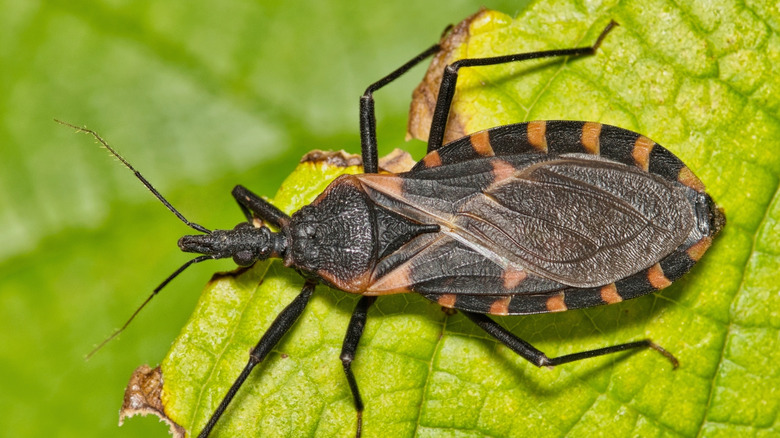
Roughly a little over half of all kissing bugs carry Trypanosoma cruzi or T. cruzi parasite. When a kissing bug bites a human, dog, or other animal, its interest is to drink some blood, which is what it relies on for its survival. However, during the process of the kissing bug getting a drink, the T. cruzi parasite can escape the insect and enter the animal. If you happen to be that animal, you are at risk for developing chagas disease.
Although there are no official statistics on how many Americans have chagas disease, estimates by the Centers for Disease Control pegs it as being possibly as high as a million. The disease itself manifests in two stages — acute and chronic. In the acute stage, those affected with the disease may experience a variety of symptoms, all of which are very similar to various other illnesses and diseases. These include fatigue, fever, headache, rash, body aches, diarrhea, and vomiting. For some who are infected, the symptoms may be so mild as to not be noticeable. Around a third of those who are infected will develop the chronic stage and may develop heart disease and other issues.
Currently, no vaccine exists for chagas. However, if you suspect you may be infected, blood tests are available to confirm the presence of the disease. Prevention hinges largely on avoidance. When spending time outdoors, wear long-sleeve clothing and use insect repellent. If camping, the best practice is to sleep under a protective covering like a Coghlan's mosquito net. It is also important to keep tents, campers, and cabins closed and sealed as much as possible.