

How To Easily Spot A Hummingbird Nest In Your Backyard
We may receive a commission on purchases made from links.
People across the country thoroughly enjoy watching hummingbirds flit around their backyards. They often do everything possible to attract these diminutive birds. Efforts range from fretting over the best time to put out hummingbird feeders to making valiant attempts to deter praying mantises and other critters that hunt hummers. However, even though they spend hours watching hummingbirds zip around, flying between flowers, trees, and feeders, relatively few have seen hummingbird nests. But once you know what to look for, you can easily spot a hummingbird nest in your backyard.
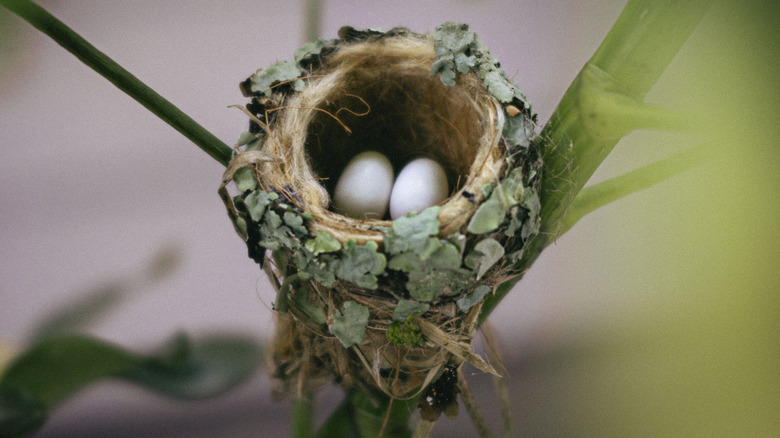
Given that hummingbirds measure their weight in grams and lay eggs the size of peas, it is no surprise hummingbird nests are not large. Most hummingbird nests are at most a couple inches wide and a couple inches tall. In other words, roughly the size of a golf ball or slightly larger. So, the size alone can make hummingbird nests challenging to spot. Additionally, because they are so small, those unaware of what they're looking at often mistake them for something else, like perhaps a knot or growth on the tree.
Since they are slight in stature and lack any serious defensive weaponry, hummingbirds go to great lengths to obscure their tiny homes. This adds to the challenge of spotting them for both birders and predators. Hummers often build their nests in dense cover or behind a shroud of thorny spines for added protection. When that's not a possibility, they will typically build them in the forks or branches or atop a large branch, utilizing natural materials such as lichen, spider webs, moss, and bark to make them blend and appear as part of the tree.
Tips for spotting hummingbird nests
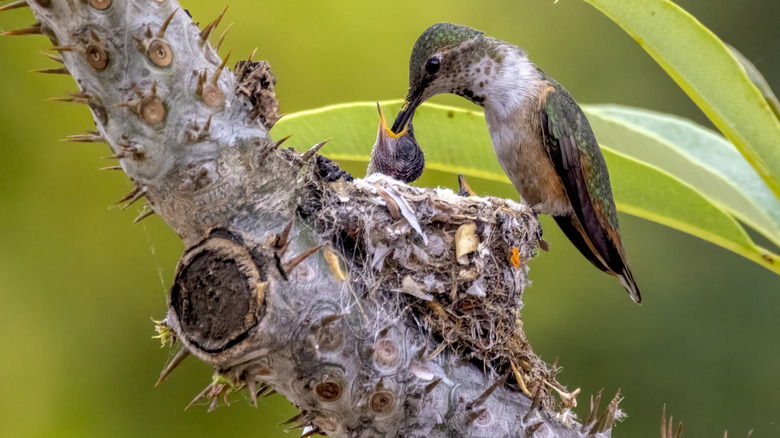
Seeing a hummingbird fly into their nest is a sure-fire way to help spot one. But, only the females will potentially lead you to their homes. That is because the males are not part of the nest building process. Nor do they have an active role in guarding the eggs and/or brood or feeding the young hummers. In short, they have no reason to go to the nest. Females, on the other hand, will frequently return while there are eggs or young ones in the nest. Oftentimes, hummingbirds will build their nests a short flight from feeders or water features that keep them hydrated and will return home soon after having a drink or meal. So, careful tracking of these momma birds can lead you to finding their hiding spot.
However, short of following a female back to the nest, these little homesites can be difficult to locate. But, there are a few tips as far as what to look for when attempting to spot hummingbird nests. For one, look for anything that appears as a small knot, growth, or anomaly on a branch. Again, these nests are tiny, so even at close distance a pair of binoculars like Bushnell H2O waterproof binoculars can be a big help in spotting them.
Another way to hone in on the location of a hummingbird nest is to listen for the chirping, chattering, or whistling of these small birds. By following these sounds, you can often find the general area where a nest is located. This is particularly helpful when looking for nests in dense foliage.