

What Shopping At Bass Pro Shops Was Like In The '70s And '80s
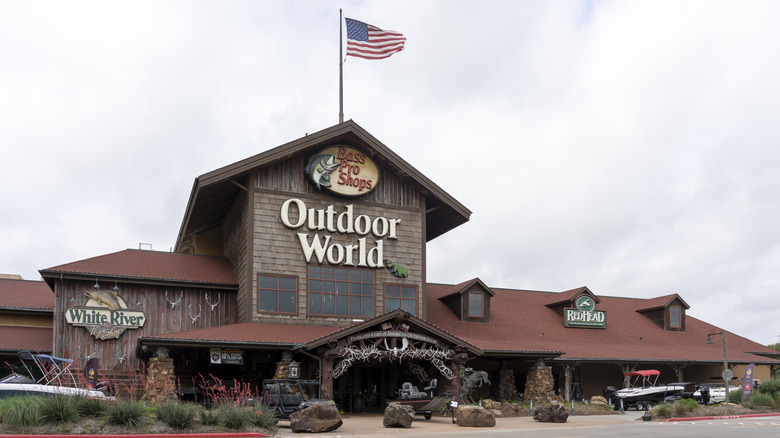
Today, Bass Pro Shops is known to virtually every outdoor enthusiast in North America. After all, their sprawling stores have a tremendous array of outdoor gear. So, for many folks, BPS is their store of choice, whether they are looking for a new fishing rod, buying a new boat, or picking up camping supplies. The outdoor retailer is so popular with such a diverse crowd that their iconic mesh trucker hats have become a viral fashion trend. However, it was not always that way. Shopping at Bass Pro Shops in the 1970s and '80s was a far different experience.
Throughout the '70s, it's safe to say that relatively few Americans had ever visited a Bass Pro Shops. Why? Well, there was only one and it wasn't even a full shop. After spending a few years competing on the then recently formed professional bass fishing circuit, BPS founder Johnny Morris decided to try his hand at selling fishing tackle. In 1972, he opened a very small (8-square-foot) location in his dad's Brown Derby Liquor Store in Springfield, Missouri.
While these days shoppers can order whatever they need from the Bass Pro website, many people prefer to visit one of the nearly 200 locations (Bass Pro Shops and Cabela's, which the company acquired in 2017) in the United States and Canada. The massive shops are not only well-stocked, but also adorned with spectacles ranging from gargantuan fish-filled aquariums to dioramas stocked with exotic wildlife mounts. Each store's unique, regionally inspired displays draw visitors from around the world. For example, the Springfield, Missouri flagship is one of the state's top tourist destinations, drawing a staggering 4 million people annually.
Bass Pro raises the bar with catalogs
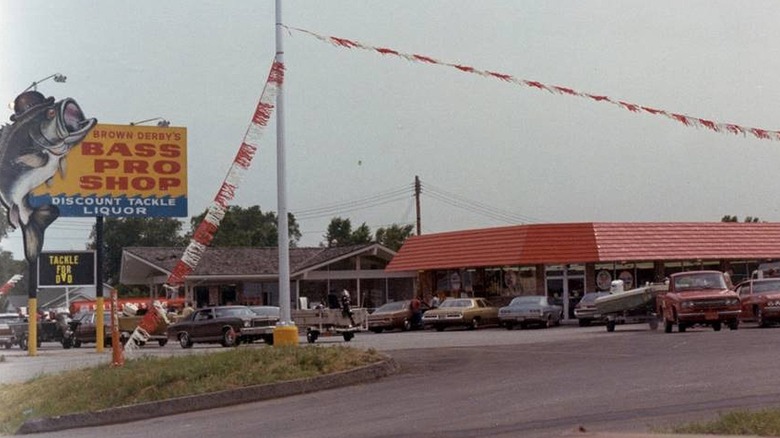
That first Bass Pro Shop inside a Brown Derby liquor store — basically some supplies on a counter and a freestanding display of rods and tackle — was the brand's sole location throughout the 1970s. Shopping at that store was, for the most part, like picking up supplies in any mom-and-pop bait stand or tackle shop (which are increasingly hard to find these days). You can get a first-hand feel for what that was like by visiting a replica of the original store, complete with shelves of liquor bottles: It's in front of the flagship store in Springfield. A walkthrough quickly reveals that, while there was a small aquarium on display, the tackle selection was modest, to say the least.
With that in mind, throughout the 70s, the way most people shopped at Bass Pro was via a nationally distributed catalog. Catalogs were a mainstay for retailers in the 1970s, with stores like Sears and Montgomery Wards leading the way. Even Banana Republic took off, in 1978, thanks to its wildly popular catalogs filled with hand-drawn product images and charming adventure stories. Seeing the potential to reach an audience beyond Springfield, Morris published the first Bass Pro Shops catalog in 1974. These direct mail offerings remained a staple of the BPS business model until the proliferation of e-commerce. However, Bass Pro has parlayed its mail-order catalog business into success online, as it is the top e-commerce outdoor retailer today, with an estimated 21% of online business, according to MMCG Invest, well ahead of number-two Dick's Sporting Goods (15% of the online outdoor purchases).
A new decade brings brick-and-mortar stores
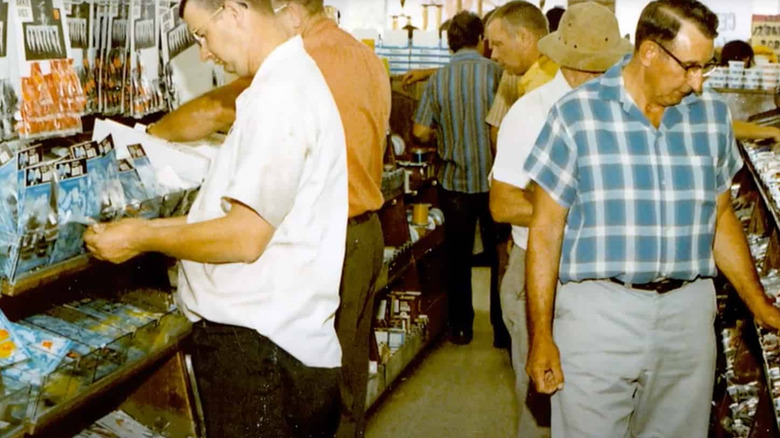
While catalogs allowed anglers to order what they needed, the shopping experience most people associate with Bass Pro began to emerge in 1981 with the opening of the first standalone store — Bass Pro Shops Outdoor World in Springfield. While that original Outdoor World was not quite as grandiose as many of the stores today (actually, not even as grandiose as that store is today, as it has grown to cover over 500,000 square feet), it was still far beyond a typical tackle store. That location included not just an aquarium, but a waterfall, mounts, and those iconic dioramas which have become integral to each store that has opened since.
The other thing that was new for shoppers was the overwhelming selection. That, too, remains a standard of BPS retail locations. In this sense, anglers were able to pore through a myriad of lures, rods, reels, and other equipment, often getting to see colors, sizes, or styles in person for the first time. Despite the name, the merchandise offered by Bass Pro was not, nor is it now, limited to freshwater fishing. While BPS has never delved into team sports-type equipment, they offer an abundance of fishing tackle for all types of angling, as well as hunting, hiking, camping, and boating goods.
While this made Bass Pro the perfect store to visit in the 1980s, whether you were looking for the right hiking shoe or what you needed for ice fishing, it was the visual spectacle that set it apart. That is also what turned BPS locations into destinations, rather than a simple shopping stop for necessities. In the '80s however, in order to get that experience you still had to travel to Springfield: Bass Pro didn't open their second retail location (in Georgia) until the mid-90s.