

Boomers Everywhere Used It Into The '70s — Now It's Forever Banned In The US

Mosquitoes have been an issue in North America since humans first set foot upon the continent. Throughout time, indigenous peoples used everything from sweet grass and alligator oil to bear grease in an effort to ward off these pesky bugs. By the middle of the last century, there at long last seemed to be an actual solution to the problem: Dichloro-diphenyl-trichloroethane, more commonly known as DDT, was found during WWII to be an extraordinarily effective insecticide. With the rise of postwar American prosperity, Boomers — and their parents — used DDT on farms, in cities, and in suburban neighborhoods until the early 1970s, when it was banned forever in the U.S.
The push for an affordable, highly effective way to kill mosquitoes began in the late 19th century, when we realized there are several dangerous types of mosquitoes that spread deadly diseases, including yellow fever, malaria, and later West Nile and Zika. From that point forward, finding an effective way to banish mosquitoes became paramount for public health. Although DDT had been developed in 1874, its insecticidal qualities were not fully understood until 1939. The timing was fortuitous, as soldiers were fighting, throughout World War II, in typhus- and malaria-riddled portions of the world.
In 1945 — the final year of the war — the U.S. Food and Drug Administration (FDA) approved the use of DDT as an insecticide. Because it was so effective, it quickly became the go-to method for controlling mosquitoes at both the industrial and residential levels. DDT became so popular, so fast, that by the end of its first year of approved use more than 2 million pounds per month were being produced just in the United States. But, as with so many miracle cures, there was a dark side soon to be discovered.
DDT use was widespread until it was banned
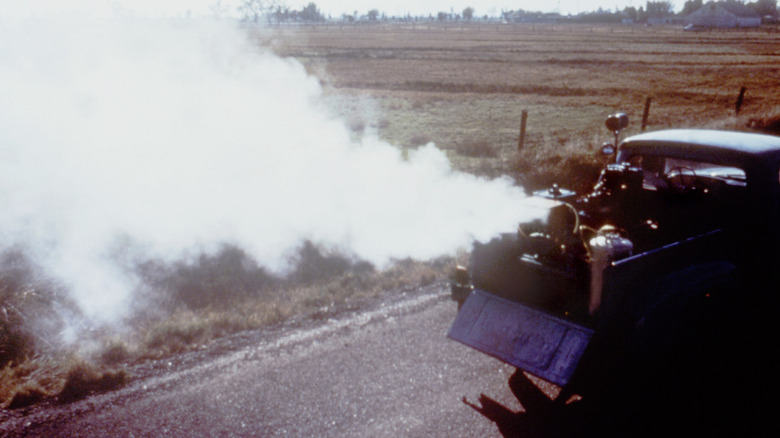
Besides being extremely effective, another reason for the rapid rise in the use of DDT during the late 1940s is that it was unregulated. Prior to the creation of the Environmental Protection Agency (EPA) in 1970, regulatory responsibility fell upon the U.S. Department of Agriculture (USDA), and that agency did not take any action regarding DDT until the late 1950s. So, for over a decade, this deadly chemical was used without restraint. Offices, schools, and apartments were sprayed with DDT while people lived or worked in them. Military barracks were treated with DDT aerosol bombs. Both home gardeners and farmers used it in powder and fog spray forms. And perhaps most famously, mosquito fogger-equipped trucks drove through neighborhoods trailing thick clouds of DDT.
DDT was unregulated largely because it was thought to be safe. In fact, people were so confident in its benign nature that Boomer kids were encouraged to follow fogger trucks and stand in the dense mist left behind. By the late '50s, those safety claims proved to be untrue. It's hard to overstate the impact of Rachel Carson's 1962 book "Silent Spring" in that collective realization. The book, which raised a number of alarming environmental issues and health concerns stemming from DDT use, brought the issue to the forefront of the public consciousness. Ultimately, the EPA completely banned — or canceled the legal use of — DDT in 1972.
Despite the ban on DDT, the fight against mosquitoes in America and elsewhere continues. There are still trucks spraying neighborhoods for mosquitoes, but they don't use DDT and kids are not encouraged to play in the fog behind them. While Americans now seek natural ways to repel mosquitoes, in some malaria-riddled countries, DDT is still very much in use.