

What's The Difference Between A Crow And A Raven?
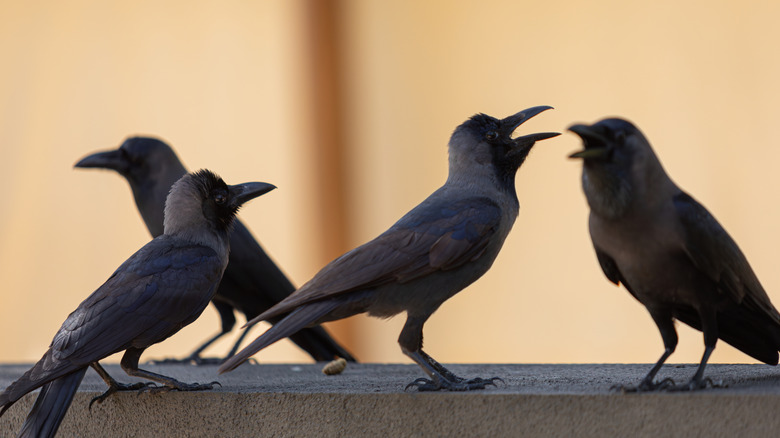
On first glance, crows and ravens can seem nearly identical. Both birds are large, intelligent members of the corvid family, sporting glossy black feathers, powerful beaks, and a reputation for remarkable problem-solving skills. It's no surprise that many birdwatchers, gardeners, and homeowners struggle to tell them apart. Still, despite their similarities, crows and ravens are distinct species with several notable differences once you know what to look for. Whether you're a fledgling bird watcher trying to be more accurate in your recording, or a home gardener making a list of birds you never want to see at your bird feeder, understanding the difference between crows and ravens might be very helpful.
The size of the majestic black bird is often the first clue. Ravens are generally much larger than crows, with thicker beaks, broader wings, and a more imposing presence. Their calls differ as well, with crows offering their familiar "caw" sounds, while ravens produce deeper, throatier croaks that carry over long distances. Even the flight patterns of these somewhat ominous birds offer hints as to their true nature, since ravens often sail on air currents like hawks or vultures, while crows flap their wings with much more consistency.
Where you encounter these birds can also help with identification. Crows are highly adaptable and frequently thrive in cities, suburbs, parks, and residential neighborhoods. Ravens, on the other hand, tend to prefer the open countryside, forests, and mountains. Though the natural habitat for ravens has expanded in some places, these birds can be highly sensitive to man-made disturbances, so the less-developed areas outside of town make for ideal homes.
Understanding crows and their habitats
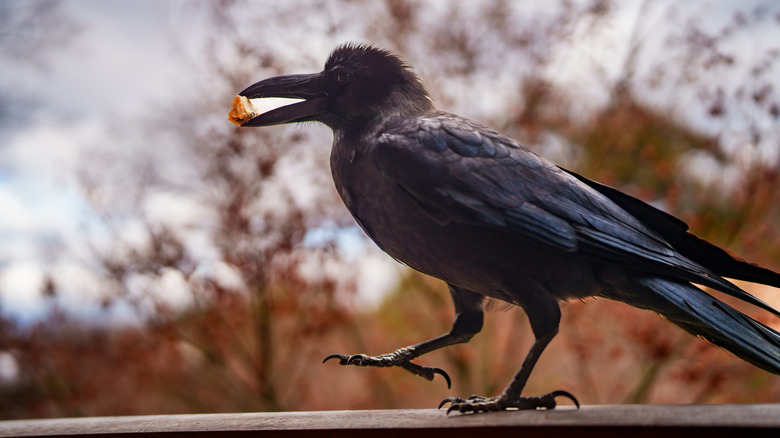
In most cases, the large black bird hanging around your home or community is going to be a crow. These birds are highly adaptable, remarkably intelligent, and tend to travel in large groups. A group of crows is referred to as a murder, which further contributes to their gothic reputation.
These birds have adapted over the years to thrive in a myriad of environments, living among us in metropolitan cities and suburbs just as easily as they can out in the wilderness. That, plus their superior intelligence allows them to form bonds with humans for better snacks and other perks. You may hear stories of people feeding their local crows from time to time, and some claim their corvid friends have returned the favor by bringing shiny gifts.
One of the fastest ways to differentiate a crow from a raven is by checking their size. While crows are still large compared to many other backyard birds, they're noticeably smaller than ravens. A typical adult crow can measure from 17 to 21 inches in length, and tout a slim build, straight beak, and a fan-shaped tail. Their distinctive "caw, caw" vocalization is another dead giveaway.
In gardens and suburban areas, crows can be both beneficial and troublesome. On one hand, they help control insect populations by feeding on grubs, caterpillars, and other pests. They also act as nature's cleanup crew by scavenging dead animals and food scraps. On the other hand, they have been known to dig in garden beds, raid bird feeders, or sample fruits and vegetables for an easy meal. Since crows are so comfortable with human activity, it's not unlikely to find them perched on fences, utility poles, and rooftops across the suburbs.
Ravens: the larger, wilder corvids
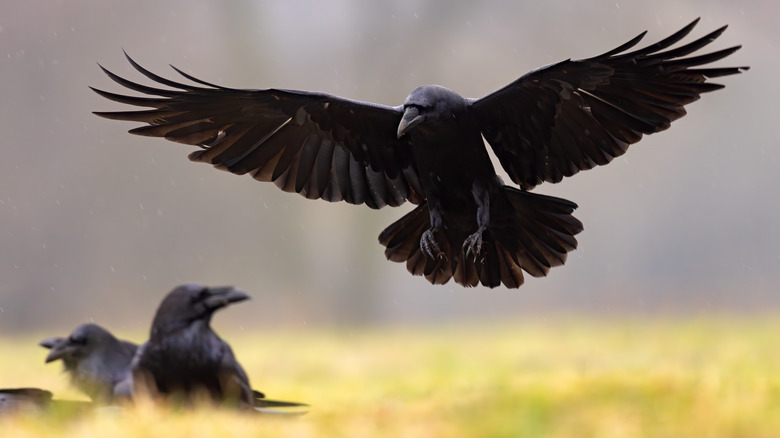
While crows are commonly sighted in cities and suburbs, ravens tend to maintain a more mysterious reputation. As the largest members of the corvid family, ravens are noticeably bigger than crows and often leave a lasting impression on anyone lucky enough to spot one. Since they spend less time around humans, people may consider the birds to be exceptionally bright. But, make no mistake, as ravens are actually way smarter than most people think.
As stated, the most striking distinction between ravens and crows is their size. Ravens tend to grow to lengths of 22 to 27 inches, rivaling the dimensions of a red-tailed hawk. Their beaks are thicker and more curved than crows, and they often display shaggy throat feathers known as hackles. Like crows, groups of ravens are classified under a macabre title, known as an unkindness or a conspiracy. When in flight, a raven's tail spreads out into a diamond or fan shape (a crow's has a straight end, creating a flat triangle), making identification easier even when they're high in the sky.
Ravens don't utilize the traditional "caw" sound we know so well. Instead, they offer a raspy croak, which some people describe as sounding prehistoric. They are also skilled mimics and can produce a surprisingly wide range of calls, which is likely why famed American author Edgar Allen Poe found the birds so mesmerizing.
If you're traveling outside the city, perhaps peeping at wildlife in the Great Smoky Mountains, and you spot a large, jet-black bird soaring overhead, there's a good chance it's a raven. Just listen carefully for the guttural croaking to confirm, and consider leaving behind a few berries, grains, or nuts for them to snack on.