

The First Thing You Should Do If You Find A Snake's Shed Skin In Your Yard
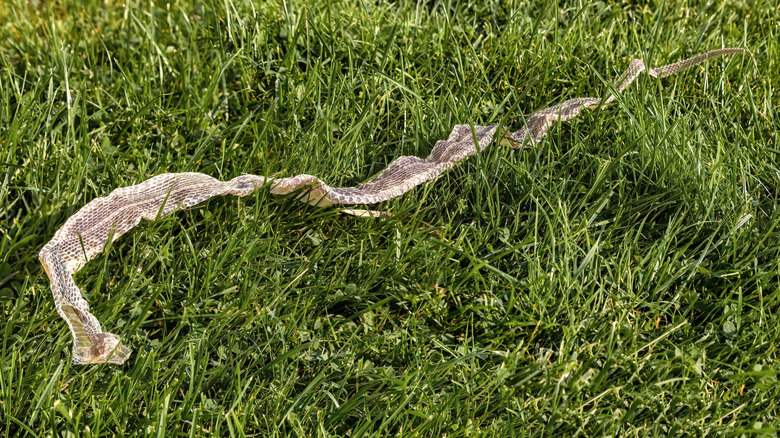
Finding a snake's shed skin in your yard can be unsettling, even if you don't mind snakes. After all, a snake skin — or more accurately a snake shed — is tangible evidence a snake is or was slithering across your lawn. However, rather than panic, you should use the snake shed to identify the type of snake that left it. Knowing the identity of the serpent can help you determine if it is a dangerous type of snake, meaning there really is cause for concern, allowing you to formulate a plan of action.
However, before scooping up the snake shed for closer inspection, you first need to attend to a few safety measures. Start by scanning the area to ensure the snake isn't still close by, since even common snakes may hide in your yard. Additionally, it's a good idea to keep kids and pets inside, or at least from the general area, until you can determine the type of snake and if it's hanging around. This is of particular importance because during and after the shedding process, snakes have poor vision and may act more defensively and aggressively than usual.
Once you have determined that the snake is not still hanging around — or at least not visible in the immediate vicinity — don a pair of latex or rubber gloves, or use a plastic bag to pick up the shed skin. This is important because shed snake skins often carry salmonella, which can result in a bacterial infection should you contact it with bare skin. Additionally, the skin may have attracted mites and other parasites while it's been sitting in your yard.
Shed snake skins can provide clues
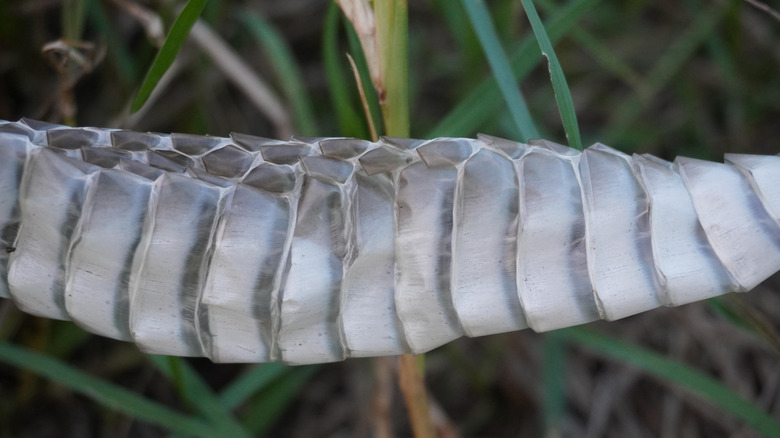
Once you have the shed snake skin in your gloved hands, there are a few details you will be able to determine from it. For starters, if the skin is complete, you will be able to tell the rough size of the snake. However, consider it an approximation, as the skin has stretched during shedding and may be larger than the actual snake. Secondly, the suppleness of the shed skin will tell you how recently it was left. Freshly shed skins are typically soft and may even still be moist. As they age, shed skins dry out and become more brittle.
While that information can be useful, obviously the most important thing to determine is the type of snake. More specifically, it is critical to determine if the snake is venomous or not. The easiest, and most accurate, means for identifying venomous snakes from a shed skin is to look at the scale pattern on the underside of the skin, near the tail. Venomous pit vipers have a single row of scales, whereas other types of snakes have a double row.
It is worth noting that coral snakes, which are not vipers, but are venomous, do have a double row. So, if you happen to live in an area where coral snakes are known to exist, a shed with a double row of scales beneath its tail would warrant further inspection. If the banded pattern of the coral snake isn't visible on the shed, you can check the dorsal scales on the back of the shed. Eastern coral snakes have smooth scales that fall into 15 rows. Arizona coral snakes also have smooth scales, but they're are arranged in a dorsal scale pattern of 17-15-15 at three points on their body.