

The Animal With The Strongest Bite Force That You Don't Want To Meet In The Wild
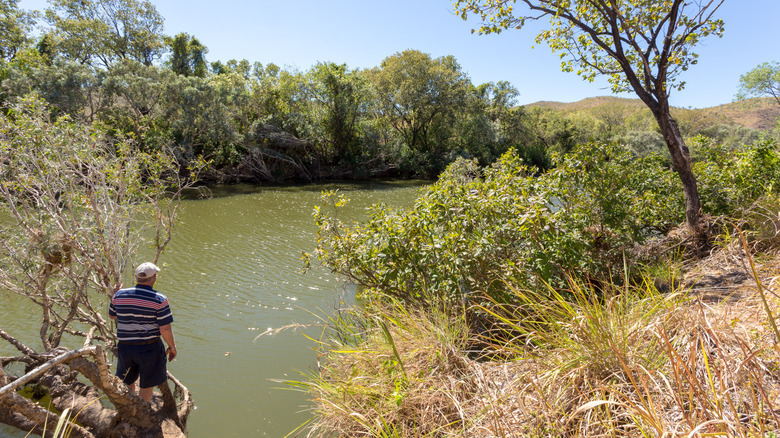
Whenever you are adventuring in the wild, you are sharing space with feral creatures — some of which are capable of inflicting severe bites. These bites vary tremendously in type. They may be relatively small, such as from insects, or somewhat larger puncture wounds, usually inflicted by snakes. While bites from venomous snakes and insects can be dangerous, even deadly, the most gruesome is the gripping, tearing kind caused by strong-jawed creatures with incredible bite force. To that end, the animal you most definitely don't want to meet in the wild is the Nile crocodile.
The Nile crocodile has the strongest bite force, measured at 5,000 psi, more than double that of an American alligator and over four times the bite force of a grizzly bear. Like the river for which it is named, the Nile crocodile is found on much of the African continent. Specifically, it lives in sub-Saharan Africa, throughout the Nile River Basin in eastern and northeastern Africa, and on the island of Madagascar. While you may think you will never run into a Nile crocodile, with wildlife getaways trending, the number of people encountering these vicious animals has been increasing and will continue to.
Although there are some places where you may encounter crocodiles in the U.S. and Central America, those are American saltwater crocodiles, not Nile crocodiles (a handful of invasive Nile crocodiles have been identified in Florida through DNA analysis). American crocs do have a tremendous bite force and are incredibly dangerous, their bite force (about 3,700 psi) does not equal that of the Nile crocodile. Luckily, despite their geographic differences, the steps for staying safe around Nile crocodiles and saltwater crocs are essentially the same.
How to avoid or handle an encounter with a Nile crocodile
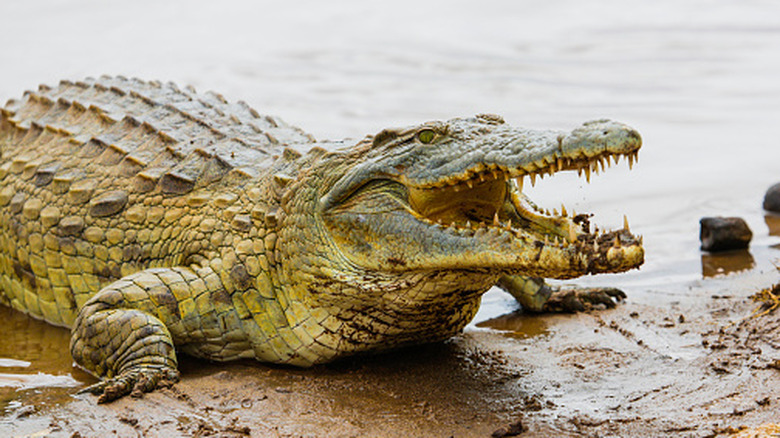
This incredibly strong bite force obviously ranks Nile crocodiles among nature's most dangerous animals. So, an encounter with one rarely ends well. In fact, of the 300 or so attacks reported each year throughout Africa, over half are fatal. In addition, research suggests nile crocodiles are one of the few apex predators that deliberately hunt humans. That's why knowing how to stay safe while wildlife watching or otherwise adventuring in their territory is imperative. It is also important to know what to do if you are attacked, as it is possible to survive.
When it comes to avoiding Nile crocodiles, the only sure-fire way is to avoid adventuring in areas they are known to inhabit. However, if you find your outdoor activities take you into their domain, the main thing to do is watch yourself around the water. Do not spend time near the water's edge and swim only in designated areas. Whether you are in a boat or on land near water, pay close attention to your surroundings and stay at least 15 feet away from any crocodile you see. You should also avoid spooking, startling, or attempting to scare them away.
Should you happen across a croc at close range, begin slowly backing away while keeping an eye on the animal. If the crocodile begins approaching, run away in a straight line — not a zig-zag manner — as fast and far as you possibly can. The good news is, if a croc does actually bite you, it may let go if it is striking out defensively. But if it doesn't let go, your best defense is to fight back, as hard as you can. Target the most sensitive parts of the croc repeatedly by punching, kicking, or scratching its eyes, nostrils, and ears.