

How To Measure Ape Index For Climbing (And Why It Matters)
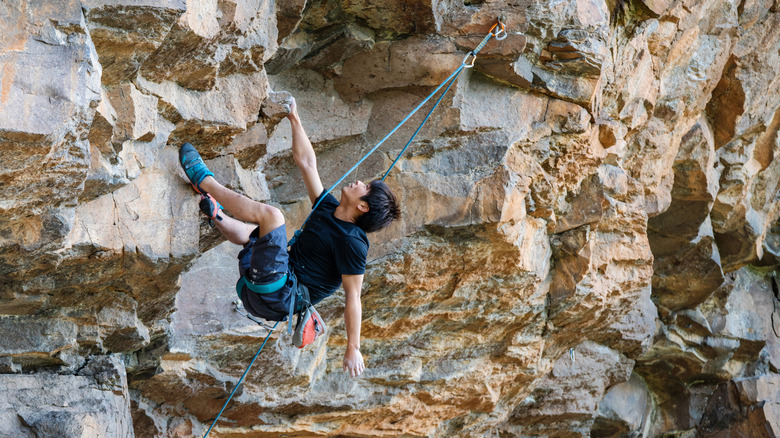
Rock climbing is among the extreme sports for thrill seekers that has been rising in popularity over the past decade. Both in the gym and outdoors, there are several types of climbing, such as bouldering, top rope, and other, more advanced techniques. Some use no or minimal equipment, while others employ a series of ropes and belays. They all have one thing in common — climbers rely on a variety of hand and footholds to make their way up a vertical face. To better understand which holds you can or cannot reach, you need to know — or at least be aware of — your ape index.
Simply put, ape index is the measure of your arm span relative to your height. A positive ape index means you have long arms relative to the rest of your body, while a negative ape index indicates shorter arms. This measurement is not specific to climbing — it is actually important to a variety of sports. In some sports, most notably powerlifting, a negative ape index is beneficial. However, in several others, including swimming and climbing, a positive ape index is thought to be advantageous (think Michael Phelps).
To measure your ape index, you actually have two choices. One method is to determine you ape index as a ratio. To do this, divide your arm span, also referred to as wingspan, by your height. A perfectly symmetrical body would have a ratio of 1. Anything above is a result of lengthy arms, below is shorter limbs. A simpler method is to subtract your height from your arm span. With this method, if the number is positive, so is your ape index. A negative number (below zero) means you have shorter arms.
Why ape index matters — or does it?
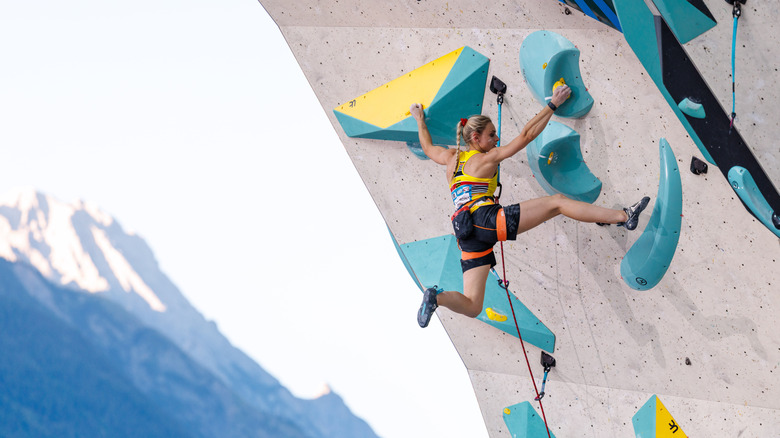
At this point, you may be wondering why your ape index even matters. After all, your arms aren't going to get any longer, so you can't actually improve your ape index. Nor should your arm length ever keep you from climbing. However, it does serve a few useful purposes. The most basic benefit to having a positive ape index is it means you can reach holds that are farther away. In some instances, the ability to reach farther from your body in order to gain a hold can help you stay safe on your next mountain adventure. In climbing disciplines where speed matters, such as sport climbing, it can also help you ascend much faster.
However, more than anything, knowing and understanding your ape index really matters more to shaping your climbing style. After all, not every world-class climber has a high ape index and some barely tick into positive territory. But knowing your ape index can help you formulate a plan for each climb, by helping you know the limits of your reach, and how best to take advantage of your natural stature.
It can also help you know what you need to avoid doing while training and climbing. That is because not all effects of a positive ape index are positive for climbers. For instance, certain moves put severe strain on your shoulders and other joints. This is even more pronounced if you have long arms: Those with a shorter index rely more on their core, while shoulders get more of workout as the ape index increases. As a result, you may need to spend more time building strength in those muscle groups and/or avoiding certain negatively strenuous moves when climbing.