

5 Types Of Spider Webs You Actually Want In Your Yard
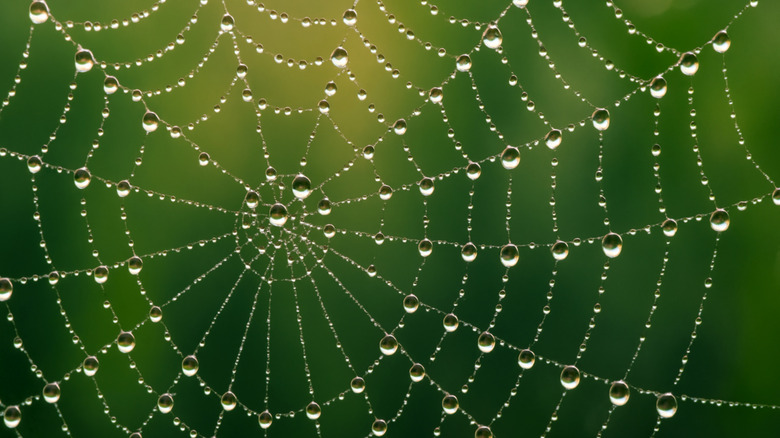
For many people, the sight — or even the thought — of a spider in a spider web gives them the chills. Even without full-on arachnophobia, the prospect of bumping into a spider web in your yard or garden can be unsettling, especially when you know that means a spider is near. However, the presence of webs is an encouraging sign, as there are several types of spider webs you actually want in your garden. Seeing one is a sign you could have an eight legged, eco-friendly exterminator at work, helping to keep your garden pest-free.
The diet for most spiders is insects — lots of insects. As a result, a healthy spider population can help keep harmful insects from devouring or spreading disease to your garden plants. They also help eliminate pesky stinging insects such as mosquitoes and wasps, which is a benefit to the gardener as well as the garden. With that in mind, if you haven't done so already, you might want to stop killing spiders in your garden or knocking down their webs when you come across them.
Granted, there are a couple of dangerous types of spiders which you probably don't want to see in your garden. Those would be the black widow and brown recluse, the only two venomous spiders in the U.S. While it's possible, it's highly unlikely that either would be hanging around the garden, as they both prefer other habitats, such as woodpiles and garages. It is also easy to distinguish their webs. Both black widows and brown recluses have disorganized webs which manifest as a jumbled, sticky mess, while the spiders you want in your garden have much tidier, symmetrical webs.
Spiral orb web
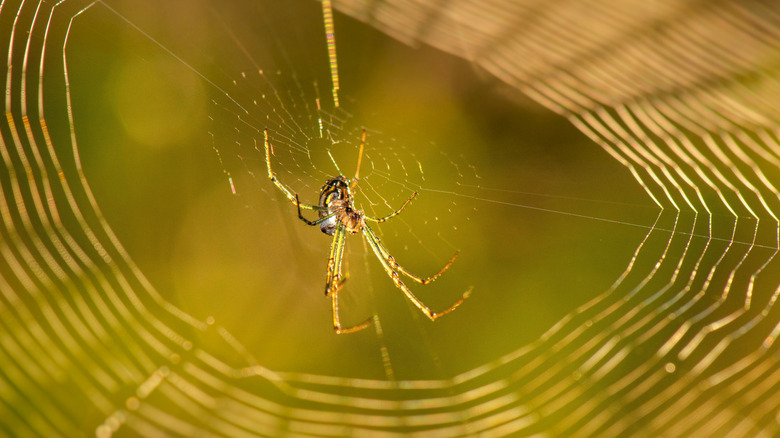
Spiral orb webs, or just orb webs, are recognizable by their spoke pattern — think "Charlotte's Web". They are made by several types of Araneidae spiders. They're also called orb weavers, like the small orange spiders in your yard, due to their web design. There are literally thousands of this type of spider across the globe, making this the most common of all spiderweb types. In the U.S., one of the most common builders of this design are the many varieties of garden spider (Argiope spp.). Orb weavers use their webs to both catch prey and as their primary shelter.
Funnel web
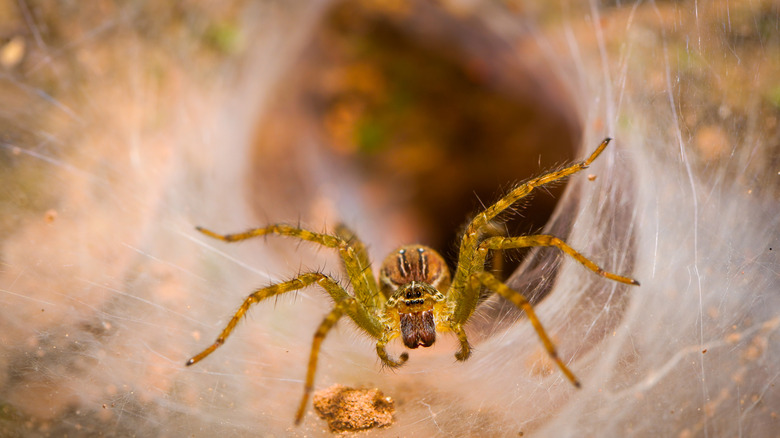
Funnel webs are, as the name implies, funnel shaped; although some may be more extended and narrow. They are found around the base of trees or in tall grass and shrubbery. In the U.S., they are traditionally made by members of the Agelenidae family, also known as grass spiders, and are generally harmless to humans. The hobo spider (Eratigena agrestis), a harmless funnel-maker native to Europe, is also now found in the U.S. Funnel webs are essentially a trap to catch crawling bugs, which is good news for you: They like aphids, flies, and other pests, and mostly stay in their funnels.
Sheet webs
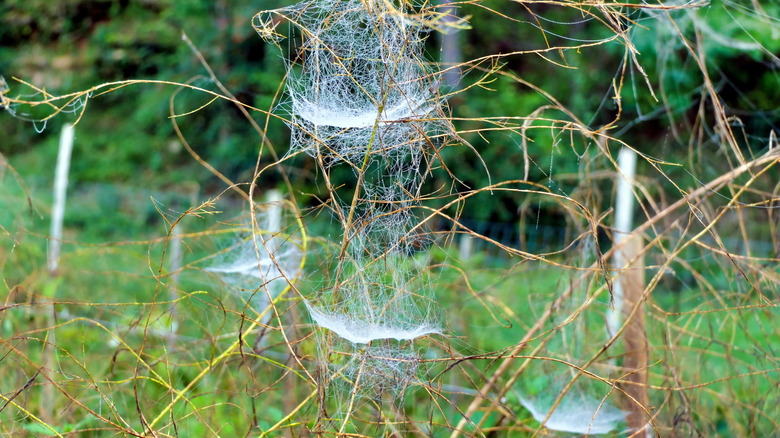
Sheet webs are more intricate than their name might suggest. The primary portion is a sort of solid sheet stretching across tall grass or bushes. But a number of clever trip-wire strands woven above the sheet mean flying insects that inadvertently hit them fall to the sheet, where they become hopelessly stuck. This version is created by tiny, rarely seen members of the Linyphiidae family. They hide beneath the sheet until their prey is subdued. Meanwhile, American grass spiders (Agelenopsis spp.) are a type of funnel weaver that create sheets with their funnels at one end. These sheets aren't sticky but make up an easily accessed "field" for these fast arachnids to hunt on.
Triangle web
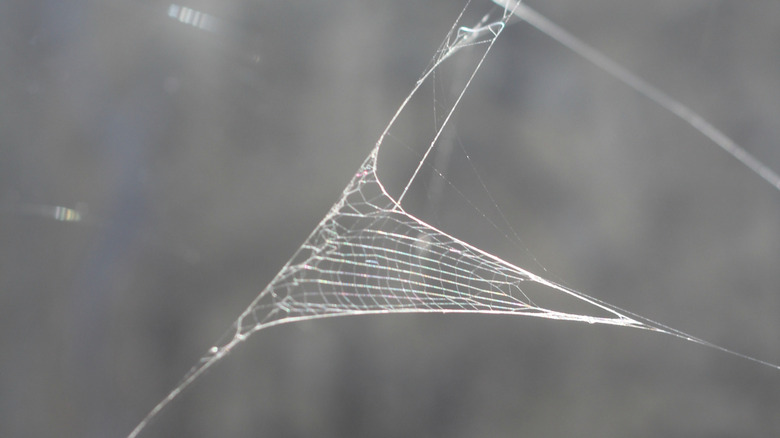
Another spider web with a descriptive name that belies its complexity is the triangle web. It does look like a triangle, with interconnected web strands laced between the primary strands. Unlike many spider webs, the triangle web is not sticky: Rather it has a fuzz-like covering similar to Velcro that secures its prey. The Triangle weaver (Hyptiotes cavatus) spider that builds these webs can pull back on a single taut strand and launch itself forward along its web at rapidly increasing speeds, faster than a cheetah accelerates. It can also use this technique to rapidly accordion the whole net onto prey by sending ripples through the web, ensnaring its victims.
Trapdoor web
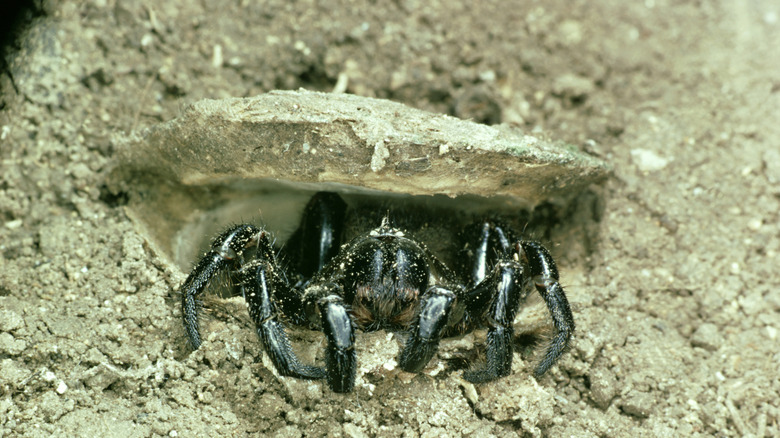
One spider web you may not recognize as a web — or even see at all — is the trapdoor web. Trapdoor spiders, which look similar to tarantulas, burrow into the ground, lining their tunnel with silk. They then weave a tight layer of silk, camouflaged with dirt and grass, to cover the opening. However, this web, which isn't technically a web, but made with the same silk and process, serves as more than just an entryway. The spiders lay in wait underneath the trapdoor until prey passes near, then leap out and pull victims, ranging from insects to lizards, into the tunnel for dinner.