

What To Do If You See A Snake On The Trail (And The One Thing To Never Do)
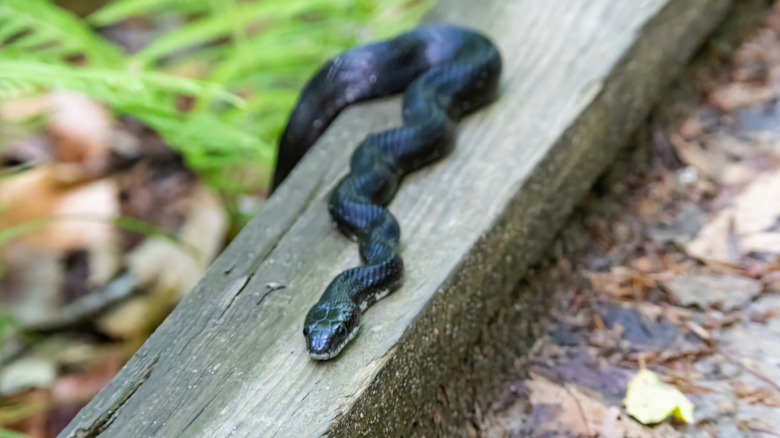
For some, running across a snake on the trail is one of their biggest concerns, while others are oblivious to the possibility, or actually excited by the opportunity. Either way, the chance to meet a snake on the trail is always there. Odds go up during certain seasons and times of year, such as at dawn and dusk during the heat of summer. In cooler periods, the middle of day is when snakes will likely be seen as they stretch across trails to warm themselves in the sun. Regardless of when or why there's a snake on the trail, it's important to know what to do — and what not to do — should you encounter one. A basic rule of thumb is to leave it alone and not try to help it along its way.
The first thing to do if you see a snake on a hiking trail is stop. Then, keep a safe distance away and watch to see if it moves off. Although most snakes can only strike or bite up to 6 feet from their position, it is recommended to remain 10 to 15 feet away, so they feel it's safe to move. If you are not that far away when you stop, back up, slowly, to provide adequate space. Most snakes you'll see are non-venomous, but they can still pack a painful bite when startled or feeling threatened.
Should the snake not move off, you have a couple of options, depending on the trail and terrain. If there is a way to maintain safe distance and pass around the snake, you can do so and continue on your way. Keep an eye on the snake while moving around it, in case it decides to flee in that direction. If detouring around isn't possible, the most prudent thing to do is to turn back.
Never provoke a snake
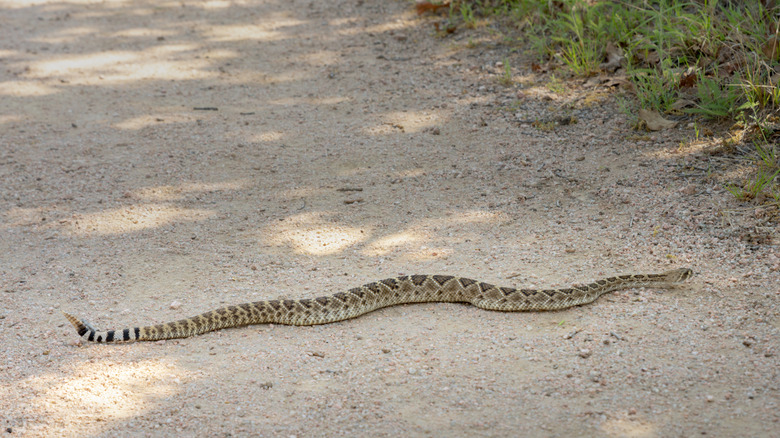
Snakes — even rattlesnakes and other dangerous types of snakes — aren't typically aggressive toward humans and don't go out of their way to strike. Rather, they would just as soon go their separate way. However, they will strike if they feel threatened. Therefore, the easiest way to avoid being bitten by a snake if you see one on the hiking trail is to not do anything it perceives as threatening. That means the one thing you should never do is provoke a snake, even if it's unintentionally.
With that in mind, do not attempt to approach, handle, or move the snake – even with a stick or other long object. In fact, trying to handle snakes is a behavior that leads to countless snakebites. You also should not try to scare the snake away as it can agitate them, nor should you attempt to kill it (it's just minding its own business). Finally, do not throw objects at the snake. This can actually have the opposite reaction you are likely hoping for and the snake very well could come closer to you instead of fleeing.
To lessen the likelihood of coming across a snake while hiking, choose times opposite of when they are most active whenever possible. Additionally, pick trails with substantial width, are well maintained and used with regularity. This makes it both easier to see snakes ahead of time, as well as less likely they will be around as they prefer to avoid active areas.