

A Common Mistake To Avoid When Getting Rid Of A Wasp Nest In Your Yard

If you've ever had the misfortune of a yard swarming with wasps, you know the sinking feeling that arises when you accept that a nest must be nearby. Though wasps are considered incidental pollinators, and provide plenty of benefits to their natural habitat, including eating lots of pests, they are quite the nuisance on and near homes, and their sting can range from extremely painful to medically dangerous, depending on your body's reaction. Obviously, the first step to diagnosing and solving your dangerous wasp problem is to locate their nests. These are commonly built under the eaves of your roof, on your home, porch, and tool shed.
Once you find the nest, you may be tempted to simply swat it down, but that's actually a major mistake. For starters, knocking down a wasp nest does little to nothing to actually alleviate your wasp population. Most of these flying insects will simply regroup and rebuild nearby as soon as they see that their current domicile has been decimated. To make matters worse, swatting a nest can make wasps very angry, causing them to swarm at you with reckless abandon.
So you'll want to avoid making contact with nests entirely. Instead, there is a simple but effective technique to safely take down wasp nests: Essentially, it's spray and run (it's a little more measured than that). Once you've eliminated the nest or nests, remember to clear away any food debris or garbage that may be attracting wasps to your yard, and keep sugary drinks covered up when hosting backyard barbecues. Though wasps can infest due to a number of factors, your best bet for keeping them at bay in the first place is to remove any potential food sources from your property.
How to eliminate wasp nests
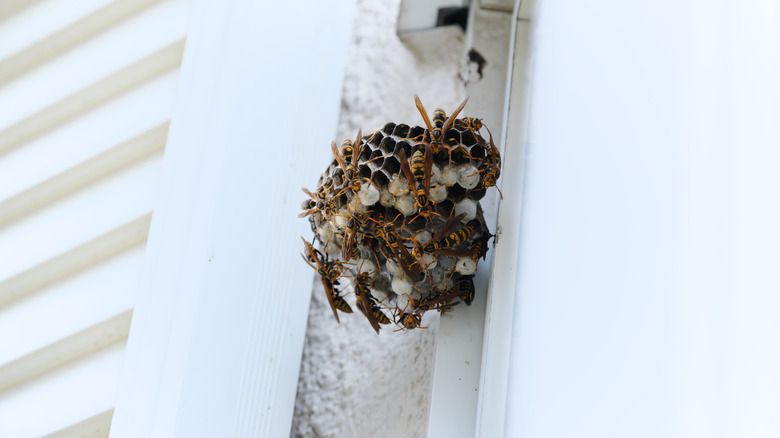
When it comes to handling their nests, skip the dangerous wasp removal hacks and focus on safety. Not all wasps are aggressive, but they are all territorial, so attacking their home is a surefire way to get them angry. If you're dealing with a particularly large or aggressive infestation, or if it's your first time dealing with this sort of thing, be sure to call in a professional. If you're determined to handle the wasps yourself, begin by approaching the nest in the late hours of the evening, when the colony is less active, and all the workers are home and asleep, leaving you with an opportunity to wipe them out all at once. Spray the nest with an aerosol-based wasp repellent, fully coating the exterior of the structure. Make sure that you're using a product that offers 10 feet or more of spray clearance, so you don't need to stand too close. If possible, use a flashlight to find the opening of the nest, and spray your poison directly into the hole. Then move away quickly.
With any luck, your wasp problem should be solved in a single spraying session. Still, you should leave the nest alone for a day or two, just to be safe. Once some time has passed, you'll be in the clear to knock the nest down (still carefully), and optionally scrub the surrounding area with a bit of soap and water. Essential oils such as peppermint, rosemary, and lemongrass are known to have a mild repellent effect on wasps as well, so it may be worth putting a few drops into your cleaning mixture. If you keep spraying down any existing nests, and removing potential food sources from your yard, you should be well on your way to a wasp-free property.