

A Drought-Tolerant Perennial That'll Shine In Your Fall Garden
A dry autumn can shorten the display of colorful leaves on trees, but this cheerful perennial will still give you a show. Yarrow (Achillea millefolium), also known as devil's nettle, dog daisy, and old man's pepper, is an ideal selection for the drier sections of your fall garden. While you need to take special care to find the best time of day to water your lawn, you won't have to worry about your yarrow. With varieties native to Europe, Asia, and North America, yarrow features stunning blooms that last into September and October. Arranged in clusters of flat, umbrella-shaped heads made up of tiny flowers, this plant can sometimes be mistaken for wild carrot (Daucus carota) or poison hemlock (Conium maculatum).
A hardy, often weedy, perennial, yarrow has long been utilized in folk medicine and is featured in many cultural practices around the world. Spreading via rhizomes under the ground, yarrow can take over areas outside of your garden, so be wary of where you plant it. However, it cannot be discounted as a valuable perennial flower to host in a fall garden for its bold blooms. It also happens to be one of the flowers that will make bees come buzzing to your garden. With its combination of drought, heat, and humidity tolerance, yarrow holds up well to harsh conditions.
Transform a dry fall landscape with umbrella-topped yarrow
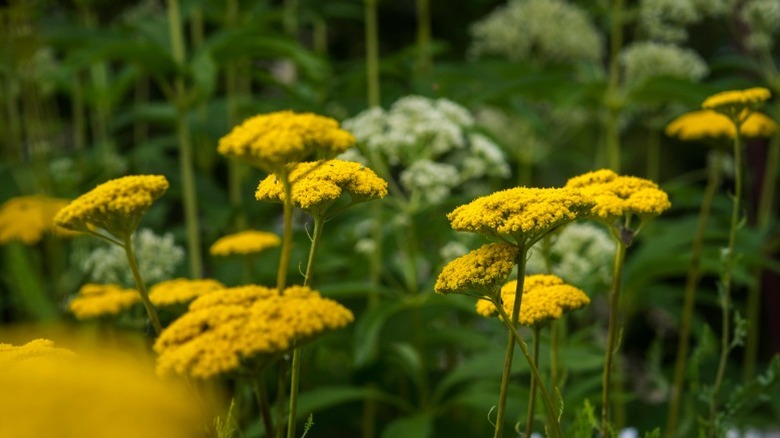
Unlike some plants that wilt with too much hot, dry weather, yarrow will actually thrive more in these poor conditions. Hardy in zones 3 through 9, yarrow often flowers later in more northern areas of the U.S., preferring cooler climates overall. You will typically see more flowers on a yarrow plant propagated in an area of the garden with poor, dry soil. Of course, as a drought-tolerant perennial, it will not tolerate wet soil. It's one of the perennials you can plant once in your garden, and it'll never leave — but only if you can avoid root rot and powdery mildew.
Growing your own yarrow for a beautiful autumnal display is really not too hard. Yarrow can be propagated via seeds from other mature plants. Be careful when collecting seeds from just any plant at the edge of a field or roadside, as cultivars bred to be less weedy might be better for most garden settings. Young plants require more consistent moisture, but once established, it works well as a low-maintenance border plant. For a really incredible look in the fall, consider planting yarrow for a gorgeous, colorful ground cover. Mix and match cultivars like magenta "Cerise Queen" and orange-pink "Salmon Beauty" for a particularly bold fall design.