

Why You Don't Want To See Blue Jays Flying Around Your Yard
We may receive a commission on purchases made from links.
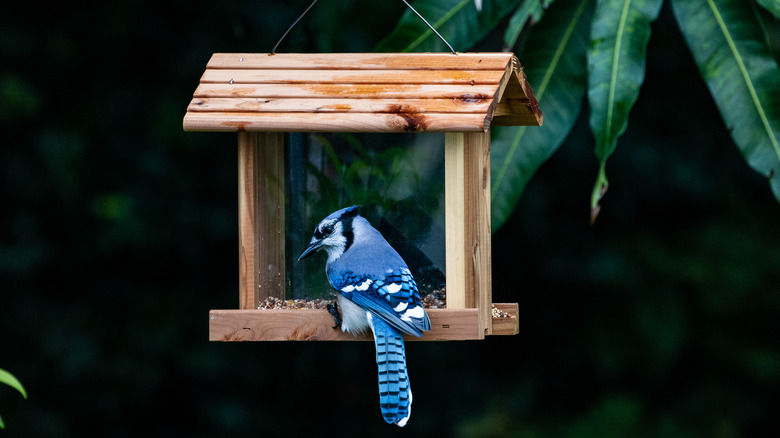
If you enjoy seeing birds in your backyard, you likely put out feeders and use other methods to attract more songbirds. Unfortunately, doing so often results in having some undesirable guests as well. You may be surprised to know that blue jays are one of the birds you don't want near your feeder or flying around your yard. This is because, despite their striking appearance, blue jays have a reputation for loud, obnoxious, destructive, and bullying behavior.
Blue jays are frequently seen from the American Midwest to the Eastern Seaboard. However, due largely to the spreading urban landscape in its natural range, the blue jay has been slowly but surely expanding its range to the northwest US. Currently, the American Southwest is the only region in the Lower 48 that is entirely void of blue jays throughout the year. This means backyard birders in roughly two-thirds of the US face the possibility of having to deal with this menacing bird.
At first glance, the blue jay is a striking creature, with various shades of vivid blues on its wings and tail, accenting its greyish-blue back and white-grey underside. Sadly, these pleasing aesthetics are usually offset by the bird's behavior. For one, blue jays are loud and bordering on hyperactive most of the time. So, for those who enjoy spending some peaceful, relaxing time in their backyard, this can be a nuisance. The loud and frequent vocalizations of blue jays can also attract predator birds, such as hawks. Additionally, they are known to be destructive, often damaging feeders, bird houses, and other objects.
Balancing the behavior of blue jays with other backyard birds
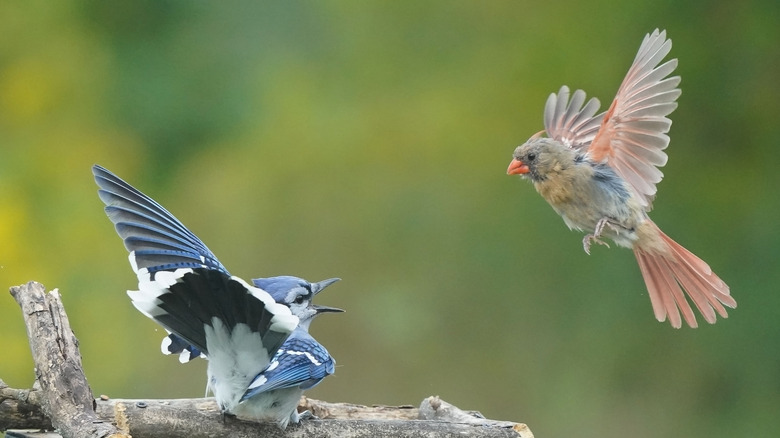
The biggest drawback to having blue jays flying around your yard is their notoriously aggressive behavior. Most notably, blue jays can be very aggressive to other bird species, greatly reducing the variety of birds you have frequenting your yard. But they are also known to have aggressive outbursts directed at household pets and even the homeowners themselves.
Unfortunately, there is really no way to selectively choose which species of birds show up in your yard. Once they've decided to hang out in your yard, blue jays are pretty difficult to convince to move elsewhere. Most often, anything you do to try to drive away blue jays will also push out the species you are hoping to attract to your yard. That's why, typically, the best you can hope for at that point is to manage the situation so that other species can peacefully co-exist with blue jays.
There are some things you can do to reduce the chances of blue jays taking up residence in your backyard. One is using feed and feeders designed for smaller birds. Caged feeders, such as the Gray Bunny Squirrel Proof Feeder, not only exclude larger birds such as blue jays, they also provide the smaller birds a level of protection while they're feeding. Likewise, tube feeders are also difficult for blue jays to utilize. Blue jays also tend to prefer bigger food items such as sunflower seeds and acorns, so utilizing smaller seeds won't be as attractive to blue jays. Should the jays continue to show up, your best option may be to put out multiple feeders in your yard, with one filled with blue jay favorites set away from the rest.