

Here's Why Some Trees Hold Onto Their Leaves Throughout Winter

When cooler weather arrives, one of the first things people tend to notice is the changing color of the leaves on trees, enjoying the breathtaking fall foliage. As the leaves change and drop to go dormant for the winter, we mourn the end of the warm months and welcome some cooler days. But some trees don't lose their leaves in the winter, standing out next to the bare branches around them.
To understand why, it's important to note the difference between deciduous trees and evergreens. Evergreens are the trees that stay green year-round, while deciduous trees are those that (typically) lose their leaves every winter. But if you've seen a deciduous tree still bearing its leaves in the depths of winter, you've probably taken a double-take and wondered if you were seeing things. You weren't, and it's actually not as uncommon as you think. The reason this happens? Well, botanists don't entirely know, but they like to speculate — it could have something to do with the tree's environment and the surrounding trees. There is, however, no reason to think your tree might be sick because it kept its leaves as the snow began to fall.
Understanding why trees hold onto their leaves
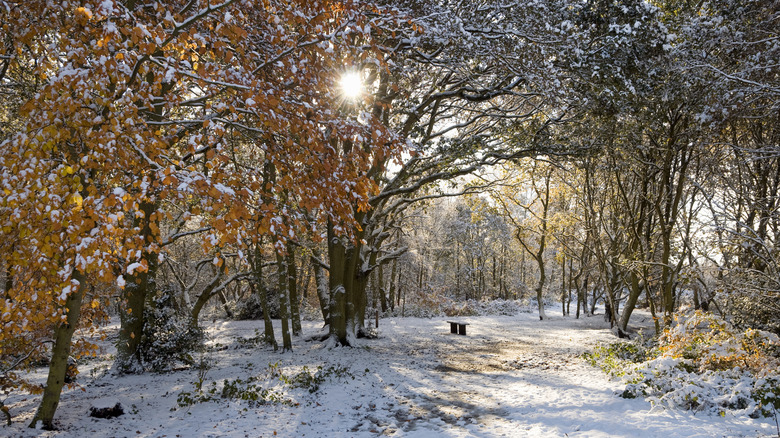
This phenomenon is known as marcescence, which describes trees that retain their brown fall leaves until spring. They keep them due to an unformed abscission layer, a separation area between the tree's leaf stem and branch, that causes them to hold onto their leaves through winter. There are some common species of trees to watch for this, including oaks, hornbeam, American beech, and witch hazels. Interestingly, this seems to happen more often in younger trees, but older trees can also occasionally become marcescent.
Trees usually drop their leaves before winter to conserve energy, as holding onto leafy branches is costly. So why don't all of them? Some botanists believe that this allows the trees to add fresh organic matter to the soil by falling in the spring, especially in areas with depleted nutrients. Of course, the falling leaves in the autumn months also work to enrich the soil by transforming leaves into fuel, but most will be used up by the time spring rolls around. Another possible reason may be that young trees are lower to the ground and often retain buds into winter, and the leaves can help to conceal these sprouts from deer and other animals seeking a cold-weather snack.
Lastly, marcescent leaves may help to deflect most of the snow from sticking to its branches by offering a sloped shelter that will direct snow away. As this snow melts on warmer days, the tree gets some extra moisture in the soil around it while keeping the heavy snow off its branches. If you live in an area with heavy snow, the leaves won't eliminate the problem entirely, so brush up on how to deal with a snow-covered tree.