

A Classic Campfire Starting Method To Know Before Your Next Outdoor Adventure
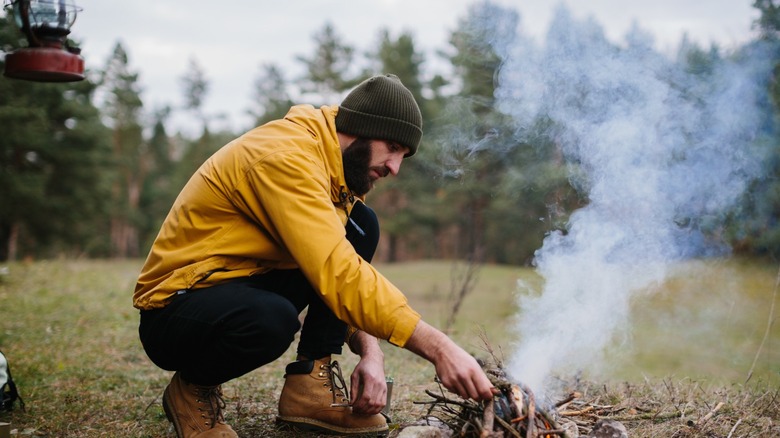
Sometimes, the fanciest ways to start a fire just do not hold up to tried and true methods. If you don't want to count on learning how to use your glasses to easily start a campfire, it's best to have a few solid options for building a fire in your toolbox. The log cabin method is a classic campfire design. Just like its name, this fire starting method resembles a log cabin if done correctly. Plus, it is considered the longest-lasting campfire method. Also known as a criss-cross fire, it takes just a little time to build.
Taking the time to learn this method before your next camping adventure will help you avoid making massive mistakes when building a campfire, such as building too big a fire. To start a fire with the log cabin method, gather your supplies near your fire pit or ring. As well as logs and matches, make sure you have some type of tinder, such as paper or dry leaves. You should also scout for small twigs for kindling. For safety, ensure that you have a reliable way to extinguish your campfire — you do not want to end up with an out-of-control fire that will ruin your outdoor adventure.
Building a log cabin fire from scratch
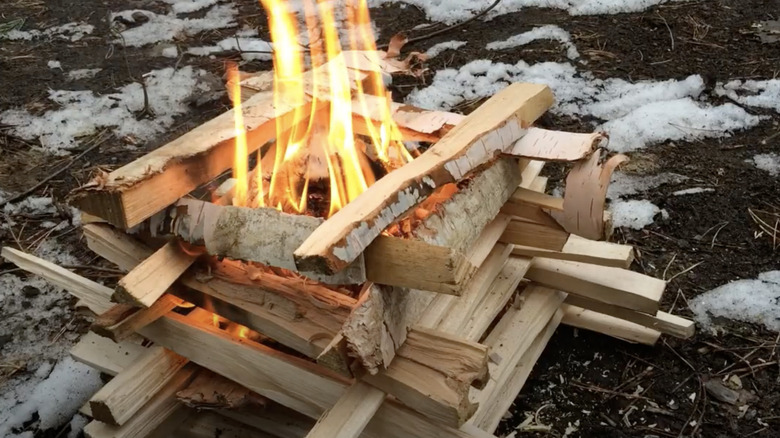
A log cabin fire needs to be set up precisely if you want it to burn steadily. Start with tinder in a pile at the center of your fire pit. Using small twigs, form a cone around it. Place two logs parallel to the kindling cone, then two more logs perpendicular, as if you are building a log cabin. Stack this structure a few layers high, incrementally placing the logs closer to the center as you go — this will give your log cabin more of a pyramid shape. After lighting the tinder in the center, top off this miniature cabin with the smallest pieces of kindling as a roof. Once the fire is going, you can continue to add logs in the same manner to keep the shape and create a perpetual fire.
Using this campfire method to start and maintain a fire ensures great air flow, which provides plenty of oxygen to feed the flames. It's also best to start with the largest logs at the bottom of your pit, adding the smallest at the top, so that they will fall into the center of the log cabin as the fire burns. The result is a bed of toasty coals at the center, which stay insulated from any wind. If you really want to expand your outdoor repertoire, make sure you know the best types of wood to use for campfires. Hardwood is ideal and will produce less smoke for your log cabin fire.