

What To Consider Before Buying A Lawn Sweeper For Your Yard
We may receive a commission on purchases made from links.
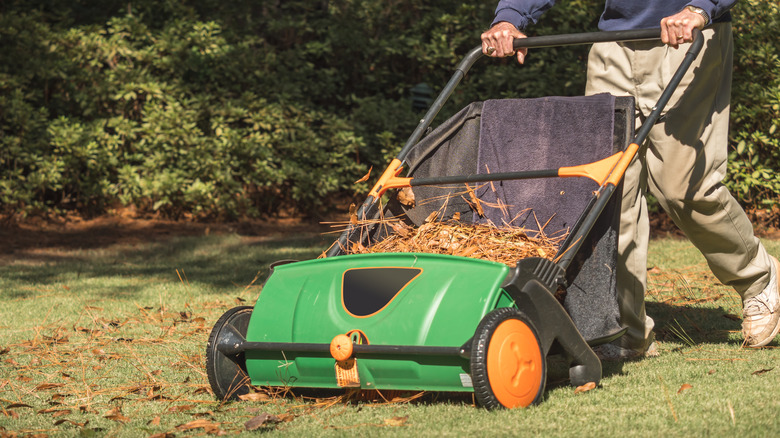
If you're a homeowner who cares for their own lawn, you may have a wide array of tools and gadgets to ensure your property line is the best-manicured thing on the block. While most home landscapers rely on tools such as lawn mowers, weed whackers, and edge trimmers to get the job done, others prefer to go above and beyond. If that sounds like you, you may be in the market for another clever gadget: the lawn sweeper. In case you're not in the know, a lawn sweeper utilizes a series of rotating brushes in order to quickly remove unsightly grass clippings even more easily than this must-try trick, or leaves or other debris from your yard. Some lawn sweepers look something like a mower in size and shape, and use a similar-looking motor. There are also non-motorized, manual push models and attachments that hook onto the back of your riding mower. It may sound a bit novel, but the machine basically works like a large, more effective version of a simple rake shovel which quickly removes fall leaves from your lawn. Why do you want a fancy rake? It can make it far easier for you to maintain a clean look across your property.
Depending on how much area you work with, a lawn sweeper may sound like either a godsend or a complete waste of money. Naturally, there are a handful of considerations to weigh out before committing to purchasing one of your own. On the one hand, they're great at efficiently cleaning up a lot of debris, particularly on large lawns, with less effort. On the other, they may be a pricey toy that takes up space if your lawn is small, doesn't require a lot of clean-up, or is particularly uneven or prone to being soaked.
The advantages of a lawn sweeper
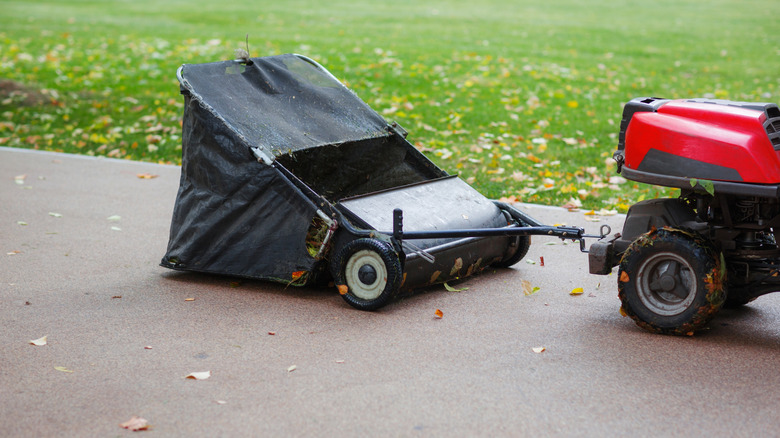
One of the biggest reasons why homeowners invest in lawn sweepers is that they save a boat-load of time. Those who spend hours scouring the lawn picking up twigs by hand and raking leaves until night falls likely need no other reason to hit the hardware store and purchase one. Lawn sweepers, especially tow-behind models for riding mowers, like the Agri-Fab 45-0492 tow-behind lawn sweeper, make quick work of any debris or detritus left on the yard. Beyond the time-saving benefits, lawn sweepers are just plain efficient, offering comprehensive cleanup of large batches of leaves and tiny pine needles alike. This thorough sweeping also helps to keep your lawn healthy year-round, as grass clippings and other left-behind organic matter can host fungal spores or disease, especially in overwatered lawns. Many of the larger models are also helpful at dethatching your lawn in the spring.
Most lawn sweepers also aren't prohibitively expensive. Some standard push models can be found for less than $100, while riding mower attachments typically run from $150-$450. While even the cheapest option is more costly than a basic rake, you'll find that the investment pays off in dividends when you don't throw your back out bending over to pick up leaves each autumn. If your lawn is especially large, you'll reap the benefits on the first use. For many, lawn sweepers seem like an ideal way to simplify the lawn care process, put the finishing touches on a well-manicured yard, with far less physical strain on the body, all for a fairly reasonable price.
Why a lawn sweeper might not be for you
While a lawn sweeper offers many obvious upsides, there are still drawbacks to be considered. For starters, these devices tend to struggle in certain conditions. User manuals for most models advise against using them on wet or lumpy terrain, or trying to pick up heavy sodden leaves. If you live in a particularly wet climate, you may find your lawn sweeper spends more time collecting dust than collecting debris from your yard. Hilly terrain can also create roadblocks, as the tires of the sweeper may dig into the grass and drag, causing more harm than good. Some lawn sweepers, particularly push sweepers, are also not rated for items like branches or rocks (though the larger tow-behind models can be great for this), meaning you may still need to rely on the classic rake method before breaking your new toy out. If you've got a small, hilly yard rife with wet leaves and large branches, you'd actually save time and money by simply raking everything up.
You'll also want to consider storage and maintenance limitations. Lawn sweepers take up roughly the same space as a lawn mower, making them unwieldy for homeowners with limited space. Before you pull the trigger on a shiny new sweeper, take a look around your garage or tool shed, and envision a second lawn mower in the space. If it seems like it would complicate your life to cram one in there, you might be better off sticking with an easy-to-store rake. Sweepers also require regular maintenance to ensure that brushes and any assemblies are in good working order, which can be a pain to juggle alongside restringing your weed whacker, sharpening your lawn mower blades, and refueling or charging batteries.