

Why Some Trees Grow With Twisted Trunks And What It Means
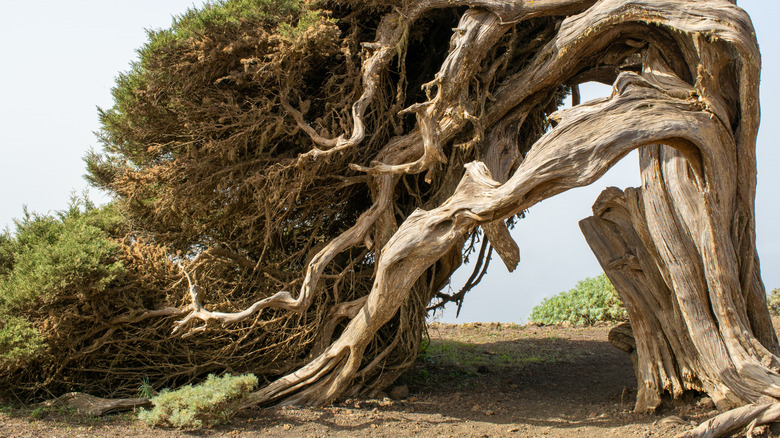
The sight of a gnarled, twisted tree can be whimsical and curious. How and why did it get that way? Is it supposed to look like that? While these questions play out in your imagination, it might bring to mind Mr. Miyagi and his bonsai trees, trained to grow in twisted and strange forms. If you're looking at an entire forest of twisted trees, you can be sure nobody took the time to train all of those trees (but you definitely want to prevent getting lost in those woods). So why are they all bent out of shape? Well, some trees grow that way on their own, and the reason makes sense.
Some of the most commonly twisted trunked trees include beech trees, the corkscrew willow, and a multitude of pine trees. Everything from Jack pine, Scotch pine, and Japanese black pine can get all tangled up. Some of these trees start life with a straight trunk and gradually get curvy as they age, and others may look curvy when they're young. Even though a twisted tree may be easier to climb, you still probably want to reconsider it as an escape from a bear. So, what makes them twisted, some more than others, even?
The reasons some trees are twisted
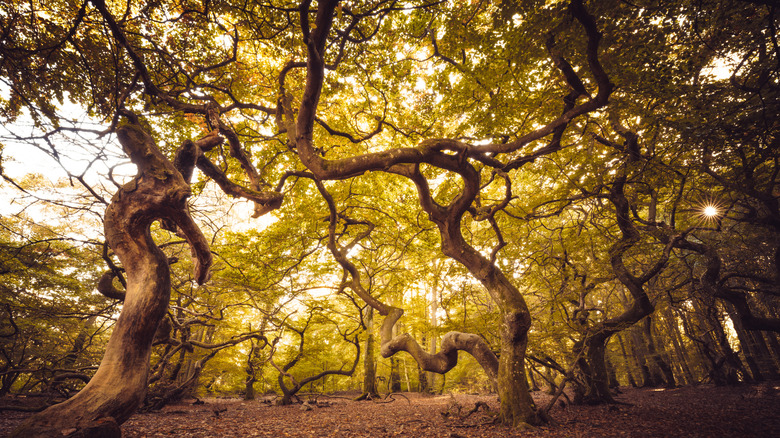
Just like we humans, trees adapt to the world around them. Some trees appear as though they're not twisted until they lose their bark, which may be a sign that the tree is dead. Bark and trunks grow separately, but bark protects the tree from the elements. Larger trees growing in windy locations or on unstable areas, like cliff sides, will grow crooked and twisted to help hold up heavy branches and stay balanced. The weird forms they take help them stay standing (think how much stronger twisted cord is than loose threads). When wind affects trees in one direction, it could be the Coriolis Effect that causes them to twist. If there is something in the way of a tree's growth, it may adjust its growth pattern as well, making it into a twisty tree. As you may notice, your indoor plants may change position depending on where the sun is shining. Some trees will track the sun, which can cause them to become twisted, also known as Heliotropism.
While some trees will grow with twisted trunks to adapt, others grow this way because that's the way they grow — it's in their genes. Corkscrew willow trees, native to China and Korea, have naturally twisted trunks and branches, which is where they get their name from.