

What's The Best Time Of Year To Go Salmon Fishing?
We may receive a commission on purchases made from links.
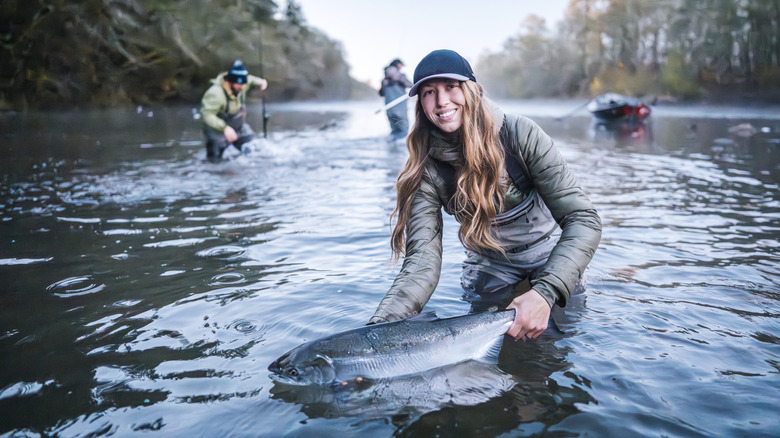
Salmon are among the most iconic fish to swim the waters of North America. They are a prized catch for commercial and recreational fishermen alike. Since they are anadromous and split their time between freshwater rivers, inland bays, and ocean waters, the best (and legal) time of year to go salmon fishing is dictated by their life and spawning cycles. Depending on the legal seasons — which vary by state, province, the target species and its population swings, and the geographic region in which you are fishing — it is possible to catch salmon from late spring through fall. However, the best time of year to go salmon fishing is generally considered to be late summer and fall.
The reason that span of time is considered prime for salmon fishing is simple — that's when the most fish and greatest varieties of species can be found in the rivers throughout the U.S. and Canada. It is also when the largest and most popular salmon species, the Chinook or king, is most populous in inshore waters and rivers. When they are found in these inshore and inland waterways, they can be caught on fly fishing or conventional tackle (there are differences). The key here is timing. Whether you are planning a trip to fish for salmon on the Pacific or Atlantic coasts or in the Great Lakes region (yes, there are salmon in the Great Lakes), plan your adventure for late summer or fall, avoiding the huge freshwater fishing mistake at all costs of going at the wrong time.
Salmon fishing on the Pacific Coast
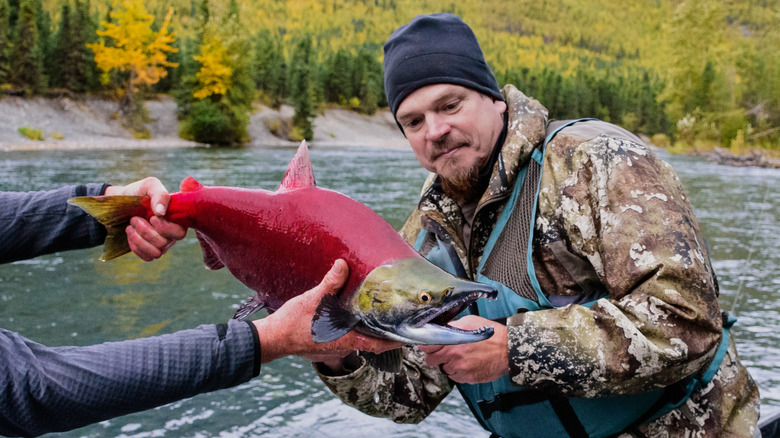
Salmon fishing on the Pacific Coast is far and away the most dynamic locale, offering the most locations and greatest variety of species. All U.S. states that border the Pacific — Alaska, California, Oregon, and Washington — have salmon fisheries bolstering local populations. Each of these states have both coastal and river salmon fishing, along with different regulations and bag limits. Sometimes those regulations may vary among individual bodies of water within those states due to the cycle and health of a local population, so always be sure to check the regulations before heading out. It's important to know, also, that indigenous peoples in the Pacific Northwest have specific salmon fishing access and rights that need to be observed and respected.
In addition to those coastal areas, Montana and Idaho offer various salmon fishing opportunities. The fish found in Idaho rivers are actually migrating in from the Pacific Ocean, up the rivers all the way to the Gem State. The fish in Montana, on the other hand, are landlocked in a handful of lakes and the rivers that feed into them.
Four species of salmon are primarily targeted by anglers on the Pacific Coast – chinook (king), coho (silver), sockeye (red), and pink. Chum salmon are also present along much of the Pacific Coast, but are not as highly prized. Additionally, some lakes in Montana have the non-anadromous kokanee salmon. The best freshwater lures and baits to throw for chinook and coho salmon include bright-colored spinners like the Blue Fox Vibrax-5, bright streamer flies, chunks of herring, and salmon roe. One strange fishing method used to catch sockeye salmon, known as flossing, involves allowing the fish to pick up the line, rather than the lure, with its mouth. The angler then slowly reels the line in until the hook is close to the fish, then sets the hook to snag the fish in the mouth.
Great Lakes and Atlantic salmon fishing
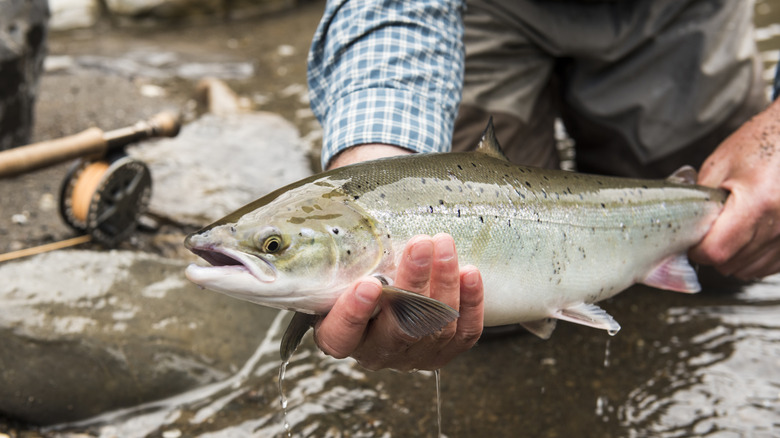
On the opposite side of the continent, the Atlantic Ocean is home to a singular species of salmon — the aptly named Atlantic salmon. Not only does the East Coast have fewer species of salmon, they are found in a much smaller area. In fact, the species that was once wide spread across the coastal waters and rivers of the Northeastern United States now has its native population range reduced to portions of coastal Maine and eastern Canada.
Although fishing for sea-run Atlantic salmon is prohibited in U.S., Maine does offer angling opportunities for landlocked salmon. However, a number of rivers in eastern Canada have fishable runs of native Atlantic salmon. In fact, for those hoping to catch wild, sea-run Atlantic salmon, Canada is the only place to do it in North America. Many of the best fishing today occurs in the province of Newfoundland and Labrador. The best lures and baits for Atlantic salmon include spoons, spinners, salmon roe, and Atlantic salmon fly patterns.
Between the two oceans, anglers will find surprisingly good salmon fishing throughout much of the Great Lakes region. In fact, it starts in the state of New York, which offers some great salmon fishing — not along its Atlantic coastline, but rather on the appropriately named Salmon River and Lake Ontario. Anglers can also get into salmon in the Midwest states of Michigan and Wisconsin. The waters of the each of the Great Lakes support various species of salmon – chinook, coho, pink, and Atlantic. Despite being landlocked, the fish actually make annual or biennial spawning runs. When they do, they can be caught from various rivers on both the U.S. and Canadian sides of the lakes. In the Great Lakes regions, most anglers use spoons, diving plugs, crankbaits, and cut herring.