

Beware Of Dangerous Waters When Swimming At This Area Of The Beach
We may receive a commission on purchases made from links.
For many beachgoers, a day at the seashore is hardly complete without a swim in ocean waters. However, the very waters that often appear so inviting can also conceal unexpected dangers that can turn a day at the beach deadly. It is quite likely you'll encounter strong currents, rough waves, and dangerous marine creatures while swimming along the beachfront. The likelihood of these and other dangers being present increase dramatically in the waters around piers and jetties extending from the beach.
Chief among the hazardous conditions you will likely encounter around structures such as piers and jetties are strong rip currents. Considering these potentially dangerous currents can occur anywhere along the beachfront, everyone who swims in the surf should know how to stay safe if stuck in a riptide. However, rip currents tend to be significantly stronger around piers and jetties. This is because the irregular breaking of waves and deflection of current around these structures feeds the energy of the current running along the shore. Typically, there will be rip currents of some strength — known as structural rips — around piers and jetties on all but the calmest of days.
Additionally, if you get caught in a rip current around these structures, you may not be able to follow the advised method for dealing the situation, which is to flow with the current until it releases you. This is because you could very well be taken into the structure, leading to a dangerous collision with the structure, getting cut on barnacles and other sharp objects, or becoming entangled and unable to free yourself. Often, fishing lines dangle from piers and jetties, which add to the threat of entanglement for a struggling swimmer.
Waters near piers present other dangers
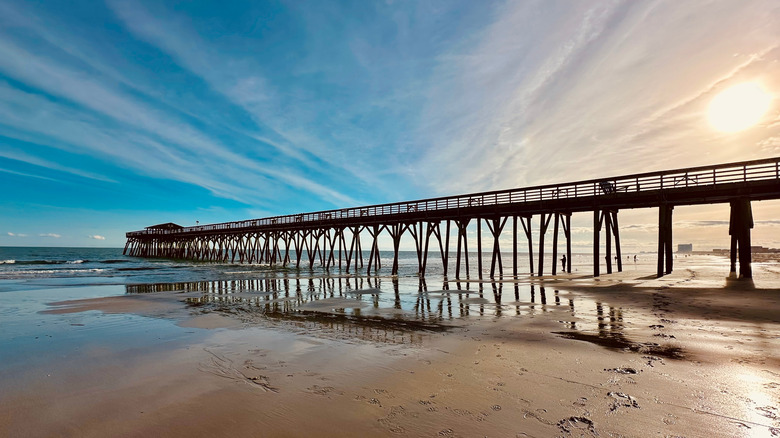
Beyond dangerous and potentially deadly rip currents, there are other perils swimmers face around piers and jetties. Like currents, wave action is often stronger around these structures. The waves in these areas can also be less uniform than they are elsewhere along the beach. The combination of churning waves and swirling currents around piers and jetties often results in a much different and varied bottom structure than in other spots off the beach. As a result, swimmers may suddenly find themselves in water that is either far deeper or much shallower than expected. Having a floatation device, such as a Stearn's life vest, can help keep you afloat if you get caught in such conditions.
In addition to the standing structure itself, the bottoms around piers and jetties are often littered with other hazards such as discarded fishing gear, garbage like broken bottles, or pieces of the pier itself that may have broken away. Most jetties have a smattering of rocks of various sizes scattered away from the main rock groin as well. Bumping into or stepping on any of these objects can result in cuts, punctures, and lacerations.
Another issue to be aware of around piers and jetties is the enhanced possibility of encounters with dangerous marine life, namely sharks. These structures provide habitat and an ideal feeding area for several dangerous types of sharks. The current swirling around piers and jetties, the fact the structure attracts a variety of smaller fish, and the presence of baits and chum from fishermen, all combine to make piers and jetties attractive areas to hang out for sharks.