

RV Tips That'll Make Tackling Challenging Mountain Terrain Easier
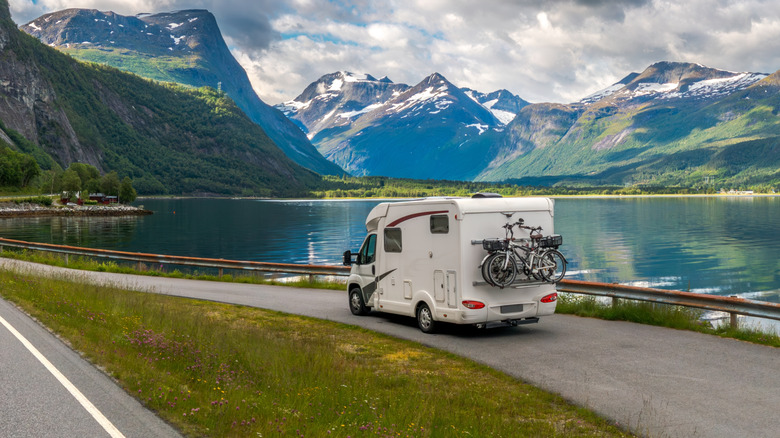
Traveling by RV brings a grand sense of adventure and freedom, and you can take incredible bucket-list road trips at your own pace. However, driving one — especially through the mountains — can be intimidating if you've never done it and stressful even if you have. Fortunately, there is an approach to keep you safe and in control without wearing out the brakes. This critical technique, called downshifting, is often overlooked by many road trippers, but it's well known among veteran RVers.
The methods of driving and controlling your RV are different from those of your car. After all, even small RVs are heavier than full-sized SUVs and require more stopping power. This is where downshifting, also known as engine braking, comes in. Downshifting at its most basic level is a means of slowing a vehicle without pressing the brakes. The process involves shifting into a lower gear, allowing the engine to control the speed, while slowly letting your foot off the gas.
Many modern RVs come with tow/haul mode. This form of downshifting is a special transmission setting that changes the shift points to optimize performance while towing. Tow/haul mode pulls your RV up hills at a lower gear and controls your speed downhill. Slow and steady wins the race; no need to white-knuckle your road trip. Practice this technique to traverse mountainous terrain with confidence and know-how. In addition to these tips, don't forget the RV 3-3-3 rule on your next road trip.
Safely driving your RV through the mountains
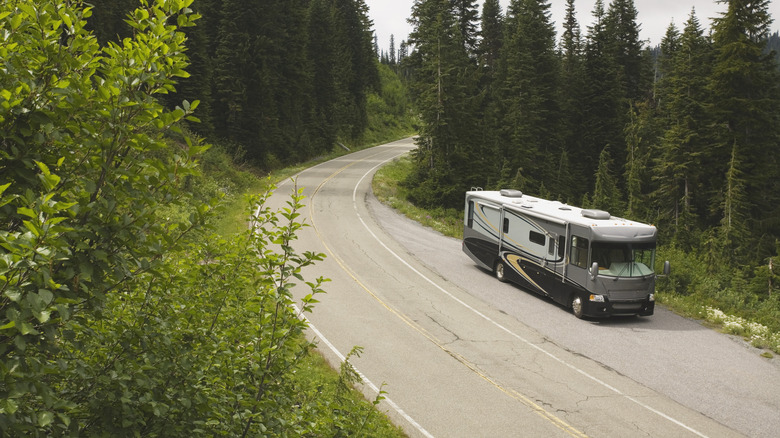
To navigate your RV safely through the mountains, start with a well-thought-out plan. Heed signs that show elevations and grade percentages. Know your route in advance, be prepared for tight curves and hills, and know where the runaway truck ramps are. They can be a lifesaver if you experience brake fade, a sudden decrease in the ability to brake. To combat this and prolong the life of your brakes, employ intermittent braking, which is pressing the brake pedal for a few seconds at a time.
Intermittent braking is a crucial method for managing hairpin turns and switchbacks, especially when piloting your rig downhill. Rather than riding the brakes down steep grades, use firm pressure but only for a few seconds at a time. Then release the brakes and let them cool down while engine braking controls the speed. Then repeat the process. This procedure, along with the following tips, will make road trips in your RV a pure joy.
In addition to a good plan, practice proactive driving. When going slow, alert fellow drivers by switching on your hazard lights (if the state you're in allows it) and maintaining adequate distance from other vehicles. If towing a car, consider having your copilot drive separately to reduce stress on the RV — and you. Rather than racing to your next destination, accept the slower pace and enjoy the scenery, and once you get to your destination, you can find out how to park your RV overnight for free.