

The Day Hike Packing Tip That'll Make You Feel Safer During Your Next Adventure

We may receive a commission on purchases made from links.
On the surface, a day hike seems like a much safer excursion than a long-haul camping trip in the backcountry. However, when you consider more day hikers get lost than any other group of outdoor adventurers, this seemingly safe activity takes on a different tone. When you add to that the fact that the survival rate of lost day hikers is lower than that of other groups, you may begin rethinking such a brief excursion altogether. However, these perils can be both avoided and dealt with by taking steps to prevent getting lost in the woods and properly packing for your day, including hiking essentials for emergencies. In fact, preparing for a day hike in a similar way that you might for a longer excursion — including packing an overnight emergency kit — is probably the most important tip for making you feel safer during your next adventure.
One packing mistake day hikers make quite often is not packing any navigational equipment, relying instead on their smartphones. Although apps can be useful for finding your way, hiking trails often wind through areas without reliable service. As a result, you could easily be stuck with no means of navigating should you wander off-trail, which is how nearly half of all wayward hikers become lost. Even GPS navigational units are prone to losing power due to dead batteries. So anytime you hit the trail for any period of time, it's a good idea to carry a basic compass like the TurnOnSports orienting compass, which needs neither signal nor charge or battery. Beyond having a compass to help you find your way if electronics fail for any reason, you need to be prepared for the necessities to make it through the night if you do become lost.
What your emergency overnight kit should contain
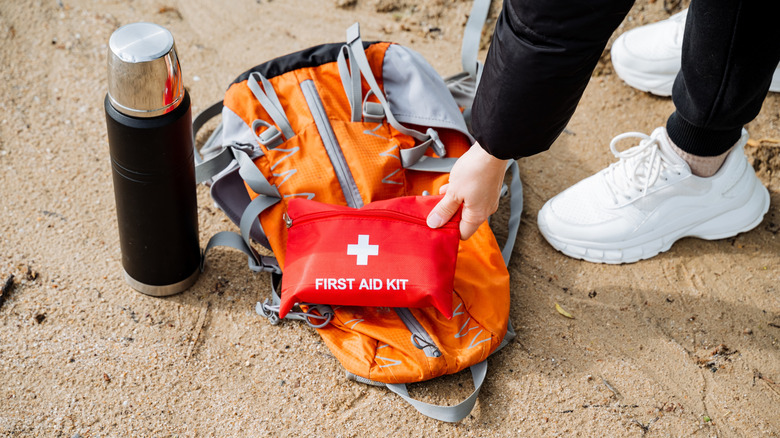
Not having adequate food, water, clothing, or shelter is what typically turns a dangerous situation deadly when day hikers become lost. With that in mind, it only stands to reason that if you are prepared with these essentials, your odds for survival are much better. However, part of the charm of day hiking is the simplicity of it. Unlike extensive backcountry hikes, day hikers are typically unencumbered by bulky gear. The key to creating an effective overnight emergency kit for day hiking is to include the essentials without becoming overloaded.
Putting together the right emergency kit starts with choosing the right backpack for your hike. Many day hikers prefer models with water bladders built in. However, you can also bring a water bottle or use a filtration device like the LifeStraw personal water filter. You should include waterproof matches and fire starter to help get a fire going, as a campfire can provide warmth and light, as well as signal rescuers. It's worth packing a signal whistle and mirror also, to help alert searchers to your location.
Of course, no emergency pack is complete without a first aid kit. While you generally don't need an extremely extensive kit on a day hike, make sure you have all the basics. Many commercially available kits, like the General Medi mini first aid kit, come well-supplied in a compact, lightweight case. The majority of these kits include an emergency thermal blanket. If yours doesn't, make sure to throw one in. A flashlight, knife, rope, snacks, and packable rain jacket round out the necessary supplies. While this may seem like overkill for a five- or ten-mile hike, you'll be grateful for the advance preparation if you ever need it.