

Basic Gear You Need For Your First Birding Adventure
We may receive a commission on purchases made from links.
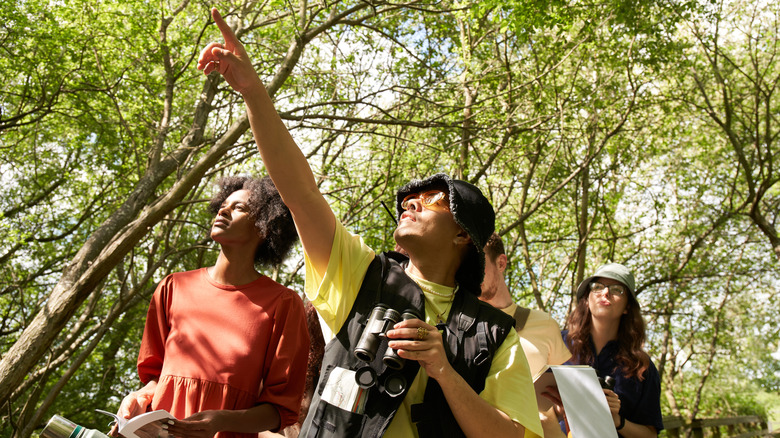
Birding, or birdwatching, is the fastest growing outdoor recreational activity, according to U.S. Fish and Wildlife. Currently over 96 million people in the U.S. — roughly ⅓ of the population — participates in some form of birding. One of the primary draws of birding is the fact it can be done with a minimal amount of equipment. However, there is some basic gear you need in order to ensure your first birding adventure is comfortable, safe, successful, and enjoyable.
While it is technically possible to go birding with absolutely no equipment, it is advantageous to have gear to help you see and identify birds, as well as keeping track of and documenting your sightings. It is also useful to have a way to organize and carry your stuff when you go afield. As you get deeper into birding, you may want to add more advanced equipment, such as spotting scopes. But you can have plenty of enjoyable, productive outings with the basic gear, especially when just beginning.
As is always the case when adventuring outdoors, it is also advisable to be appropriately dressed for the prevailing conditions and prepared for possible changes in the weather. In addition to birding-specific gear, you should also carry the 10 hiking essentials in case of emergency, so you can stay hydrated and tend to anything that may arise. However, before rushing out and spending a lot of money, it's worth looking through your stash of outdoor gear, as you likely already have most if not all you need to be prepared for your first birding adventure.
Binoculars help you spot birds better

The entire goal of birding is to see various bird species. While it is possible to view birds with your naked eye, utilizing a pair of binoculars certainly helps you spot them better. The magnification power of binoculars can aid in getting a better view of relatively small birds from a good distance away. For the purpose of birding, it is also important to have binoculars capable of giving a bright, clear view so you can better see detail and color for bird identification.
Beyond that, it should be noted that you won't always be birding in perfect weather. So it is typically worth the money to get a weatherproof pair of binoculars. Additionally, being able to see clearly at a moment's notice is important. This places a premium on the lenses being fog-proof. Finally, the binoculars should be compact so they are not cumbersome to carry. With that in mind, it is possible to spend literally hundreds of dollars on a set. However, reasonably priced models such as the Bushnell H2O 10x42mm waterproof and fog proof binoculars perform admirably at a reasonable cost.
A field guide and journal aids in identifying and tracking birds
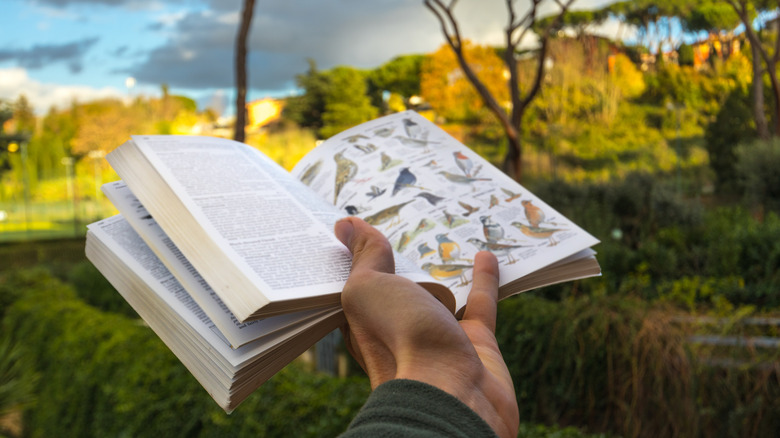
Of course, seeing birds is one thing. Knowing the difference between various species is quite another. To that end, it is helpful to carry a bird identification field guide, such as the National Audubon Society's Birds of North America. Reference guides such as this typically provide color illustrations and/or photos to match with the birds you see, as well as detailed descriptions of physical traits. Many field guides also include species-specific range maps and migration information. Since this information changes slowly, you can also pick up an inexpensive used copy to start. For those who prefer a high-tech version, there are several great apps for outdoor enthusiasts, such as the Merlin Bird ID app.
In order to keep track of which species you spot, consider keeping a field journal. Just about any notebook or notepad will work, but given the often inclement conditions experienced when outdoors, products such as the Rite in the Rain weatherproof side spiral kit, which includes a waterproof notebook, weatherproof pen, and zippered fabric cover. In addition to notating species you spot, it is a good idea to provide details of the location, weather, terrain, and time of day in your journal entries.
A backpack keeps gear organized and accessible
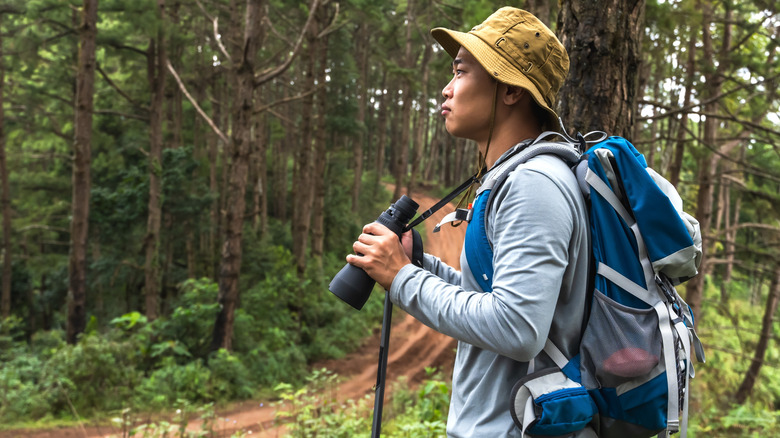
As you begin to gather your gear, it will become clear that it is cumbersome at best and impossible at worst to juggle even the most minimal number of items needed while in the field. Remember, in addition to birding gear such as binoculars, field guides, and journals, you'll need to have standard outdoor essentials such as a water bottle, sunscreen, and first aid kit. Furthermore, all this gear needs to be readily accessible and convenient to carry. For that, your best bet is a good old-fashioned backpack.
When it comes to choosing the right backpack, there are several things to consider. First is the amount of gear you will be carrying. Besides the size of the pack, features such as the number of exterior pockets aid in personal preferences as to where and how you want to store everything. In order to keep your items dry — whether from rain or from setting your pack on wet ground — consider an Earth Pak Waterproof Backpack or similar product. Whichever model you choose, make sure it is not just adequate to hold all your belongings, but also comfortable, properly sized, and easy to get on and off.
Proper clothing will keep you comfortable
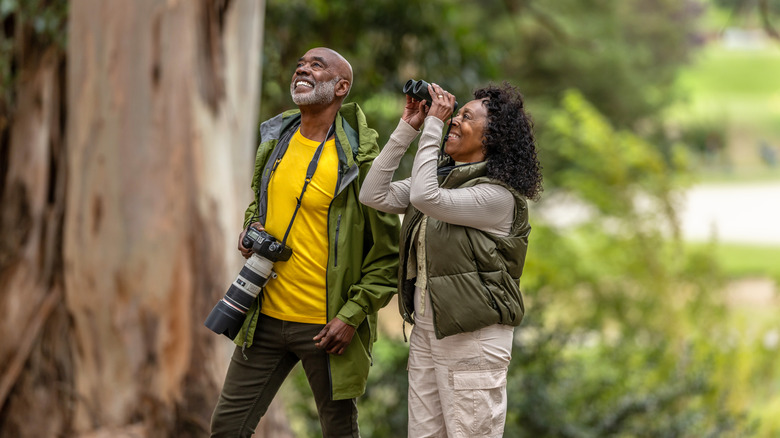
Although there are clichés regarding the way birders dress, there are actually no mandates for what to wear while on an excursion. However, it is best to avoid being too conspicuous, so try and steer clear of bright, vivid colors. It is also advisable to dress for the weather, area, and trail conditions. To that end, it isn't that different from preparing for a hike, in that you need to dress in layers during fall, winter, and spring, and try to keep cool during summer. Regardless of season, you should also have some packable rain gear handy in case the weather turns.
As with hiking, it is also critically important to wear the right footwear for the conditions. Wearing the wrong hiking shoes can be dangerous, leading to slips, falls, and other injuries. So, make sure your hiking shoes or boots are not just comfortable, but provide good traction for the type of terrain you are covering. Additionally, if you are birding in areas that are particularly prone to snakes, you may want to invest in protective garments such as the ForEverlast snake guard leggings for extra safety and peace of mind.
Bring a camera to capture images of birds you see
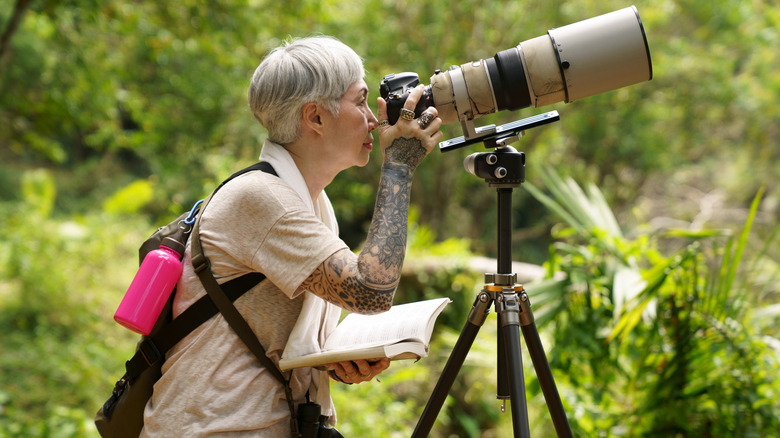
Finally, while it's certainly not mandatory, it's a nice idea to bring a camera along on your birding adventures. Taking photos is a great way to help document the species you see. In some instances, it can even help you more accurately identify them, as you can study the photos in-depth and with magnification to look for subtle nuances that distinguish one species from another.
While you will see a cadre of birders with very high-end cameras and lenses, it is quite possible to get good bird photos with much more reasonably priced equipment. There are actually a number of DSLR and mirrorless bodies offered by manufacturers such as Canon and Nikon that come in a range of price points. Versions with high resolution and stabilization features are best. Regardless of the model chosen, it should be fitted with a lens capable of 200 to 300mm zoom. Something along the lines of 24-200mm or 24-300mm is ideal.
You can also go with a superzoom camera. These cameras have a similar body to a DSLR, but the lens is permanently attached. Again, picking a version that has high resolution and stabilization is important. Given that the lens on a superzoom camera is not interchangeable, it is also important to get a model with adequate optical zoom which, unlike digital zoom, does not reduce resolution.