

Camping In Your Car May Not Be The Best Option And Here's Why
We may receive a commission on purchases made from links.
With millions of miles of roadways crisscrossing the United States, bucket list-worthy road trips are an American tradition and have actually increased in popularity in recent years despite uncertain gasoline prices. At the same time, camping has been soaring in popularity over the past decade. Many have opted to combine the two through car camping — actually sleeping in your vehicle as opposed to a tent. However, while it may be convenient, camping in your car may not be the best option. Doing so can open you up to a myriad of issues involving comfort, weather, storage space, access, safety, and more.
The first thing you should consider if you are thinking about car camping is the type of vehicle you have. An SUV or van is typically a better choice than a sub-compact sedan for a variety of reasons, starting with space for both you and your gear. Additionally, a vehicle with higher clearance and/or 4-wheel drive will allow you to explore beyond the easily accessible sites. This allows you to avoid one of the more common drawbacks to car camping — crowded conditions at campsites.
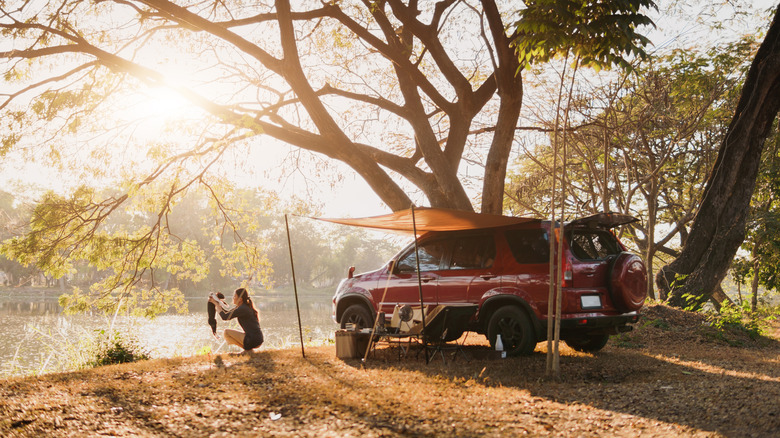
If you're restricted to a smaller vehicle, you may want to consider utilizing a small, easy-to-set-up tent like the Coleman Sundome. Even if you intend to sleep in your vehicle, this can help avoid the inconvenience of crowded conditions within your own campsite, as you can split your gear between car and tent. It can also free up extra sleeping space to provide a bit more comfort throughout the night. An attachment such as the HASIKA SUV camping tent can also extend the space you have while car camping, allowing you to open the tailgate while still providing privacy and bug protection.
Car camping can be uncomfortable
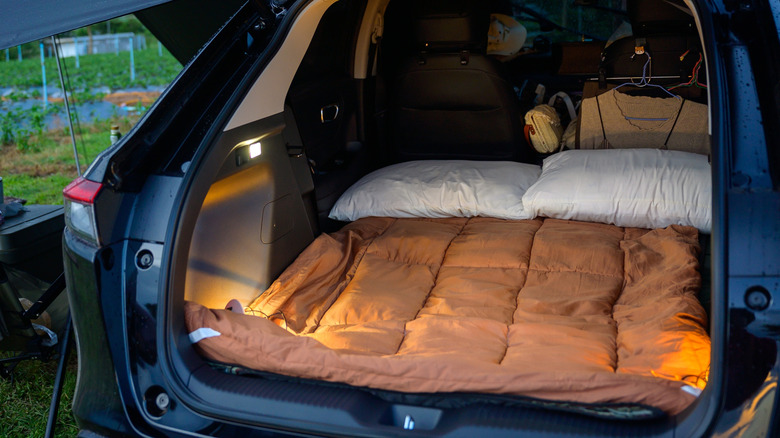
Whether you solve a limited space issue by adding a tent or by avoiding one of the biggest common camping mistakes of overpacking, there are a few other issues to deal with when car camping. For one, you will be limited to how many people can reasonably sleep in a vehicle. Typically, that number is two. Even then, the comfort may be minimal. Unless you have the luxury of a large, flat space such as that provided in SUVs or the back of a truck bed, you may have a hard time getting a decent night's sleep.
Additionally, although most campers put a premium on keeping campsites tidy by packing certain essentials, this can be tough when car camping. If you are meticulous about the cleanliness of your vehicle, this option is likely not for you. When car camping, you can expect your vehicle's interior to become dirty from sand, mud, grass, and other elements you spend the day traipsing through. If your gear gets wet or messy, expect that to impact your car's interior as well.
Finally, weather can also create some issues when car camping. While it is possible to turn on your vehicle for heat or A/C, unless you want to keep it running all night, you will be at the mercy of the weather. Although tent campers also have to deal with the elements, when car camping, you don't have the convenience of netting over the windows to keep bugs out while still allowing a breeze on warm nights. Without the windows cracked, you may find the inside of your vehicle quickly filling with condensation, regardless of the temperature outside.