

Maximize Your Outdoor Garden Space On A Budget With A Must-Try Trellis DIY
We may receive a commission on purchases made from links.
One of the challenges of backyard gardening is finding space to grow your plants, so they aren't competing for nutrients, sunlight, and water. One way to maximize the space you have is by using trellises. Plants naturally try to grow upward toward the sun, and trellises allow them to grow even higher instead of spreading across the ground. The word "trellis" comes from the French word for latticework, "trelliage." They originated in the French countryside, but the popularity of these structures grew in the 17th century when King Louis XIV had them built at Versailles. There is no need for you to employ a royal architect for your garden trellis, because they are affordable and easy to make with materials that you can buy at your local hardware store.
Growing vegetable plants on trellises is a smart idea because the trellis helps keep blooms and fruit off the ground, where they gets exposed to rot and insects. Pole beans grow about 6 feet tall and thrive on trellises, but not all vegetable plants will grow on trellises, so confirm that what you are purchasing is considered a climbing plant. Various flower species also climb and will add a colorful aesthetic to your backyard. For something sweet and fragrant, honeysuckle is a perennial plant you can plant once and it will never leave. Petunias, especially tidal wave petunias, are a popular climbing flower because they are a plant that will repel pests naturally. The great thing is, you don't have to spend a lot on a trellis. In fact, there's an easy DIY using a bit of scrap lumber and twine.
How to build a garden trellis
For this job, you'll need an power drill, screws, hemp twine from Bean Products (or any sturdy twine of your choosing), four eight-foot-long, 2-by-2 inch boards, screws, a level, and eye hooks. Trellises work well with raised beds because they provide a surface to screw the trellis' beams into.
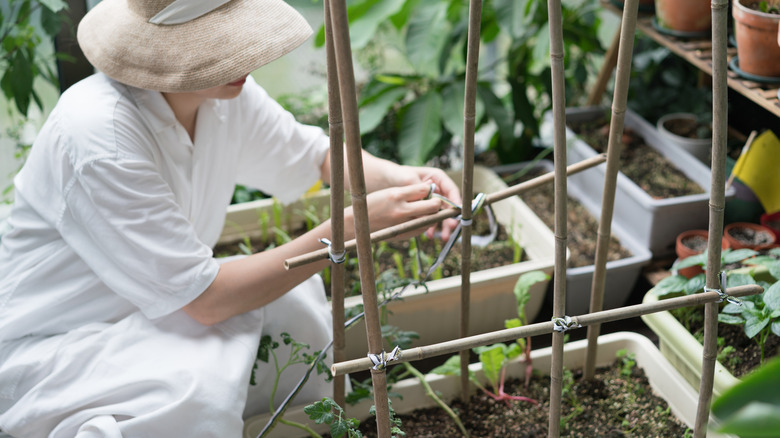
Start by screwing two of the boards into the base of your raised bed directly across from, and parallel to, each other. Use your level to ensure they are plumb (perfectly vertical) with the ground. Screw one board as a cross beam across the top of the structure, and one across the bottom of the structure, creating a box. Along these four boards, screw in your hooks and run strings through them vertically and horizontally to create a grid pattern. Plant your vegetables and flowers under the string, and they should climb it.
If you still have more seeds to plant, there are plenty of other ways to maximize space. It's usually best practice to map out a garden before you start planting. When mapping out your garden, make sure that walkways between rows are narrow and learn how companion plants impact your garden. Basil grows well next to tomatoes because the herb repels hornworms that often hurt tomato plants, while carrots work well planted next to onions, because their roots don't grow at the same depth. If you want to save time and money on hardware and enjoy even more bounty, plant corn to make a natural trellis for your bean plants.