

How To Choose The Best Boat Type For Your Next Coastal Saltwater Fishing Adventure
We may receive a commission on purchases made from links.
Thirty of the 50 United States are bordered by saltwater to some extent. Besides the oceans and the Gulf waters, these coastal regions contain countless sounds, bays, tidal lakes, rivers, creeks, and estuaries. There is almost 100,000 miles of shoreline wrapping around all U.S. coastal waters. While they all have the common element of saltwater, these coastal water bodies vary tremendously in many other ways. Having spent decades as a professional fishing guide, boat captain, and traveling angler, I can attest to the fact that no single boat is suited to fishing them all. But, the water you most commonly fish will be key in how to choose the best boat type for your next coastal saltwater fishing adventure.
Choosing the right boat for the type of water you fish is equal parts fishing function and safety. One of most common ways people die while fishing is boating accidents. This includes not just collisions with other boats, but also single-boat incidents such as capsizing and running aground. The odds of these mishaps go way up if you attempt to use the wrong boat in the wrong type of water. You also need to consider things like your fishing style and target species, as well as whether you'll regularly be accompanied by other people or taking your dog on the boat.
When, where, and how you will be launching your boat (without making mistakes) can also play a role in your decision. For example, you may intend to fish shallow, protected waters. But, if you have to cross wide open, deep water to get there from the boat ramp, you'll need a different type of boat. On the other hand, if you are considering a large boat, you need to ensure your tow vehicle has enough power to pull it.
Bay boats offer versatility
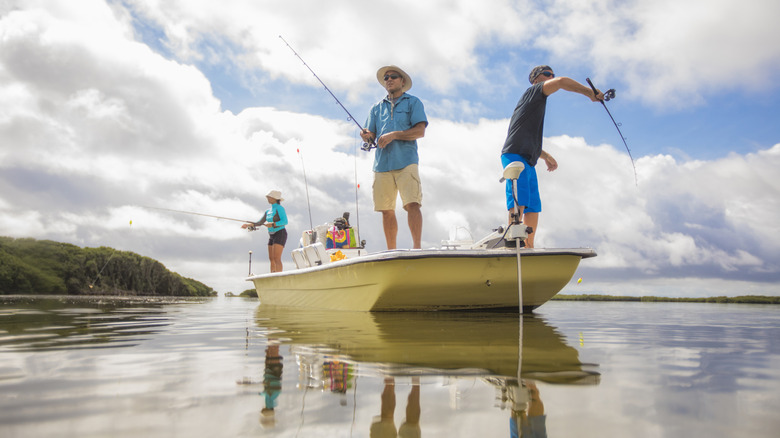
Bay boats are often cited as the best choice for coastal fishing because of their versatility. They are typically generous enough in size, ranging from 18 to 24 or even 26 feet in length, with an ample gunwhale. Most often, they have raised decks in the front and back offering good fishing areas, an adequate amount of storage, and the capacity to carry a good number of people. They also tend to run fairly shallow, but handle chop pretty well. Most bay boats have a center-console design, although they are not to be confused with the larger boats that are often referred to as simply "center-consoles." The hull of a bay boat may be flat, semi-V-shaped or V-shaped.
The very versatility that helped bay boats become so popular can also be looked at as a bit of a weakness, depending on the type of fishing you prefer. Being so versatile essentially means bay boats are a good compromise, which in itself is not a bad thing. However, for certain specialized types of fishing, they may not be the best choice. For example, while they run relatively shallow, they don't run shallow enough to access some very shallow flats. Conversely, although they handle moderate chop admirably, they can be overwhelmed by rougher conditions in deeper, wide open areas.
Additionally, bay boats are best suited for fishing while drifting or anchoring, as they are not easily maneuvered with a push pole. They can be a good choice for those who use their boats as a means to get to an area where they can get out and wade. If you routinely fish with a few family members or buddies, bay boats are a good option.
Flats boats and skiffs are good for shallow water
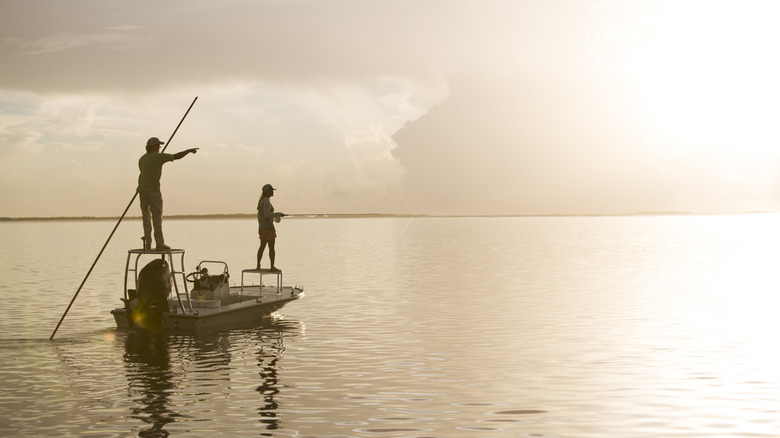
For those who spend their time on super shallow flats, a flats boat or skiff is a much better choice. Boats in these categories are designed to run and float much shallower — sometimes in only inches of water. The vast majority have a semi- or modified-V design to not only help cut through chop, but also to track true and silently when being propelled by a push-pole. Flats boats and skiffs usually have an elevated front and back deck. More often than not, they are fitted with a poling platform on the rear and/or casting tower on the front deck.
Flats boats and skiffs tend to be smaller and lighter than bay boats. This means these boats require less horsepower and can run in shallower water. However, it also means they can be bounced around pretty good when crossing choppy water, making them entirely unsuitable for running in larger, rougher waters. Additionally, passenger space is typically pretty limited, with even larger flats boats usually only capable of carrying three people at most. However, given that many anglers who are dedicated to silently fishing the shallowest of waters usually fish solo or with one other angler, this it often a moot point.
These shallow running boats can be configured as either center or side consoles. It is becoming ever more popular to run them with tiller handle outboards as well. This is particularly true of the relatively recently created category of microskiffs. Regardless of the cockpit configuration, most flats boats and skiffs are set up for functionality and sparsely appointed as far as amenities in an effort to keep excess weight to a minimum.
Center console and hybrids handle rough water well
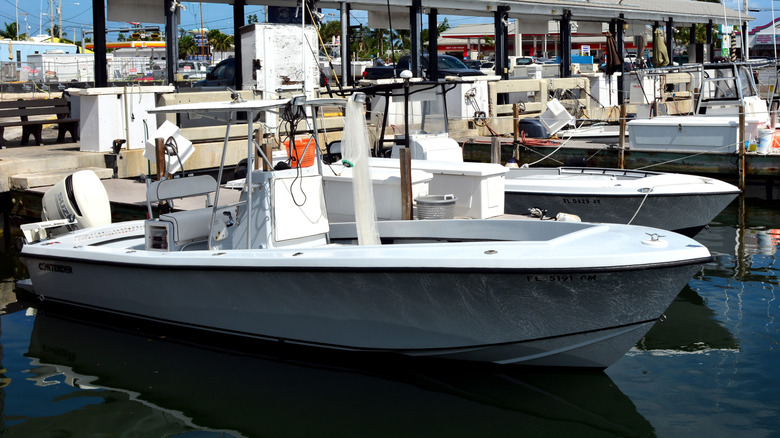
For anglers who regularly fish in deeper bays and sounds, as well as nearshore waters, center consoles hold several advantages. Traditional center console fishing boats — as opposed to bay or flats boats with a center console configuration — are longer, wider, and have a deeper gunwhale. The majority are V-hull or modified-V designs. Their size and design makes them ideal for cutting through rougher waters. They are also more stable for fishing in larger swell. These boats have plenty of storage for gear, comfortable seating, and typically are fitted with either a T-top or other shade-producing cover. Additionally, center consoles are usually capable of carrying numerous people.
The downside to traditional center consoles is that they are heavy, which requires more horsepower to push and a more powerful vehicle to tow it. They also tend to require more water to float. The deeper draft means anglers are often restricted from fishing some shallower areas of bays, sounds, and estuaries. Center consoles also typically require a bit more maintenance because of the larger hull and engine size, along with maintaining the additional equipment they are usually fitted with.
The answer to most of these weaknesses has been a new breed of boats known as hybrid center consoles. These boats take advantage of modern materials to create a lighter, shallower running version of the popular center console boats. This allows anglers to fish all but the shallowest of flats without sacrificing the ability to run in rougher waters. As one might imagine, this innovation comes at a higher price. However, while hybrids tend to have a hefty sticker price, for people looking to fish a wide variety of waters, they are usually worth the cost.
Jon boats are known for their durability
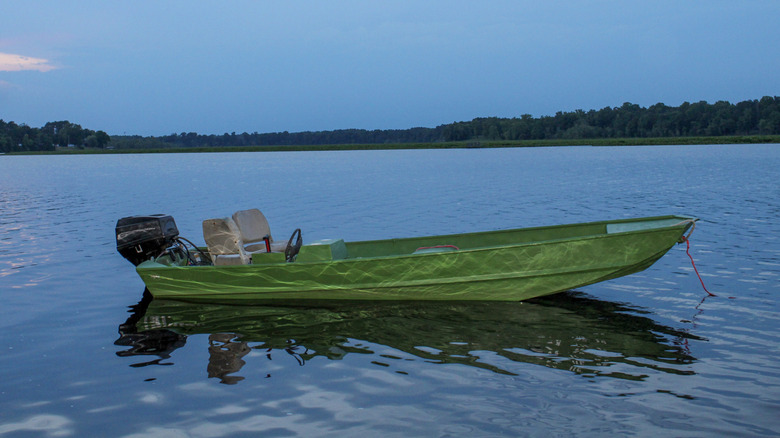
When it comes to versatility — and durability — aluminum jon boats are tough to beat. Jon boats come in a wide array of sizes. For inshore saltwater fishing, the most common models range from 10 to 20 feet, although some larger models are also used. Those looking for jon boats will often see their dimensions incorporated into their model name and number, with the length followed by the width. For example, a 1436 is 14 feet long by 36 inches wide. Wider models will usually be more stable.
The biggest advantages to jon boats are their durability, price, and the fact they are highly customizable. However, not all jon boats are created equally. Hull designs include flat bottom, semi-V and deep-V models. However, beyond their size and shape, there are other considerations with aluminum jon boats. Some models are riveted, while others are welded. As a rule, the welded models are stronger, so riveted models are best for smaller, protected bodies of water. Welded jon boats are also usually constructed of thicker aluminum.
Jon boats can be paired with a tiller engine, or made into either a side or center console. Various deck and seating configurations are possible. Aluminum boats tend to be relatively light, don't require much horsepower, and usually run fairly shallow. They are especially good choices for running in areas that are strewn with hull-eating obstructions such as oyster reefs and rock piles. If they do end up punctured, aluminum boats are also easily patched or fixed.
Fishing kayaks can be launched almost anywhere
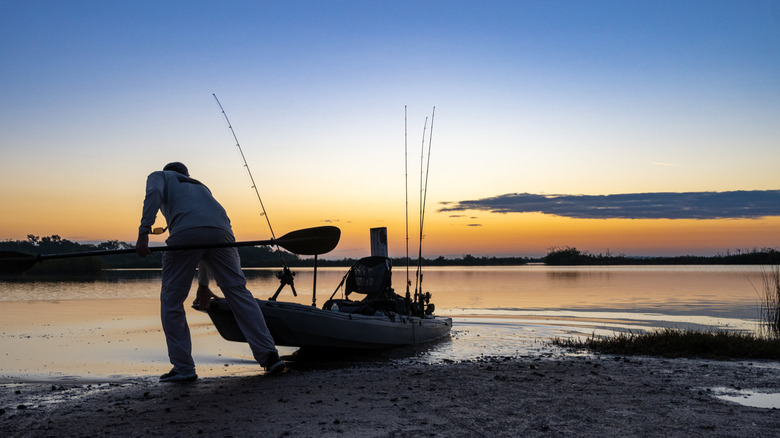
Fishing kayaks have been rapidly rising in popularity among coastal anglers over the past couple decades. Once seen as the option for those who couldn't afford a boat, kayaks have carved a niche for themselves with many anglers fishing from kayaks because they prefer the advantage these personal watercraft provide. Kayaks are the most portable of all coastal fishing boat options and can be launched almost anywhere. You don't need a boat ramp to get a kayak in the water. All you need is a small stretch of open shoreline. Additionally, they are much easier to store and transport than all but the smallest of boats.
While anglers can adapt almost any kayak for fishing, there are more and more models specifically designed for the task. These kayaks certainly shouldn't be confused with basic recreational models. For starters, they are typically wider, offering anglers a more stable fishing platform. They often are fitted with elevated seats, allowing more comfort and better vision, as well as making casting much easier. Although some kayak fishermen do still paddle, the vast majority use pedal- or motor-equipped models. Keep in mind, however, kayaks equipped with motorized propulsion are classified as power boats and must comply with all requirements for those vessels.
Many fishing kayaks are also equipped with a number of the same amenities as flats boats and skiffs. Depth finders like the Hummingbird PiranhaMAX 4 are common, as are coolers, tackle storage, trolling motors, and a bevy of rod holders. Additionally, although kayaks excel on shallow flats and in back water areas, a growing number of anglers also use kayaks for nearshore and even offshore fishing.