

5 Creatures To Beware Of When Adventuring In New York's Ocean

We may receive a commission on purchases made from links.
Although the northern border of New York state extends to Canada, its coastline along the Atlantic Ocean is considerably lower, placing it as the northernmost of the states comprising the Mid-Atlantic region. Much like the other states in this region, New York's ocean waters and the creatures that inhabit them are shaped by two distinctly different influences — the cold waters of the North Atlantic moving south and the Gulf Stream's warm current moving up the coast. This unique confluence results in a diverse set of creatures to beware of when adventuring in New York's ocean, ranging from cold-water sharks to warm-water stingrays.
New York also offers a wide array of beaches for exploration. From stretches of sand on Long Island and the Hamptons to beaches within Queens and Brooklyn, there are a number of summer hotspots for those looking to swim, surf, fish, beachcomb, or just hang out. The one thing each of these beaches has in common is there are at least one or more of these potentially dangerous creatures swimming offshore. So, in addition to packing plenty of sunscreen and snacks, before your next adventure to New York's beaches and ocean, it's a good idea to know which creatures are best avoided.
Sharks swim in these waters
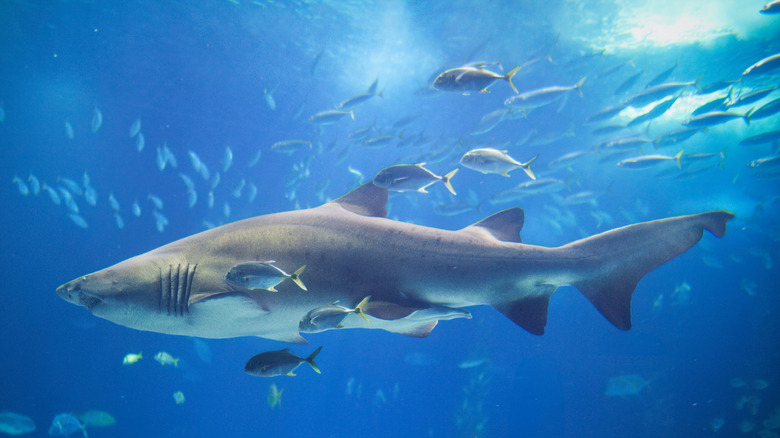
Although sharks may not be the first thing that comes to mind when you think of New York, the waters of the Atlantic Ocean bordering the Empire State have more than a dozen different species swimming surprisingly close to shore at any given time. Among these are some of the world's deadliest types of sharks, including hammerhead, sand tiger, and the infamous white shark.
Although shark attacks have been relatively rare over the past century, they have occurred. More disturbingly, they have happened at an increasing rate over the past few years, with more than a dozen shark bite instances happening on Long Island alone since 2022. In 2023, the first shark bite incident within the waters fronting New York City since 1958 occurred at the popular Rockaway Beach.
However, in spite of the recent upward trend, odds of being a shark bite victim are still minuscule, especially if you follow shark safety protocol in the water. The first rule of thumb is to never swim alone. You should also avoid swimming during the lowlight periods of the day, in murky water, around large schools of small fish, or where people are fishing or chumming the water. Additionally, don't wear shiny jewelry or splash excessively, and get out of the water immediately if you see signs that a shark is nearby.
Jellyfish are commonly encountered during summer

Although not as physically imposing as sharks, jellyfish are much more likely to be encountered by beachgoers, and thus present potentially an even greater threat. The coastal waters of New York — including Long Island Sound, the nearshore Atlantic Ocean, and New York Harbor — are home to a handful of jellyfish species on a seasonal basis. The three most likely to be encountered are the comb, moon, and lion's mane jellyfish.
Comb jellies are fascinating to look at, but don't possess sting cells, therefore present no danger to people. Although some assert they don't sting, moon jellyfish are armed with stinging cells on their tentacles and very capable of delivering a sting, albeit a very mild one. The lion's mane jellyfish, on the other hand, is among the most dangerous types of jellyfish. Brushing against the tentacles of a lion's mane jelly — one of the largest jellyfish found in the world's oceans — can be excruciatingly painful, and disembodied tentacles continue to be a risk for several days.
Given the potential for peril, it's wise for those recreating in New York's coastal waters to know how to easily spot jellyfish and well as what to do if stung by one. While in the water, keep an eye out for the bulbous shaped bodies of jellyfish. However, be mindful that the pain comes from the tentacles trailing them, so never pass behind a jellyfish that is moving through the water. Since these tentacles must contact the skin to have an effect, long-sleeve clothing or a bodysuit can offer some protection, as can applying Sea Safe Anti-Jellyfish Lotion before entering the water. If you are stung, remove the tentacles and rinse with water from the ocean. Pouring vinegar over the area is considered the most effective treatment.
Portuguese man o' war can deliver pain
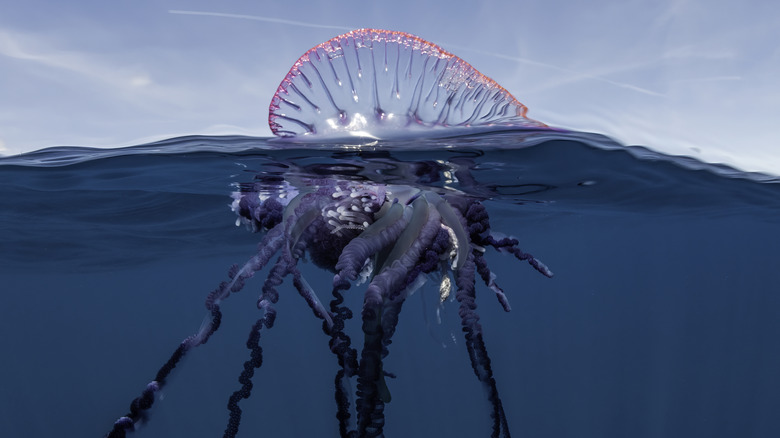
Although they are frequently mistakenly referred to as jellyfish, Portuguese man o' war are not (instead they are a siphonophore), despite their similar appearance and ability to inflict a singing sting (they are closely related). In fact, man o' war are actually not even a single creature, but rather a group of organisms that work as one to meet their collective needs. To that end, the most visible portion of a siphonophore is the purplish-blue balloon or sail that floats atop the water's surface. While this portion of a man o' war is harmless, the trailing tentacles, which are usually around 30 feet long (and can stretch up to 100 feet) on mature specimens, are covered in stinging cells. Although they are designed to immobilize small fish and other prey, they can cause severe pain, rash, and welts on humans.
Because they ride on top of the water, man o' war are typically easier to spot than jellyfish. However, due to their long tentacles, they can be more difficult to avoid. The safest option is to give them a wide berth and avoid moving downcurrent of one if possible. Even if they are on dry sand after washing up on the beach, man o' war are still able to sting for weeks, so never attempt to touch or handle one. If you are stung, remove any remaining tentacles using tweezers or gloved hands. Then immediately rinse with water from the ocean. If possible, rinse with hot water, which helps break down the toxins. However, unlike jellyfish stings, you should not use vinegar on a man o' war sting, as it can actually worsen the stinging.
Lionfish have a surprising presence in New York's ocean waters
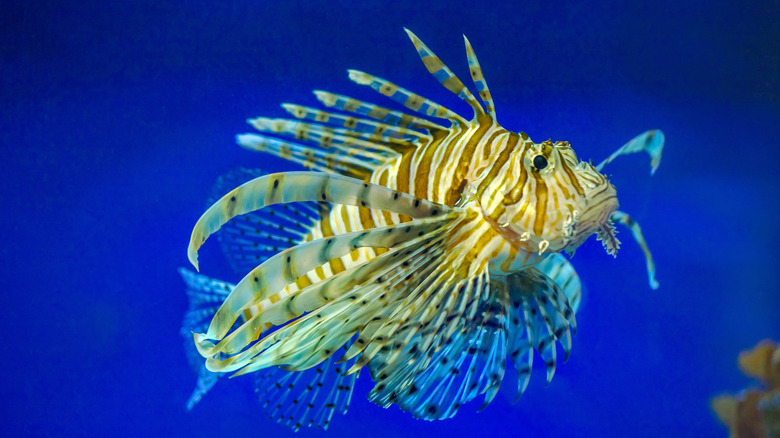
Appearing almost as if they came from another planet, lionfish are one of the venomous creatures you should beware of during your next trip to the ocean. Given they are armed with spiny fins loaded with venom, it is no surprise they are best avoided. The surprise is they are in New York's ocean waters, given they are native to an entirely different ocean half a planet away. Originally hailing from the Indian Ocean and westernmost waters of the Pacific, lionfish found their way into the Atlantic basin. Although they are predominantly found further south — around Florida and in the Caribbean Sea — lionfish have been confirmed off the New York coast. Most sightings happen in the summer and the common theory is they ride north on the warm currents of the Gulf Stream.
The good news for those adventuring in New York's ocean waters is lionfish use their venomous fins as defensive weapons, not to attack. As a result, they pose no risk to people unless they are being handled or accidentally stepped on. This means those handling them, such as fishermen or divers, are the ones most prone to being punctured by their fins. If you are in a situation where you need to grab a lionfish, such as having to unhook it from a fishing line, it is advisable to wear gloves. Should you be stung by a lionfish, you should thoroughly wash the wound site, being sure to remove any debris or spines remaining in the skin. Then soak the wound in hot water for up to an hour-and-a-half (being careful not to burn yourself). Finally, apply cold packs to the affected areas.
Stingrays are a seldom seen danger
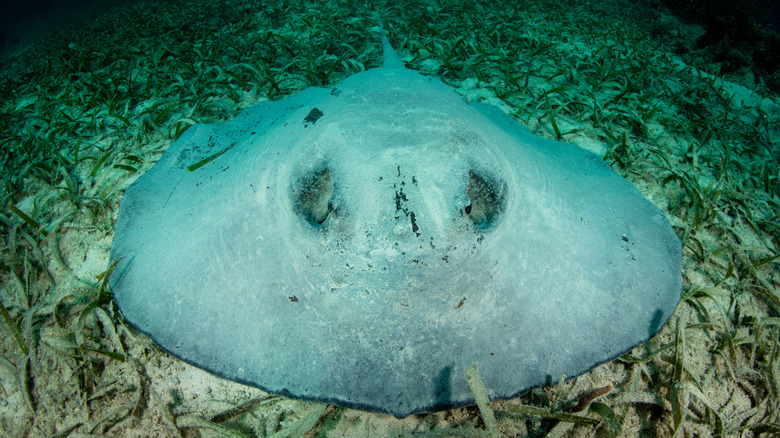
Stingrays, particularly roughtail stingrays, do occur all along the Atlantic shoreline of the United States, including the waters off the coast of New York. While some notable specimens have shown up in these waters, including the 400-pounder that garnered national attention when it was pulled from Long Island Sound by a research crew in 2023, they aren't nearly as common in the Mid-Atlantic as they are further south. Though behemoths like that rarely get in shallow enough water to encounter people, smaller ones occasionally do. So, it's a good idea to know how to protect yourself from a stingray while wading or swimming in the ocean.
Stingrays, though largely peaceful, are able to inflict serious injury with their venom-filled, barbed spine located at the base of their tail. Most often, people are injured after stepping on a stingray. The best way to avoid such an encounter is to keep your feet in contact with the bottom and shuffle along rather than taking full steps. If you are stung by a stingray, get out of the water right away. Clean the puncture wound as much as possible, removing any pieces of the barb that may have become stuck. Then, soak the wound in hot water and get medical help as soon as possible.