

How To Safely Handle And Release Fish

We may receive a commission on purchases made from links.
A growing number of anglers purely practice catch-and-release. In fact, certain areas — including some of the best fishing spots in national parks — are catch-and-release only. Anyone enjoying this style of fishing needs to know how to safely handle and release fish. Even anglers who plan to harvest fish for a meal will often be in a situation where they need to release those that do not meet size restrictions. However, just because a fish is returned to the water does not mean it survives. Proper handling is required to ensure it is returned to the water healthy. With that in mind, it's important for all anglers to familiarize themselves with proper catch-and-release techniques before their next fishing trip.
Ensuring the survival of released fish actually begins before you even get to the water. This means not only knowing how to handle and release a fish safely before making your first cast, but also being prepared ahead of time with the proper equipment. Not having such items with you is an angling mistake to avoid and can compromise the safety of both you and the fish. At the top of the list is a landing net with fish-safe rubber mesh. When targeting larger or toothier species, it is also a good idea to carry a lip-gripper like the Snail Trail floating fish gripper. You should also always carry needle nose pliers or forceps for hook removal.
In addition to having the right landing and hook removal gear, how you fight the fish can also impact its survival. This is particularly true in summer when fish quickly become fatigued. So, whether using fly fishing or regular fishing gear, be sure your equipment is adequate to quickly subdue fish and do not extend the fight longer than necessary just for sport.
Proper handling and hook removal
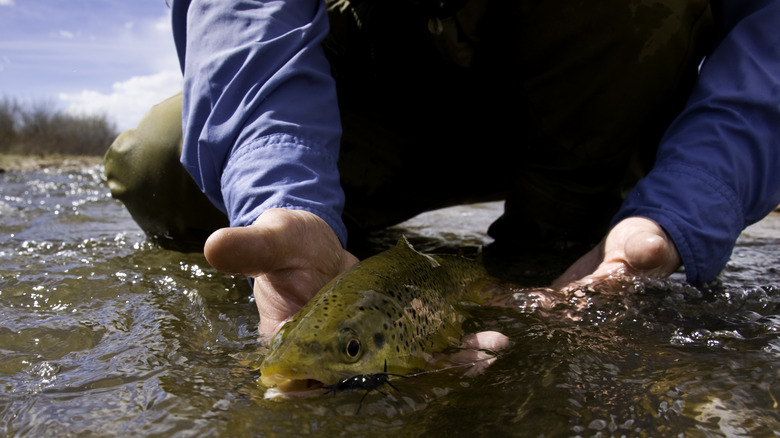
When it is time to land the fish, scooping it in the net and allowing it to remain in the water is the best and safest practice. However, some species and sizes of fish can be safely landed by hand. These fish should still be allowed to remain in the water as much as possible, which typically can be done by cradling them in your hands. However, whether landing by hand or with a net, be sure to wet your hands before touching the fish. Fish are covered with a protective coating of mucus. Touching them with dry hands will remove this coating, allowing bacteria and other possible infections to set in.
Of course, in order to release a fish, you first need to remove the hook. Anglers who regularly practice catch-and-release often use barbless or circle hooks to make this task easier and less stressful for the fish. Regardless of the type of hook being used, it is important to remove it promptly. Before removing hooks from larger, hard-to-handle, and/or toothy fish, you may need to secure them with a lip gripper tool first. Another helpful trick is to turn the fish upside down. When this happens, they transition into a somewhat catatonic state and remain nearly motionless until they are upright again.
Once the fish is secured with either your hands or gripper, use forceps or pliers to grasp the hook by the bend. Then, use a sharp, quick motion to force it backwards. Be sure your line is slack before attempting to remove the hook. If the hook is too deep to reach or has entered the fish's stomach or gills, the best bet is to cut the line close to the hook and leave it embedded.
Reviving and releasing the fish
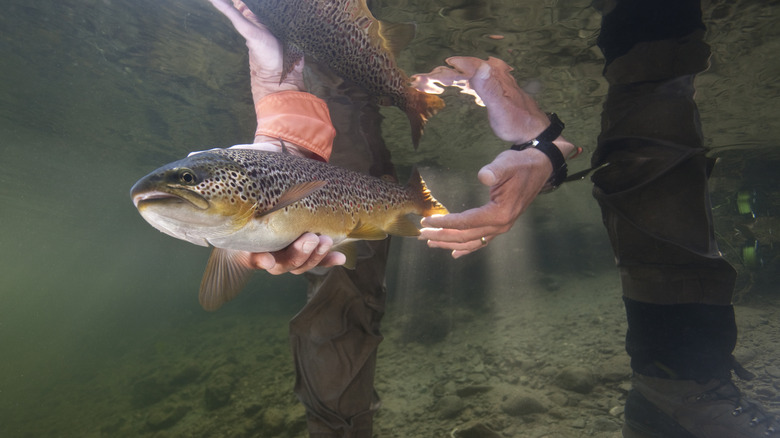
Once the hook is removed, it is time to send the fish on its way. However, there are steps you need to take in order to ensure it is ready to swim away strong and survive. If the fish is in a net, lower the net to just into the water to guard against the fish floating out before it is ready. Gently hold the fish upright, making sure it is completely underwater. If there is moving current, face the fish into the flow, as the moving water will provide a steady supply of oxygen to their gills. However, if the current is exceedingly strong, move the fish into calmer water to revive and release it.
If there is no current flow, you can gently move the fish to force water over its gills. The key is moving them forwards. Moving them backwards can actually cause them to drown. In order to avoid this, some advocate moving them in a figure 8 pattern, while others suggest wide loops. As they regain their strength, they will be opening their mouths and gills more forcefully and breathing on their own without assistance. When they are strong enough to swim away on their own, lower the net, release your grip, and allow them to swim off.
If fish are not moving well enough to swim away on their own, do not release them. Spend as much time as necessary to allow them to recover and regain strength. Sometimes, fish are sluggish due to lactic acid which builds up in their muscles during the fight. One way anglers can help them recover from this is to move their tail back and forth with one hand while supporting the weight of the fish with the other.