

How To Choose Between A String Trimmer And A Brush Cutter For Your Overgrown Lawn
We may receive a commission on purchases made from links.
There are a myriad of lawn and garden tools available to tackle just about any task you may encounter during your lawn maintenance duties. One of the secrets professional landscapers know is choosing the right tool for the job can make all the difference. If you find yourself routinely needing to cut or trim vegetation in areas your mower can't manage, you likely will need to utilize either a string trimmer or brush cutter. However, it is important to understand these two tools so you know how to choose the right one for the job.
These two implements are actually fairly similar. String trimmer, as you most likely can deduce from the name, uses string to cut through weeds and grass. Typically, the larger the diameter of the string and more powerful the engine, the denser the vegetation it can cut. Brush cutters look very similar. However, instead of having a head with fast spinning string, brush cutters are fitted with metal blades or a metal cutting disc. There are some models that come with interchangeable heads, allowing you to switch between string or metal cutting edge, but most often you'll have to choose between the two separate tools.
Another similarity between string trimmers and brush cutters is each has models reliant on various power sources: gas, electric, or cordless (battery-powered). Generally speaking, the advantages of gas models is they are very portable, tend to be more powerful, and have unlimited run time — assuming you have plenty of gas. On the downside, they are also heavier, louder, and at times hard to handle due to vibration. Electric models are quieter, light, and easy to maintain, while cordless models have the same unlimited range as gas engine versions.
String trimmers are good for routine lawn care
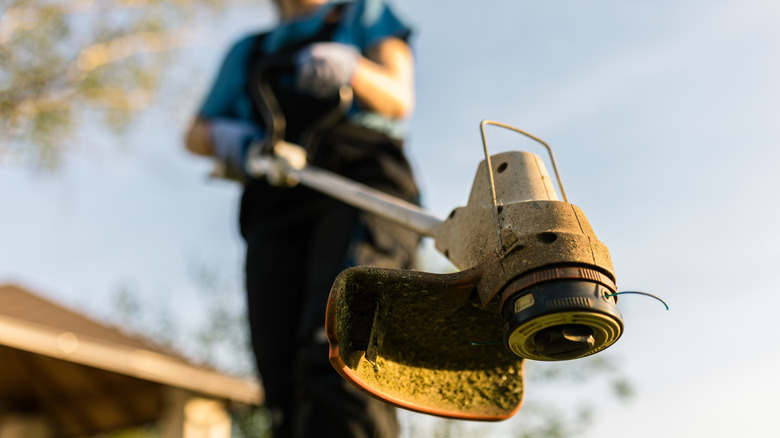
String trimmers, which are often commonly called weed eaters or weed whackers, are designed to handle relatively light trimming and vegetation clearing. They are most commonly used for cleaning up small areas of grass around trees, along fences and edges, and other areas that lawn mowers can't quite reach. Many models, such as the Black+Decker 20V Max Cordless String Trimmer and Edger, are also designed to be utilized to edge along sidewalks, driveways, patios, and other flat surfaces.
If the vast majority of your use for the implement will be restricted to trimming a fairly well maintained lawn, just about any string trimmer will do. If you are also in the habit of trimming larger areas, such as ditches or a bit thicker brush, then you will need to ensure you get a model with sufficient power to handle the task. Just as one of the common mistakes when buying a lawn mower is to choose a model with insufficient power, so it is with string trimmers as well. When in doubt, it is best to err on the side of more power, which will come in handy in the event you should need to utilize it to cut denser vegetation than you originally anticipate.
The other consideration is the power source. For small, well-kept lawns, corded electric models will suffice. However, for larger yards, it is best to go with either gas or cordless string trimmers. If your trimming duties typically take more than an hour, gas is likely the better option. Should you choose a cordless for such elongated sessions, an extra battery is a wise purchase.
Pros and cons of brush cutters
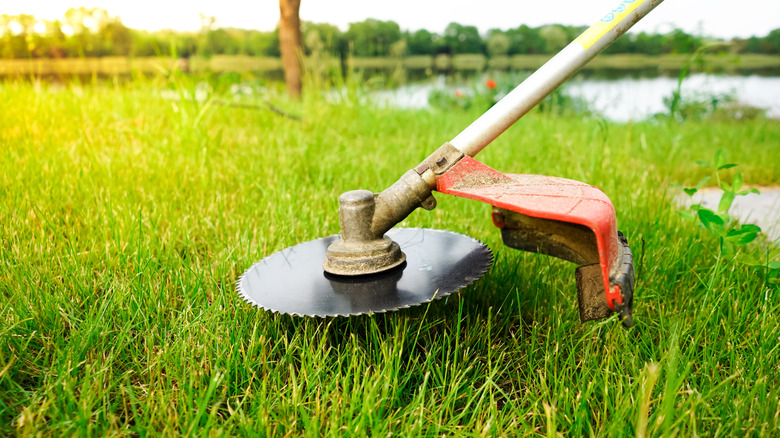
In many ways, brush cutters are essentially beefed up versions of string trimmers. They are designed to cut through not just grass and stalky vegetation, but even thick vines and small branches and limbs. So, while string trimmers are ideal for simple lawn maintenance, for severely overgrown yards or areas that are prone to underbrush growth, such as vines, saplings, and shrubs, a brush cutter is the better choice. While string trimmers can be used for some moderately heavy work, such as trimming high, dense grass and small vines, such duty tends to result in excessive line breakage. Furthermore, string trimmers are much more limited on the density of brush they can cut through than are brush cutters.
Additionally, brush cutters can be used for cutting grass. This may lead to the question of why use a string trimmer at all? Well, although a brush cutter can be used on grass — and edging, for that matter – its metal blades are unforgiving. While the nylon strings of a trimmer may do some damage should they contact brick or wood, the high-speed spinning metal of a brush cutter will do severe damage. Plus, they are very prone to throwing rocks, gravel, and debris.
Like string trimmers, brush cutters can be found in gas, electric, and cordless models. However, since most of the heavier use that brush cutters are best suited for takes place away from a readily available power source, gas and cordless models are most practical. Additionally, several models of brush cutters are designed to accept a variety of accessories, which can be utilized for various lawn care tasks.