

Reuse A Common Household Staple To Protect Small Plants From Birds
We may receive a commission on purchases made from links.
Many gardeners and backyard birders enjoy having songbirds flock to their yards. However, with the exception of trying to attract hummingbirds to your garden to help with pollination, most would just as soon not see these feathered creatures among their cultivated plants. This is because some birds can do a great deal of damage to fruit and vegetable crops, helping themselves to just about any ripening food items, digging up seeds, and eating seedlings. It can be a problem whether you are growing plants in a raised garden or an in-ground bed. However, you don't have to look far for a solution, as you can reuse a common household staple to protect small plants from birds: Think jugs, bottles, and crates.
Physical barriers are among the best ways to keep birds away from your small plants. While items like netting and mesh wire are often used as protective mechanisms, if you glance around your house and garage, you will likely find everything you need to take care of this pesky problem. Depending on the item, it may be able to be used just as is or need slight modifications. Either way, crates, jugs, and bottles are an inexpensive and effective way to protect your small garden plants from birds.
How to use crates and bottles to protect small plants
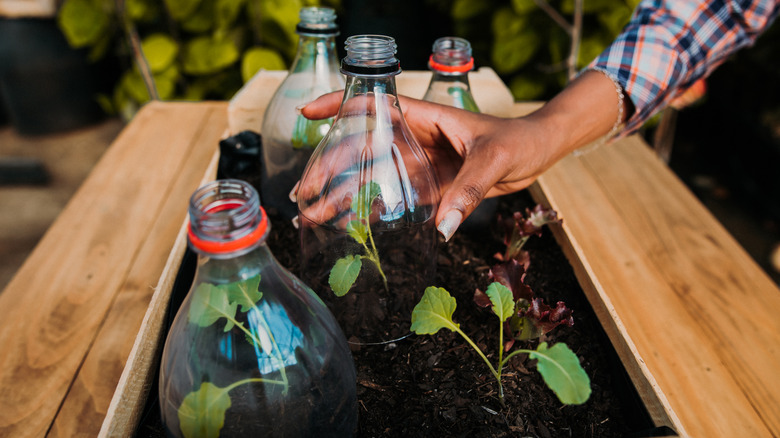
Plastic jugs and bottles are frequently used to help keep plants warm, as they tend to generate a mini-greenhouse effect. However, they also create a physical barrier that prevents birds from tearing into them. Preparing them for use as plant protectors is relatively easy. Start by gathering the appropriate size bottles and jugs based on the size of your plants — quart, 2-liter, gallon, and so forth. Remove the lids and thoroughly rinse the empty bottles. The lids can be discarded or put in the recycle bin, as they aren't needed for this project.
At that point, using a sharp knife or box cutter, cut the bottom off the bottles and jugs. The tops can then be positioned over each individual plant. However, some gardeners advocate for hardening the bottom edge to add stability. To do this, place the bottom of the bottle on a non-stick skillet that is simmering on low heat. Gently push the bottle down as it begins to melt, which should cause the plastic to roll inwards. While the edge is still warm and soft, move it from the skillet and push it over a large, upside-down glass measuring cup — 2 or 3-cup models work best. Once it is cooled, it can be set over the plant.
Using plastic or wire crates is even easier. Simply gather the appropriate size crates — utilizing those with multiple openings to allow plenty of air and sunshine to reach the plants. If you don't already have suitable crates on hand, models such as the Sterilite Storage Crate can be purchased and utilized year after year to protect plants. To keep birds off your plants, turn the crates upside down and place them over them.