

An Eye-Catching Heart-Shaped Flower That'll Lure Hummingbirds To Your Garden
We may receive a commission on purchases made from links.
If you, like many backyard birders, are hoping to see more hummingbirds in your yard, there are several things you can do. Hanging hummingbird feeders is an obvious choice. You can also add a water feature to keep hummingbirds cool and hydrated or find the perfect spot to place a hummingbird swing in your yard. It has also been shown that adding the color red can attract these birds. This can be done by tying colored ribbons around trees or growing plants that attract hummingbirds. One of these is bleeding heart (Lamprocapnos spectabilis), an eye-catching heart-shaped flower that'll lure hummers to your garden.
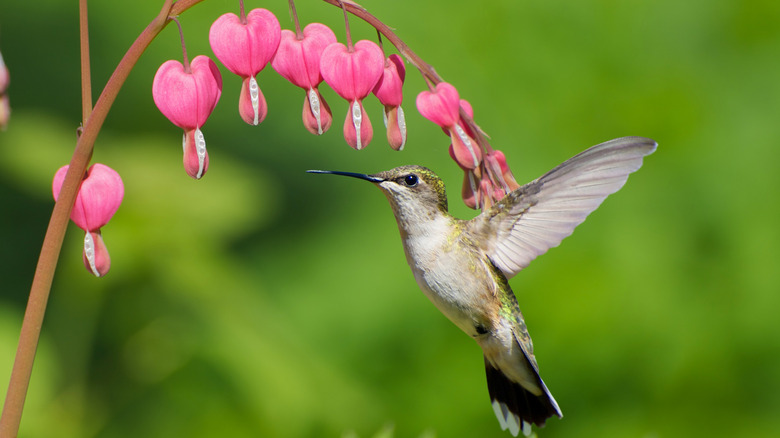
In addition to their color, which can range from pink to red, bleeding hearts are also attractive to hummingbirds for a couple other reasons. For one, they are rich in nectar. The high-calorie-burning hummingbirds use this for fuel. Additionally, the shape of the flowers, which have an elongated, tubular form dropping beneath the heart-shaped petals, allows hummers easy access to the nourishing nectar.
Although they are native to Asia, bleeding hearts grow well in a wide swath of North America. Anyone living in USDA hardiness zones 3 to 9 can expect favorable growing conditions for these hummingbird-attracting plants. The perennials typically bloom in spring, coinciding with hummingbird migrations in many regions. Additionally, bleeding hearts are relatively easy to grow, making them a perfect addition to your backyard garden.
How to grow bleeding hearts to attract hummingbirds
Bleeding hearts can be grown from either seed, such as the Seeds of Strength Bleeding Heart Seeds, or seedlings. Whichever route you go, you should choose a spot that is partially shaded. Keep in mind that bleeding hearts are more tolerant of full shade than full sun, so err on the shady side. The soil should hold moisture and drain well. Bleeding hearts do best in either neutral or slightly acidic soil, so be sure to adjust as necessary after testing the pH level.
To start from seed, first plant seeds in a pot with a good soil mix. Seal the pot in a plastic bag, then stick it in the freezer to stratify. Once the cold stratification process is complete, usually 6 to 8 weeks, the pot of seeds should be placed in a warm, well-lit area. Slowly increase the temperature and light exposure as the seeds germinate. The seedlings can then be transplanted either to a raised or in-ground garden bed or to a larger container. Growing them in a container allows you to move them throughout different locations in your yard throughout the year. Regardless, when they are transplanted, it is important to leave the root crown lightly covered below the soil, as being completely submerged in moist soil can cause it to rot.
Watering bleeding hearts is perhaps the trickiest part. They tend to not do well in soggy or dry soil. The key is keeping it just right — moist but not wet. Otherwise, they are relatively maintenance free. It is rare that fertilizer is needed, although it's a good idea to monitor the soil condition and adjust as needed. They also do not require any pruning. While deadheading will cause no harm to the plants, allowing them to drop their seeds allows for natural propagation.