

How To Make A DIY Survival Fishing Kit
We may receive a commission on purchases made from links.
There is always the possibility of becoming lost or stranded when adventuring outdoors. Statistics show the vast majority of those who do become lost are actually just out for a day trip. Additionally, a disproportionately high number of those who perish as a result of becoming lost or stranded are day hikers. This is often because they are not well-provisioned enough to sustain themselves for an elongated period of time. With that in mind, a survival fishing kit is among the emergency supplies that can save your life, as it can help you secure a high-protein source of food if you happen to become stranded near a body of water.
While there are a number of commercially available survival fishing kits, it is simple enough to create a DIY version. In fact, you may want to create multiple kits of varying sizes and complexity for different outdoor activities you partake in, as it is important to have one as part of your essential hiking emergency supplies. Much of what you have to do to make your own kit is likely laying around your house, especially if you're an angler. However, even buying all the necessary supplies is relatively inexpensive and can prove well worth the investment should you become lost or stranded.
Gather the necessary items for your DIY fishing kit
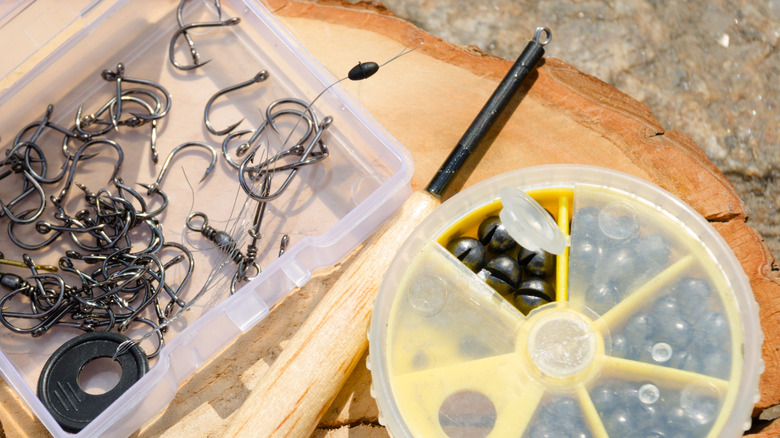
The first step to making a DIY survival fishing kit is to gather the necessary supplies. Keep in mind that even if you are already an avid angler, you may not have all the items you need readily on hand. That is because in a survival fishing kit you need to include the gear to catch whatever you can, not a specific size or species of fish. At the very basic level, what is needed is a selection of hooks (#4, 6, 8, or 10) and a length of fishing line. It is important to include some small hooks for panfish and trout that may not be hooked by larger versions. As far as line, you can use either monofilament or braided fishing line. Most go with braided line because it's stronger.
Split shot sinkers as well as some small bell weights are perhaps the next most useful items. While, at times, you can catch bait, you can't always count on being able to do so. For that reason, it is a good idea to include some artificial lures like small spoons and/or soft-plastic worms and grubs. Think in terms of universal appeal, utilizing small, basic versions such as curl-tail worms. Given that worms are among the best baits for freshwater fishing, it can be advantageous to include some scented artificial worms like GULP! Pinched Worms so you always have a handy supply of bait. In a saltwater setting, FishBites EZ Shrimp can serve the same purpose.
Other items that can prove handy are floats or bobbers — cork or wood versions tend to be more durable than plastic models — and snap swivels. A small knife or multitool can also serve a variety of purposes if you don't already have one in your emergency supply bag.
Organize your kit in an easy-to-carry container
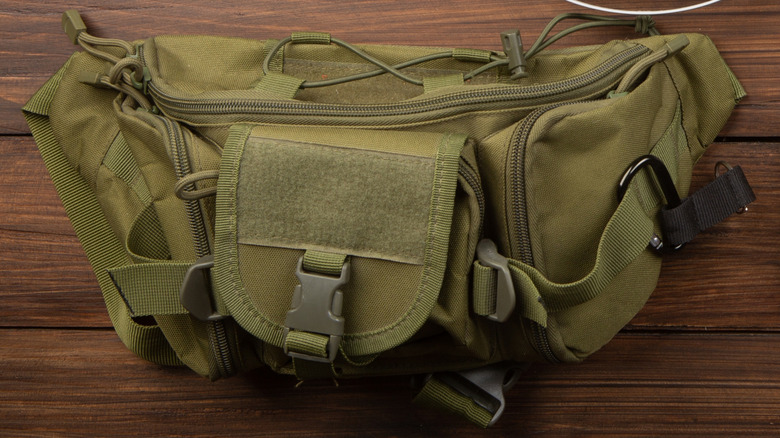
Once all the fishing supplies have been gathered, it is a matter of organizing them in some sort of container. That can include a wide array of objects. Big kits can be put in a sling or fanny pack or small backpack. Smaller day kits can be placed in a mint tin, prescription bottle, or any one of the dozens of various small-sized utility tackle boxes. There are also ways to create a carrying tube with a small piece of PVC and a couple of end caps.
Obviously, larger kits can hold more items. For the simplest of kits, a selection of hooks, split-shot sinkers, and at least 50 yards of line can be stuffed in a pill container. To protect the line and prevent tangles, some advocate for wrapping the line around the container and covering it with duct tape. That ensures you have the absolute necessities at all times. As you increase the size of your container, you can increase the amount of items included. For larger kits, a selection of lures and artificial baits should be included. Your smaller containers can be tossed into the larger pack when necessary as well.
Some larger packs can also store small telescopic or collapsible rods. A small dowel rod can also assist in handlining (if the kit is contained in a PVC tube, the tube can serve this purpose). However, if you are unable to fit a travel rod or dowel in your pack, you can also find a stick or limb to utilize instead.