

Plant This Flowering Tree In Your Yard To Be Enchanted Each Spring

Some plants give spring such a fabulous welcome that they're known for ushering in the season. Examples include snowdrops, crocuses, daffodils, and other spring-blooming bulbs that thrive when planted in the fall. In the trees and shrubs category, magnolias may win the prize for most glorious greeting. Deciduous varieties of this tree open their large-petaled flowers in early spring, filling neighborhoods with bursts of pink and white. You may also see magnolias with yellow or violet blossoms. Magnolia flowers tend to assume graceful shapes that boost your yard's visual appeal while attracting bees to your garden. They're also a magnet for songbirds and nectar-seeking hummingbirds.
Comparing flower shapes is one enjoyable part of selecting a magnolia for your yard. Saucer magnolias (Magnolia x soulangeana) offer big, cup-like blossoms as winter exits and other trees are just starting to form their buds. Most magnolias excel in USDA hardiness zones 5 through 8, and saucer types are happy in zones 4 and 9 as well. Star magnolias (Magnolia stellata) take a different approach to beauty, making aromatic blooms that resemble starbursts. Though magnolias are often associated with the southeastern United States, star types are found in zones 4 and 5 as well. This region includes much of Maine, Vermont, the Upper Midwest, Montana, and Wyoming. Best suited for zones 7 through 9, southern magnolias (Magnolia grandiflora) are what you'll often find in Georgia, Louisiana, and other southern states where this evergreen is a native species. Mississippi residents are so fond of southern magnolia that they've made it their official tree and flower.
Selecting the right magnolia tree for your yard
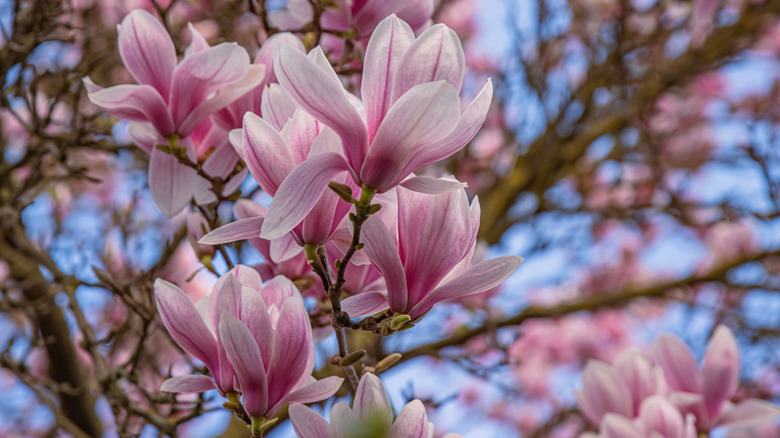
Flower shape is just one factor to think about when selecting a magnolia tree for your yard. You should also consider tree size, flowering habits, petal color, and planting site characteristics. Your yard's size and soil can tell you which trees are most likely to thrive there. For instance, star magnolias are just 5 to 8 feet tall when grown as shrubs, which makes them an excellent choice for smaller yards and gardens. Popular cultivars include snowy white 'Royal Star' and 'Centennial,' whose flowers have tons of blush-colored petals. Southern magnolias are much bigger, achieving heights of 60 to 80 feet and producing flowers that sometimes reach widths of 12 inches. These trees are better suited to sprawling properties and need to be mulched since few plants are willing to grow beneath them. Two cultivars to check out are 'Majestic Beauty' and 'Cairo.' The former makes loads of late-spring flowers, whereas the latter blooms for ages.
If your yard can get a bit soggy, try a sweetbay magnolia (Magnolia virginiana) such as 'Jim Wilson.' Unlike most other magnolias, it handles wet ground like a champ since its native range includes swamps. Sweetbays are also suitable for urban areas because they can manage some pollutants in their habitat. In contrast, bigleaf magnolia (Magnolia macrophylla) will perish when faced with pollution or bog-like conditions. It's happier in countryside landscapes with rich, well-draining soil. In general, magnolias prefer slightly acidic environments and full sunlight, but they'll accept partial shade. Need to lower your soil's pH level for a new magnolia? Mixing oyster shells into your garden soil may help.