

If You're Putting In A Deck On A Tight Budget, Here's The Right Material For You

We may receive a commission on purchases made from links.
If you want an upgrade that will add serious value to your home, you may be considering building a deck. However, if you are doing it on a tight budget, finding a cost-effective material is of utmost importance. While there are a wide variety of deck-building materials available, when it comes to budget-friendly options, wood is the way to go. However, even then, there can be great variation in cost between different types of wood products. So, there are a few additional aspects you need to consider when choosing a low-budget deck-building material.
For starters, you need to balance the upfront cost with the cost of maintenance and upkeep, as well as the projected lifespan of the material. All wood decks require staining and other routine maintenance. Additionally, sealing a wooden deck with a product like Thompson's WaterSeal can help extend its longevity. Those costs must be factored in, as stain and waterproofing sealant are not free. The time it takes to accomplish these tasks must also be factored. With that in mind, pressure treated lumber is certainly worth the extra money over untreated wood products. While treated lumber still requires maintenance, it doesn't need it as often, will last much longer than untreated wood building materials, and is still roughly half the cost of composite building material.
Deck design can also affect cost
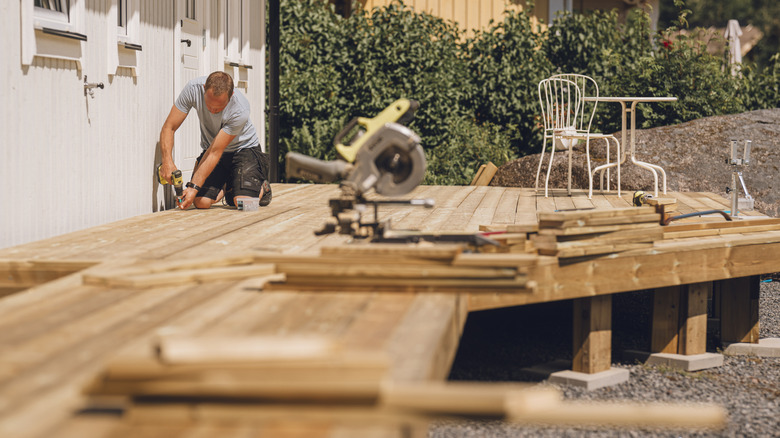
The way in which you design your deck can also greatly impact the cost of the project. Obviously, cost is directly related to the overall size of the deck. The larger the deck, the more material is needed. However, there are ways to trim costs regardless of the square footage of the deck. One is the height of the deck. Lower decks, often referred to as ground level decks, will cost less money, as you won't need the extra materials needed to elevate it. Additionally, any extra features such as railings or steps will add to the cost. Eliminating such features will drop the cost.
Beyond that, the way you shape and work the measurements of your deck design can reduce cost. Square or rectangular decks will reduce waste and costs. More creative designs and/or curved shapes will require cutting off excess, which adds to the amount of materials needed and, thus, raises the cost. Even when building square or rectangular decks, you will be able to reduce your costs significantly if the dimensions of your design incorporate standard lumber sizes in both length and width. This will allow you to use stock boards, which are cheaper, and negate the need for trimming, which means you will utilize every bit of the boards you buy.