

Think Twice Before Planting This Popular California Tree In Your Front Yard
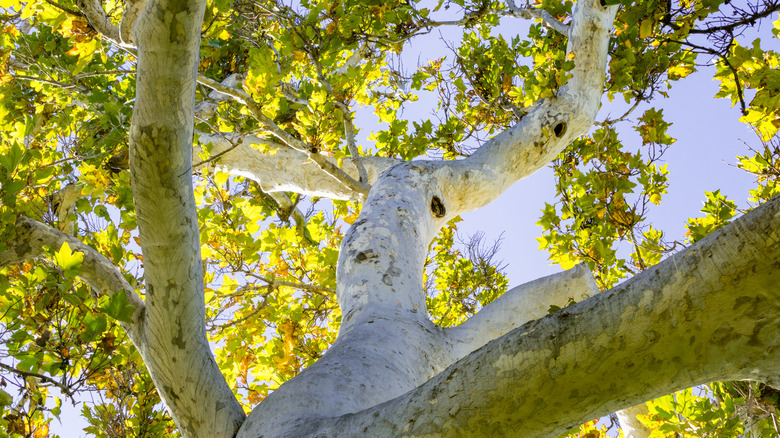
The California sycamore (Platanus racemosa) is big, bold, and full of surprises. Found beside rivers, at the bottoms of canyons, and in the foothills of mountains in the western United States, this prehistoric species can grow 100 feet tall and 5 feet wide. Profusions of branches and multiple trunks that grow at dramatic angles are common for this supersized plant. Its leaves are the biggest of any tree indigenous to North America, often measuring 10 inches tall and 12 inches across. Though the California sycamore is majestic, it's too massive for the average front yard. It's better suited for a sprawling estate or park, where the shade from its giant canopy can be appreciated.
In addition to growing huge, the California sycamore grows rapidly. As it gains height, it becomes hard to prune without special equipment to reach its upper branches. This means that you'll need an arborist's help to maintain it. A California sycamore's main root can burrow 10 feet deep, and its other roots are aggressive. They've been known to harm sidewalks, pipes, septic systems, and building foundations. The giant piles of leaves that fall from this tree can vex time-strapped homeowners. Dead leaves may kill a lawn if they're not raked up promptly. They may also clog gutters and drains. Plus, a California sycamore sloughs off bark, twigs, and even branches, creating even more yardwork.
A California sycamore's seed pods can spawn problems, too. These orbs, known as buttonballs, drop from the tree as they mature, making a mess beneath it. They're covered in hairs that help disperse the tree's seeds but cause allergic reactions for some people.
California sycamore alternatives for your front yard
Some California sycamores have watched over their surroundings for hundreds of years, but they're not the only trees that can lend character to your property. If you're seeking a front-yard tree for California sycamores' growing range — USDA hardiness zones 7 through 10 – consider other Golden State natives and ornamentals indigenous to North America.
Want a tree that's tall but not towering? Try planting an eastern redbud (Cercis canadensis) in front of your home. This species reaches a height of 20 to 30 feet and boasts eye-catching features such as heart-shaped leaves and red or pink blossoms. Unlike a tree with a humongous canopy, an eastern redbud will add some shade to your yard while leaving plenty of light for your sun-craving plants. In addition to looking mighty pretty, this tree is adaptable, thriving in zones 4 through 9 and tolerating a range of soil textures, including clay and sand.
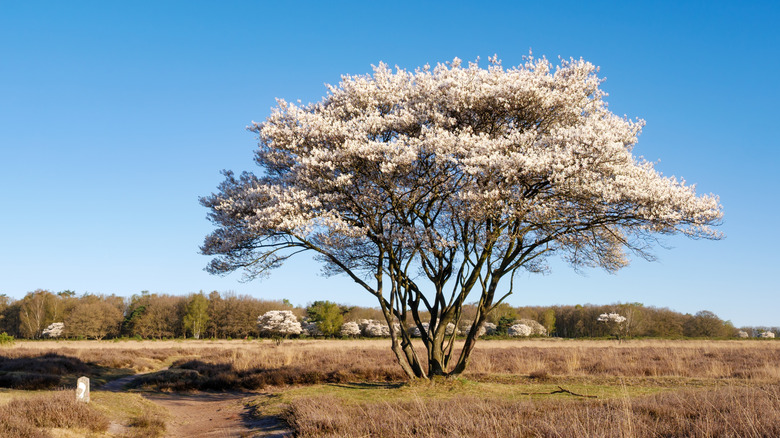
Or, opt for a serviceberry (Amelanchier spp.), another North American native that excels in zones 4 through 9. Most grow 15 to 25 feet tall and offer year-round interest, from showy spring flowers that bring bees to your garden to vibrant fall foliage that enhances your landscape. The edible berries, which appear in the summer, are likely to attract songbirds to your yard. Plus, serviceberry trees support more than 120 species of butterflies and moths. The western serviceberry (Amelanchier alnifolia) does especially well in California, Oregon, Washington, and Alaska since it's native to these states, as well as the western coast of Canada.