

How To Choose The Best Fuel For Your Lawn Mower
We may receive a commission on purchases made from links.
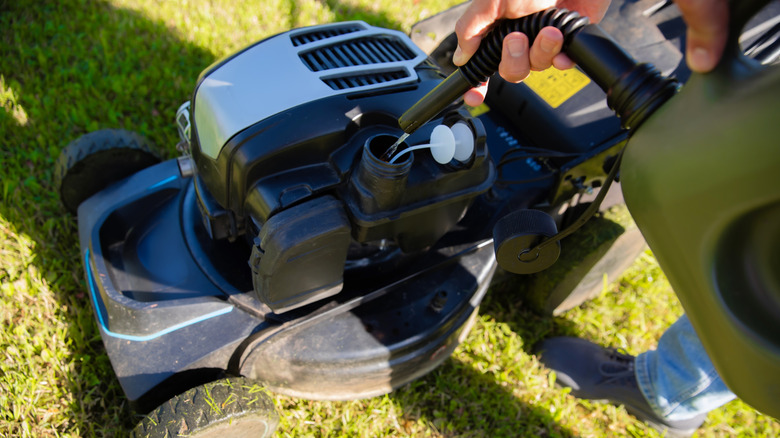
Unless you have chosen to create a no-mow garden, you need a well-functioning lawn mower to follow the one-third mowing rule and maintain a luscious lawn. You also need gasoline, as lawn mowers (and other small-engine lawn tools) rely on it to operate. If compared to the human body, gasoline would be their food source. Like the human body, however, these engines will not perform as well or last as long if they are fed a poor diet. To that end, it is important to choose the best fuel for your lawn mower in order to maximize performance, reduce maintenance issues, and extend the lifespan.
In the U.S., there are three main grades of gasoline available at almost every filling station. Those classifications are based on octane level. Octane is a measurement of how much pressure it takes to cause the gasoline to become unstable and combust. The three levels you most often see are regular (which is typically 87 octane), mid-grade (89-90 octane), and premium (91-94 octane). The vast majority of small engines are designed to run on 87 octane.
Although manufacturers typically say at least 87, that just means you shouldn't go below that; however, nor should you go above it. Small engines don't generate enough pressure to efficiently burn higher octane fuels. After taking care to buy the right mower and avoid common lawn mower mistakes, filling with premium may sound like a good idea, but it can actually lead to poor performance and make it difficult to start. One level you do need to watch, however, is the amount of ethanol that is in the fuel. Ethanol can cause serious harm to small engines, so always choose the gas with the least amount of ethanol. Ethanol-free gas, which is offered at some stations, is even better.
Proper storage and fuel additives make a difference
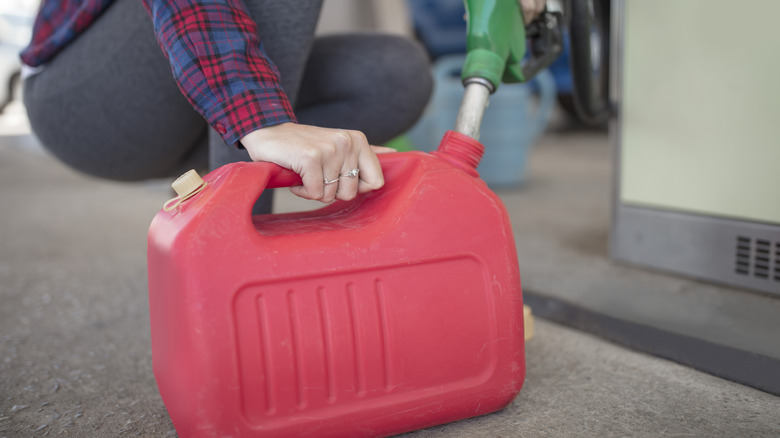
Although gasoline doesn't have an expiration date on it at the pump, it does degrade over time. Not only will old gas lose some of its effectiveness, but it can cause internal parts of your engine to gum up and become covered in residue. Short term, this leads to performance issues. Long-term, it can shorten the life of your mower. Additionally, if you have fuel that is not ethanol-free, it can become laden with water, as ethanol attracts moisture and can introduce water into gasoline, whether it is in a storage tank or your mower.
With that in mind, this typically isn't much of an issue if you are mowing often enough that you frequently refill your mower and storage tanks. However, gas that sits for more than 30 days can become an issue. The best way to avoid problems when storing your mower beyond this range is to empty the tank. Do this by running the mower until it is out of gas before storing it. It is also possible to siphon gas from the tank, although this will not remove all the gas that is already in the engine. If the tank is not empty, add a fuel stabilizer such as Sta-Bil. You should then run the mower for a couple of minutes to make sure the product is mixing with gasoline throughout the engine before storing it.
Fuel stabilizers should also be added to any stored gas cans to keep the gas fresh. This is particularly important for fuels containing ethanol to prevent the accumulation of water in the can. However, there is no need to keep excessive amounts of gas on hand. It is better to utilize smaller storage cans and refill them often as opposed to having unused gas sitting for long periods of time.