

The Bizarre Freshwater Fish You'd Be Lucky To Catch On Ultra-Light Tackle
We may receive a commission on purchases made from links.
Alligator gar are a bizarre freshwater fish. Typically described as prehistoric due to the fact they have changed so little over millennia, they are one of largest freshwater fish in North America. In fact, they are actually only second to the white sturgeon and are capable of tipping the scales at more than 300 pounds. Given their size and ferocious look, it's not a surprise they are considered among the most dangerous freshwater fish. Nor is it a surprise they are a popular target species for freshwater anglers looking to do a little big game fishing. However, while catches of various size alligator gar are common, you'd be lucky to catch one on ultra-light tackle.
The enormous unlikelihood of catching a full-grown alligator gar on ultra-light tackle is due to a variety of reasons, not the least of which is its gargantuan size. Add to that the fact alligator gar are equipped with double rows of incredibly sharp teeth, their bodies are covered in rugged scales, and they tend to live in rivers and lakes that are often full of line-snagging obstructions and it's hard to fathom anyone accomplishing such a task. However, as reported by Chron, that's just what one angler did in the spring of 2025. Art Weston captured a 153-pound fish using 2-pound test line in Lake Livingston, East Texas. That fish was a new International Game Fish Association (IGFA) freshwater line class record for alligator gar.
To put the catch into perspective, even an angler as accomplished as Weston, who has set 81 world records and holds every men's division alligator gar world record, only gave himself a 1% chance of making it happen. While his persistence paid off, most anglers hoping to catch an alligator gar, whether with fly or regular fishing tackle, should probably opt for considerably more substantial gear.
Typical techniques for catching alligator gar
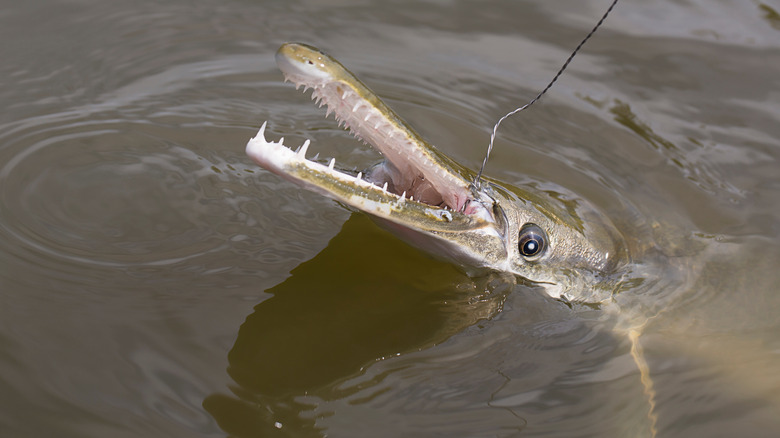
Record-chasing ultra-light anglers aside, most people use medium-heavy or heavy action rods in the 7 to 8 foot range when targeting alligator gar. These beefy rods will be paired with equally strong reels, like a Penn Warfare Level Wind or Penn Senator. Those reels should be spooled with heavy braided line. For alligator gar fishing, 50 pound line should be considered the minimum, with 100 or 150 pound line being common. Attached to the braid will be a length of wire leader to protect against the fish's sharp teeth and rough scales.
A large baitfish, such as shad, perch, or carp either whole or cut into large chunks make the best bait for freshwater fishing of this sort. That bait should be put on a bronze hook in the 3/0 size range and fished either on a bottom rig or beneath a slip float. Larger hooks can be used, but make successful live release of the fish less likely. Considering these big fish can be five decades old, catch and release is highly encouraged.
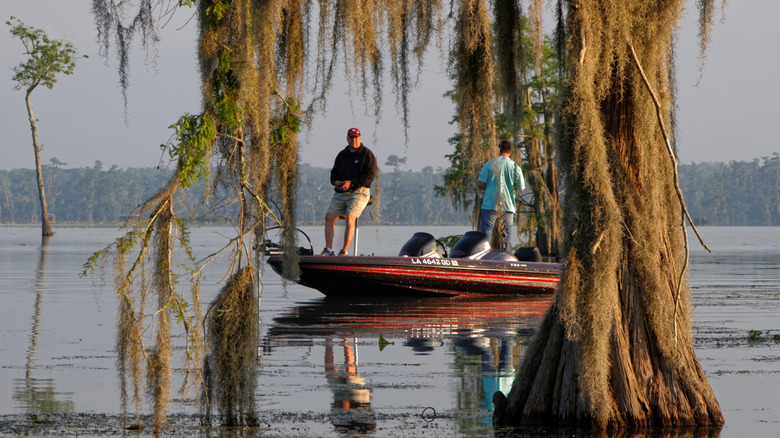
Alligator gar can be found in a variety of bodies of freshwater, but the best fishing tends to be in slow-moving rivers, lakes, bayous, and backwater ponds. Once your bait has been cast into a likely location, it is simply a matter of waiting for a gar to take the bait. More often than not, the strike will be surprisingly subtle for such a large fish. Since gar tend to move off with the bait before positioning it to eat, you should wait at least for close to 30 seconds before setting the hook. Once the battle is over, if possible, land the fish from shore as this is less traumatic for big fish than being hauled over the side of a boat.